Bhagavad-gītā Chapters 1 to 6 Part 12 of 12
Bhagavad-gītā 6.33 to 47: Practice, Detachment and the Topmost Yogī
Bhagavad-gītā 6.33 to 47; Chapters 1 to 6 summary that joins the ideas
How do practice, detachment, and bhakti complete the journey of the first six chapters?
Essential preparation
Before the lesson begins
Start by checking the preparation from the previous guide. Then keep the passage and a place to record your reasoning ready.
Check the Previous Preparation
Preview: 6.33 to 47. Prepare Arjuna’s objection, Kṛṣṇa’s response, the destinations of the unsuccessful yogī, and a complete yoga-ladder diagram. Memorise 5.29.
The present guide includes the complete explanation you need, even if you did not complete the preview.
Know Before You Begin
- This guide retells and explains Bhagavad-gītā 6.33 to 47; Chapters 1 to 6 summary that joins the ideas in order.
- No outside page is needed to understand the lesson.
- Important Sanskrit terms are explained where they appear.
Keep This Ready
- This complete guide on your screen.
- A notebook, paper, or notes app.
- A way to speak or type with a partner.
- No printed cards, book, or special materials are required.
What Will You Make?
- A correct map of the passage movement.
- A revised yoga-ladder explanation and a personal delayed-retrieval plan.
- A revised complete teaching and a delayed-retrieval plan
- A preparation plan for the next guide.
Reference and enrichment
See the complete passage before examining the details
Learners need to answer Arjuna’s concern about the restless mind, understand the destination of the unsuccessful yogī, integrate the yoga ladder, and demonstrate that bhakti contains the unit’s culmination without superficial triumphalism. The visual map below gives the movement first, so every later detail has a place.
- Explain Arjuna’s objection and Kṛṣṇa’s response in 6.33 to 36, including practice and detachment as a disciplined answer.
- Describe the destinations and renewed opportunity of the unsuccessful yogī in 6.37 to 45 without promising specific outcomes beyond the passage.
- Use a yoga-ladder diagram and verses from Chapters 2 to 6 to present a complete case for the culmination in bhakti and the topmost yogī of 6.47.
- Complete a working together retrieval and transfer plan covering all twelve memorisation verses and the eight course aims.
Practice meets restlessness
Follow the complete circle. A broken link weakens the whole relationship.
- 01Mind wanders
- 02Notice
- 03Practise return
- 04Release attachment
- 05Reconnect with Kṛṣṇa
- 06Mind wanders
Essential teaching in verse order
The verses move from the first point to the conclusion
Each section gives the verse range, its meaning in simple words, and the connection to the next part of Kṛṣṇa's answer.

Kṛṣṇa acknowledges the mind's difficulty
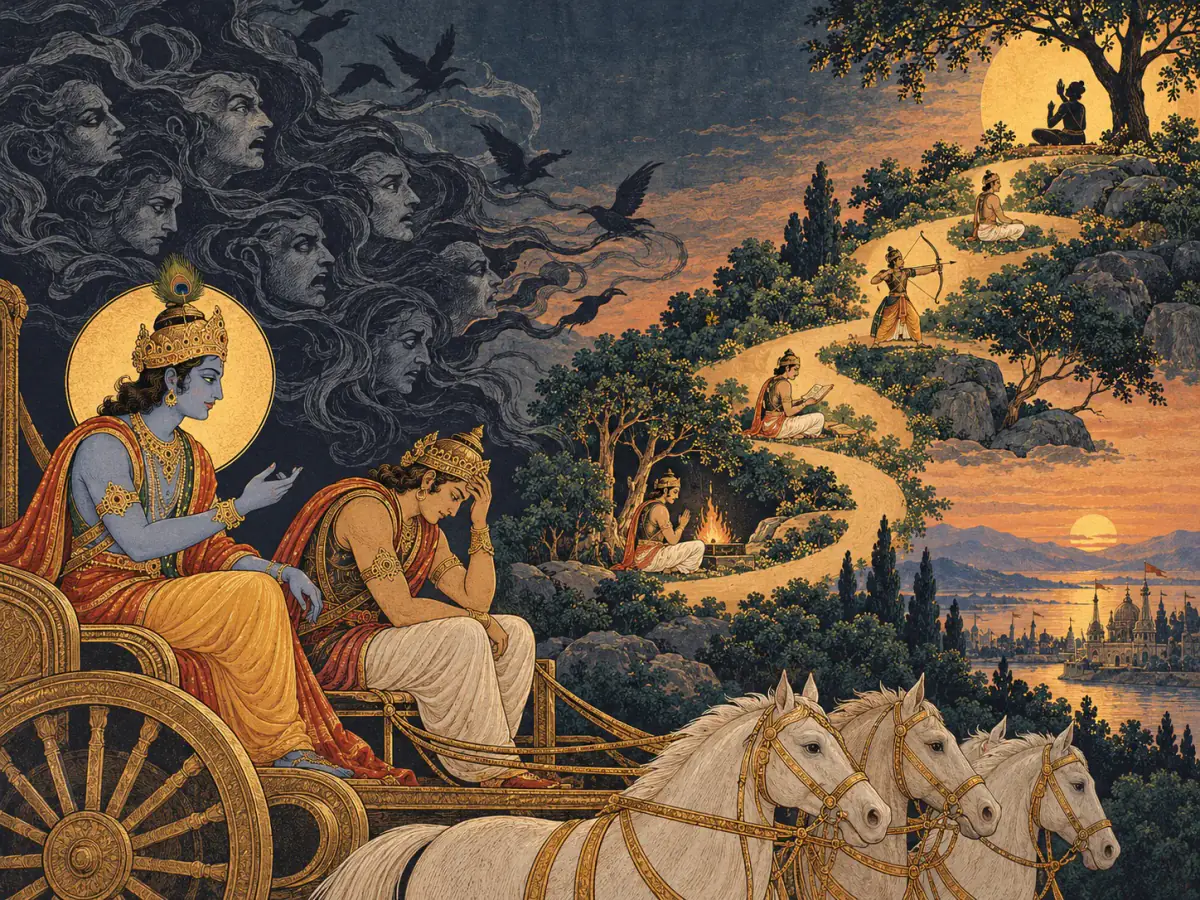
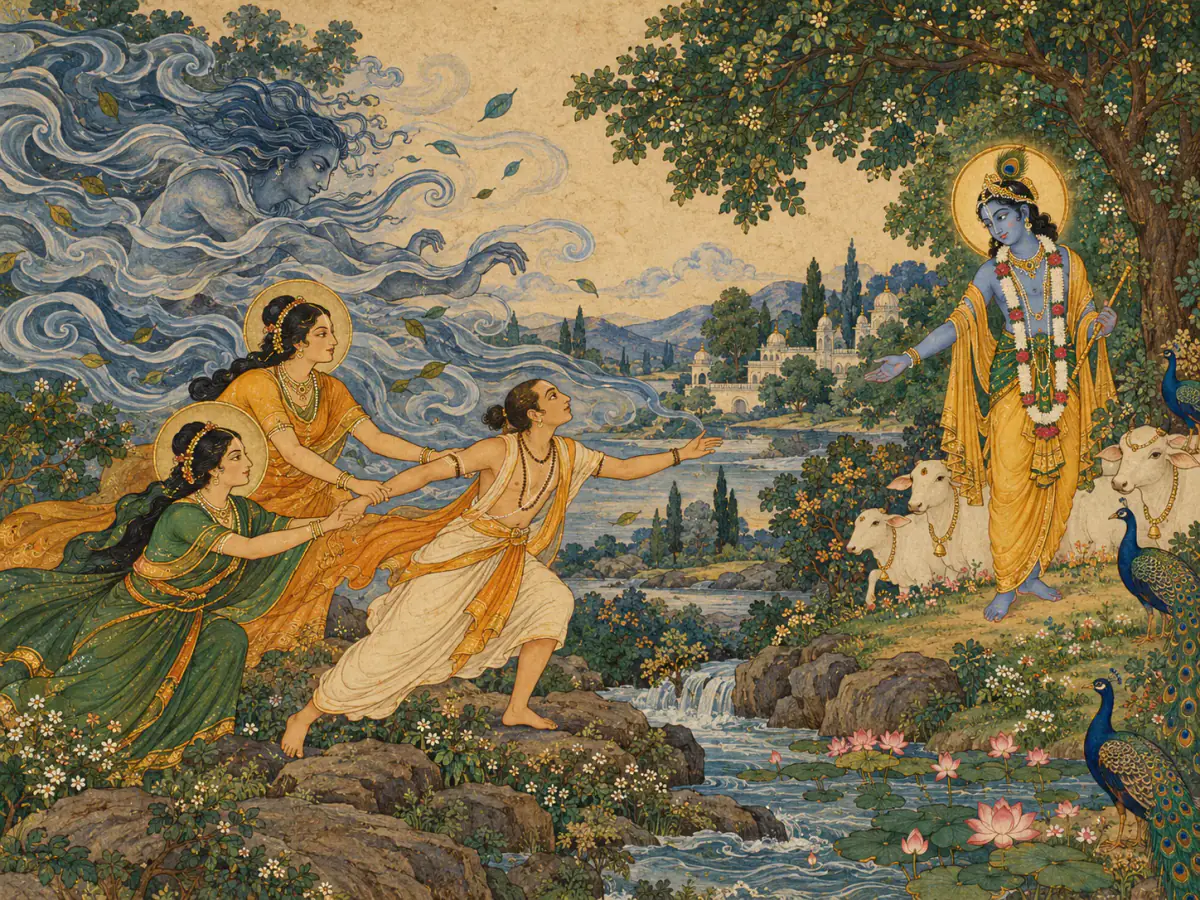
Arjuna compares the restless mind to the wind. Kṛṣṇa does not deny the difficulty; He answers it with sustained practice and detachment.
Arjuna says the mind is restless and difficult to control, like the wind. Kṛṣṇa agrees that it is difficult, then gives two means: regular practice brings the mind back, and detachment weakens the pull of distractions.
Sincere spiritual effort is not lost
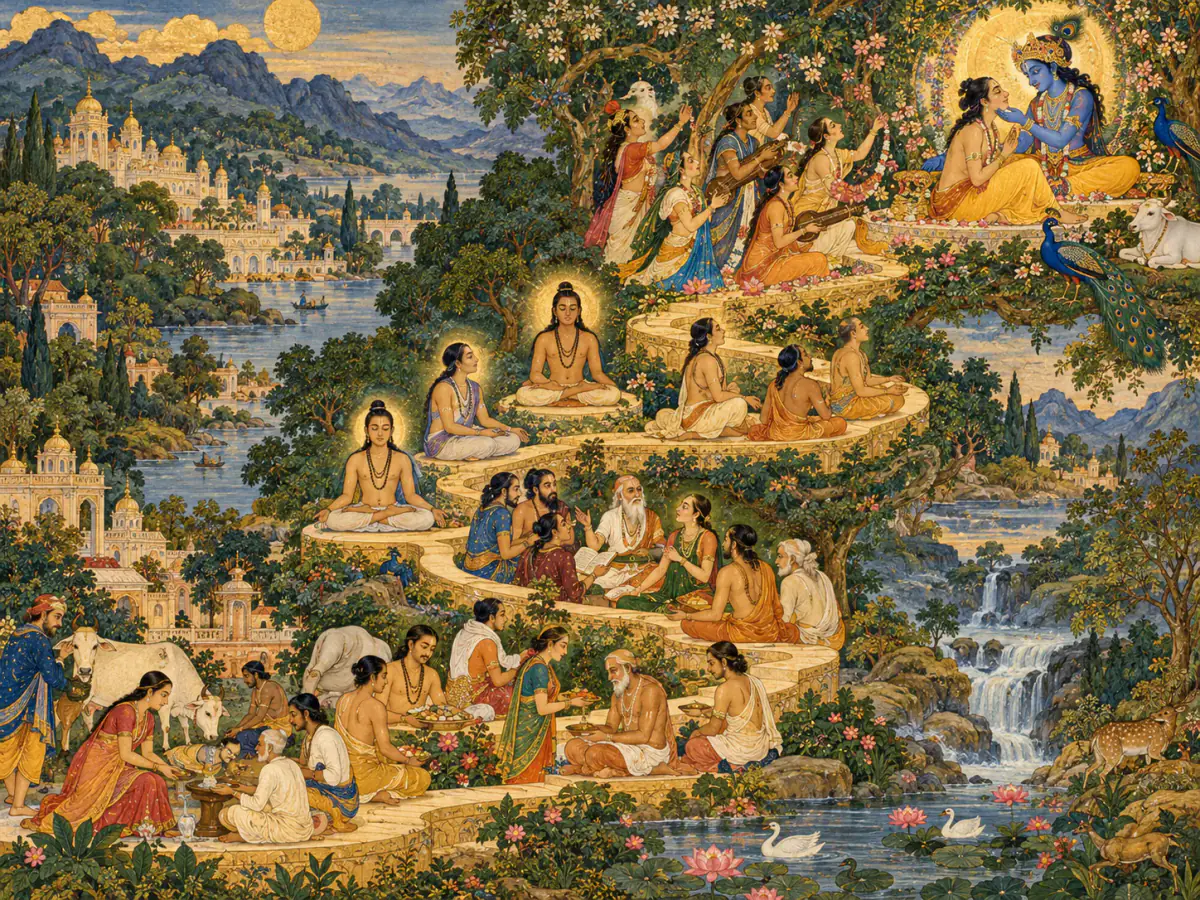
Arjuna fears that an unsuccessful practitioner might lose both material and spiritual paths. Kṛṣṇa describes favourable continuation and revived spiritual intelligence.
Arjuna fears that an unsuccessful yogī may lose both material and spiritual success. Kṛṣṇa assures him that sincere spiritual effort is never lost. The person receives another chance to continue the path.

The yogī is placed above other paths
The yogī is described as higher than the ascetic, person who depends only on worldly reasoning and person who works mainly for material results. The comparison prepares the final identification of the most intimately connected yogī.
Past spiritual practice creates a favourable chance to begin again. The person is drawn back toward yoga and continues the work left unfinished. Kṛṣṇa then says that the yogī is higher than the ascetic, scholar and result-seeking worker.
Bhakti is the culmination
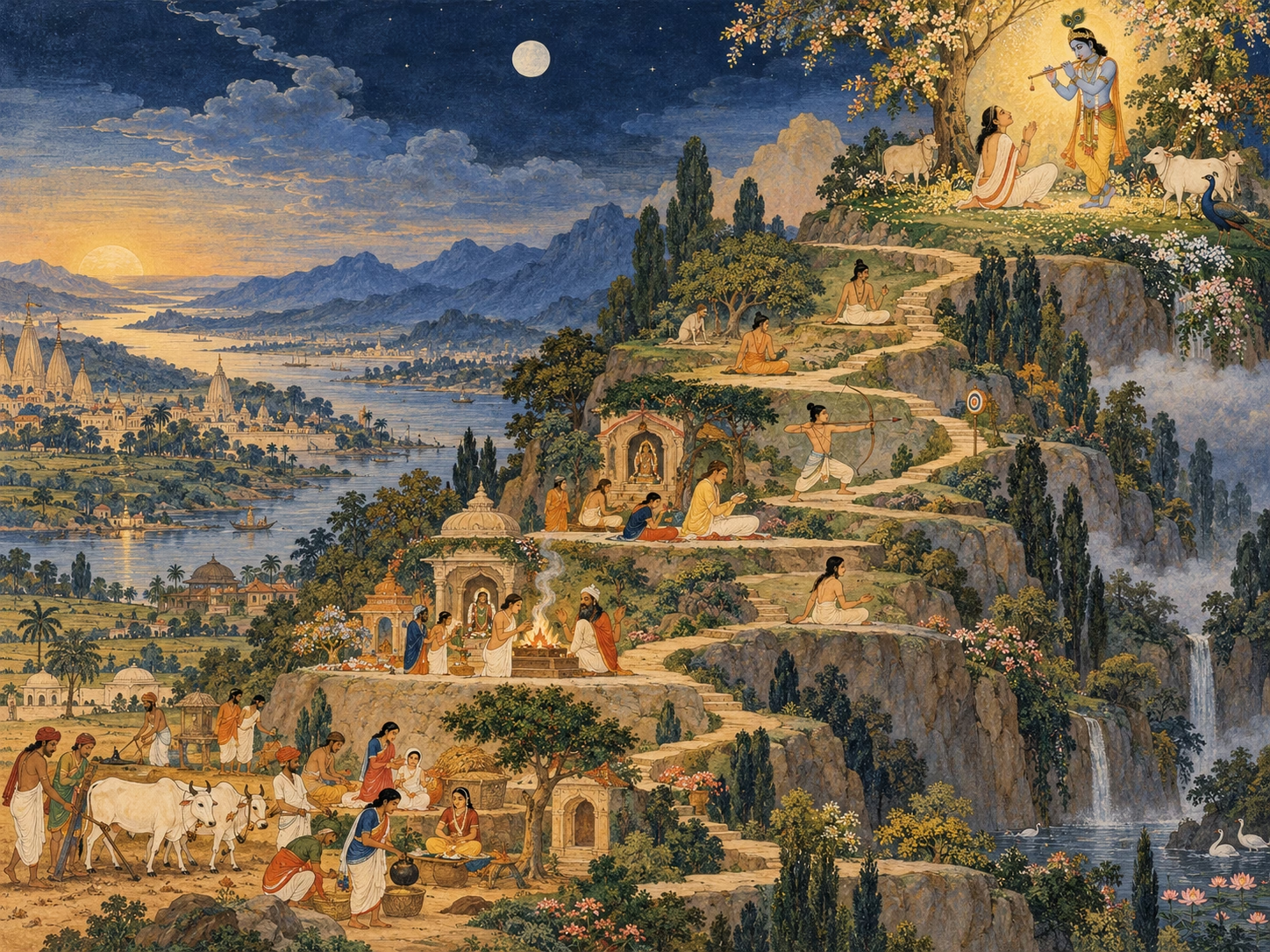
The topmost yogī abides in Kṛṇa inwardly, has faith and renders loving service. The verse gathers discipline, meditation and relationship into bhajana.
Verse 6.47 gives the conclusion: the highest yogī keeps the mind in Kṛṣṇa, has faith and serves Him with love. Bhakti is not an extra decoration; it is the loving relationship that completes yoga.
Essential practice
Activity 1: Yoga ladder storyboard and teach-back
What needs to be doneBuild a five-frame storyboard, explain the relationship among the processes, and end with why the topmost yogī remembers and serves Kṛṣṇa with faith. Then use the on-site or online instructions, receive one specific response, and revise the answer or work that others can see and check.
PurposeIntegrate action, knowledge, meditation, practice, detachment, and bhakti without presenting the processes as unrelated labels.
SuccessA five-frame unit map and a revised teach-back
Stop whenThe product is complete, one verse point has been checked, and one improvement has been made from feedback.
If You Are Studying On-Site
- Sketch the five frames alone.
- Teach the map to a partner.
- The partner asks where bhakti is present before the final frame.
- Revise the connections and teach it again.
If You Are Studying Online
- Use the five fields as storyboard frames.
- Share your screen or paste the frame headings.
- Receive one relationship question.
- Revise the weakest transition.
- 01Notice
Build a five-frame storyboard, explain the relationship among the processes, and end with why the topmost yogī remembers and serves Kṛṣṇa with faith.
- 02Explain
Integrate action, knowledge, meditation, practice, detachment, and bhakti without presenting the processes as unrelated labels.
- 03Improve
A five-frame unit map and a revised teach-back
Complete information bank
Complete verse guide for Bhagavad-gītā 6.33 to 47; Chapters 1 to 6 summary that joins the ideas
These blocks give the full movement, the purport meaning in simple words, the central terms and the deeper conclusion of every assigned section.
Every verse included in this lesson
The numbered markers give the complete assigned range. The explanations below tell the story, give the meaning, define the central ideas, and show how Kṛṣṇa's teaching develops from one movement to the next.
The restless mind
Arjuna calls the mind turbulent; Kṛṣṇa agrees it is difficult yet says practice and detachment can govern it.
Arjuna's objection is realistic, and Kṛṣṇa accepts that mastery is difficult. Practice repeatedly returns consciousness, while detachment weakens the claims that pull it away.
The restless mind: the deeper meaning
Kṛṣṇa agrees that the mind is difficult to control. This honest agreement prevents false shame. Practice gives repeated direction, while detachment loosens the habits that keep pulling attention away.
Practice returns; detachment releases. Crisis now develops into Identity.
Verses included here: 6.33, 6.34, 6.35, 6.36.
No spiritual loss
Arjuna asks about one who begins but does not perfect yoga, and Kṛṣṇa assures him that sincere spiritual effort is not destroyed.
Arjuna fears losing both worldly and spiritual success. Kṛṣṇa assures him that sincere spiritual effort is never destroyed, while avoiding a promise of effortless perfection.
No spiritual loss: the deeper meaning
Arjuna fears becoming like a broken cloud with no home in either world. Kṛṣṇa answers the fear of total loss, but He does not teach that effort is unnecessary. Opportunity continues, and practice must continue with it.
No sincere spiritual effort is lost. Identity now develops into Duty.
Verses included here: 6.37, 6.38, 6.39, 6.40.
Favourable continuation
The unsuccessful yogī gains circumstances for renewed practice and gradually revives previous spiritual intelligence.
Favourable birth and revived spiritual impressions allow the practitioner to continue. Previous discipline attracts the yogī back toward inquiry and further effort.
Favourable continuation: the deeper meaning
Past practice returns as attraction, opportunity, and intelligence, not as automatic completion. The person is helped forward and still chooses to renew the unfinished work.
Past practice becomes renewed opportunity. Duty now develops into Offered action.
Verses included here: 6.41, 6.42, 6.43, 6.44, 6.45.
The yogī is higher
The yogī is placed above the ascetic, the person who depends only on worldly reasoning, and the person who works mainly for material results.
The yogī is placed above the ascetic, empiric knower, and person who works mainly for material results. The comparison prepares the final verse and should clarify relationships rather than invite contempt.
The yogī is higher: the deeper meaning
The comparison with ascetic, scholar, and fruit-seeking worker prepares a more important question: what kind of union makes a yogī highest? Verse 6.47 answers through relationship with Kṛṣṇa.
Become a yogī, then ask which yogī is most united. Offered action now develops into Knowledge.
Verses included here: 6.46.
The topmost yogī
The yogī who abides in Kṛṣṇa with faith and loving service is described as most intimately united with Him.
The culmination combines inward absorption in Kṛṣṇa, faith, and loving service. Bhakti is not an ornament added after yoga; it is the relationship that fulfils the discipline of consciousness.
The topmost yogī: the deeper meaning
The final verse joins inner remembrance, faith, and loving service. Bhakti is both inward and active. It gives the discipline of yoga a personal object, a trusting mood, and a loving expression.
Mind in Kṛṣṇa, faith, loving service. Knowledge now develops into Meditation.
Verses included here: 6.47.
The yoga ladder
Move from the supporting level toward the more integrated level without erasing the earlier work.
- 01Karma-kāṇḍa: fruit
- 02Karma-yoga: offered action
- 03Jñāna-yoga: discrimination
- 04Dhyāna-yoga: meditation
- 05Bhakti-yoga: loving service
The first six chapters in six movements
Read from left to right. Each step creates the condition for the next.
- 01Crisis
- 02Self
- 03Duty
- 04Offered action
- 05Knowledge
- 06Meditation fulfilled in bhakti
The complete lesson on one screen
Each row joins a verse range to its movement, central terms and main conclusion. The full explanation appears directly above the chart.
| Verse range | Movement | Key terms | Memory cue |
|---|---|---|---|
| 6.33 to 36 | The restless mind | restless mind, wind, abhyāsa, vairāgya | Practice returns; detachment releases. |
| 6.37 to 40 | No spiritual loss | fallen yogī, cloud torn apart, no destruction, auspicious effort | No sincere spiritual effort is lost. |
| 6.41 to 45 | Favourable continuation | pious or wise family, previous intelligence, renewed practice | Past practice becomes renewed opportunity. |
| 6.46 | The yogī is higher | tapasvī, jñānī, karmī, yogī | Become a yogī, then ask which yogī is most united. |
| 6.47 | The topmost yogī | mad-gata antar-ātmanā, śraddhā, bhajate, yukta-tama | Mind in Kṛṣṇa, faith, loving service. |
Why this verse guide comes between the two activities
The first activity helps you remember the order. This section gives the full meaning of the verses in simple words. The second activity then helps you explain and use what you have learnt. The pattern is explanation, practice, more explanation, and more practice.
Essential practice
Activity 2: Yoga-ladder teach-back
What needs to be doneTeach the unit in a complete presentation using the ladder, four verse anchors, and one sentence explaining how bhakti relates to the other processes.
PurposePractise the lesson's central relationship by producing something that can be checked and improved.
SuccessComplete a revised complete teaching and a delayed-retrieval plan and connect it to at least one passage or visual map.
Stop whenYou can explain how the product changed after the discussion: Did the presentation demonstrate the relationships, or only rank labels?
Map the processes
Begin with the exact situation or claim in the task.
Anchor the differences
Connect this move to the passage, not only to a personal reaction.
Show the culmination
Connect this move to the passage, not only to a personal reaction.
Invite one question
Connect this move to the passage, not only to a personal reaction.
Reattempt one focused section
Finish with a response that can be explained and improved.
If You Are Studying On-Site
- Make your own first draft.
- Explain it to one partner. Your partner checks whether the verse point and your reason are clear.
- Receive one clear question or correction.
- Improve the product before the class discussion.
If You Are Studying Online
- Write the first draft in the response box or in your own notes.
- Share only the part you want checked in chat or a breakout room.
- Use the checklist after your partner has heard your verse point and reason.
- Improve one sentence and say what you changed.
Build the product one move at a time
Each box corresponds to one step in this lesson's activity. Write enough that another reader could understand your reasoning without hearing an extra explanation.
Use this self-check before you finish
Expected product: A revised complete teaching and a delayed-retrieval plan
Debrief this activity
Did the presentation demonstrate the relationships, or only rank labels?
Reference and enrichment
Use the visual summary to check your explanation
The map below helps you compare your answer with the reasoning and conclusion of the verses.
The topmost yogī
Read all four fields together. Each contributes a necessary part of the complete picture.
- 01Mind in Kṛṇa
- 02Faith
- 03Loving service
- 04Steady relationship
Pause and decide
Quick check: is the main idea clear?
Why this check is here: the next lesson will build on this idea, so you should be able to explain it in your own words.
What your answer tells you
Proceed when learners select practice and detachment and can connect both to sustained devotional discipline. If you are not sure, use the explanation and visual map directly above. Say why each of the other options does not fit the meaning explained on this page, then try again.
- 01The restless mind
Arjuna calls the mind turbulent; Kṛṣṇa agrees it is difficult yet says practice and detachment can govern it.
- 02Favourable continuation
The unsuccessful yogī gains circumstances for renewed practice and gradually revives previous spiritual intelligence.
- 03The topmost yogī
The yogī who abides in Kṛṣṇa with faith and loving service is described as most intimately united with Him.
Reference and enrichment
Common misunderstandings and clear answers
These short answers show where a correct idea is sometimes used in the wrong way.
No loss does not mean no consequence
The assurance encourages sincere practice; it does not promise an effortless path or justify negligence.
Full explanation: Arjuna's objection is realistic, and Kṛṣṇa accepts that mastery is difficult. Practice repeatedly returns consciousness, while detachment weakens the claims that pull it away. Kṛṣṇa agrees that the mind is difficult to control. This honest agreement prevents false shame. Practice gives repeated direction, while detachment loosens the habits that keep pulling attention away.
The yoga ladder shows relationship, not contempt
The processes are distinguished while their useful components are understood as included and fulfilled in bhakti.
Full explanation: Arjuna fears losing both worldly and spiritual success. Kṛṣṇa assures him that sincere spiritual effort is never destroyed, while avoiding a promise of effortless perfection. Arjuna fears becoming like a broken cloud with no home in either world. Kṛṣṇa answers the fear of total loss, but He does not teach that effort is unnecessary. Opportunity continues, and practice must continue with it.
- 01No loss does not mean no consequence
The assurance encourages sincere practice; it does not promise an effortless path or justify negligence.
- 02The yoga ladder shows relationship, not contempt
The processes are distinguished while their useful components are understood as included and fulfilled in bhakti.
Essential summary
The complete lesson in clear statements
- 01
The mind is difficult to control, and the text answers honestly rather than romantically.
- 02
Practice and detachment work together in training attention.
- 03
Sincere spiritual effort carries forward rather than being destroyed.
- 04
The yogī is higher than the ascetic, person who depends only on worldly reasoning and person who works mainly for material results.
- 05
The topmost yogī thinks of Kṛṇa with faith and renders loving service.
Do not leave without this
Carry the first six chapters forward
Complete the delayed-retrieval plan, continue the twelve-verse review cycle, and revise one open-book response outline. The next guide will retell and explain this full section, so this preview is preparation rather than a missing part of the present lesson.
A revised complete teaching and a delayed-retrieval plan. Keep the revised version for later retrieval.
Current accreditation submission rules must be confirmed by the governing centre.
Bring one question that arose from the verse guide, one point you can explain confidently, and one point that still needs checking.
- 01Remember
The topmost yogī thinks of Kṛṇa with faith and renders loving service.
- 02Keep
A revised six-minute teaching and a delayed-retrieval plan
- 03Return
Review the complete course map and the culmination in the topmost yogī.
Interactive self-check
How deeply do you want to check your understanding?
Choose 10, 20, or 30 questions. You will see one question at a time. Submit an answer, study the explanation and its on-page reference, then continue. A correct answer brings a small celebration.