Bhagavad-gītā Chapters 1 to 6 Lesson 1
Bhagavad-gītā Chapter 1: Kurukṣetra, Dharma and the Purpose of Study
Course foundations, Preface, Introduction, and Bhagavad-gītā 1.1 to 1.27
How does a battlefield become the place where spiritual instruction begins?
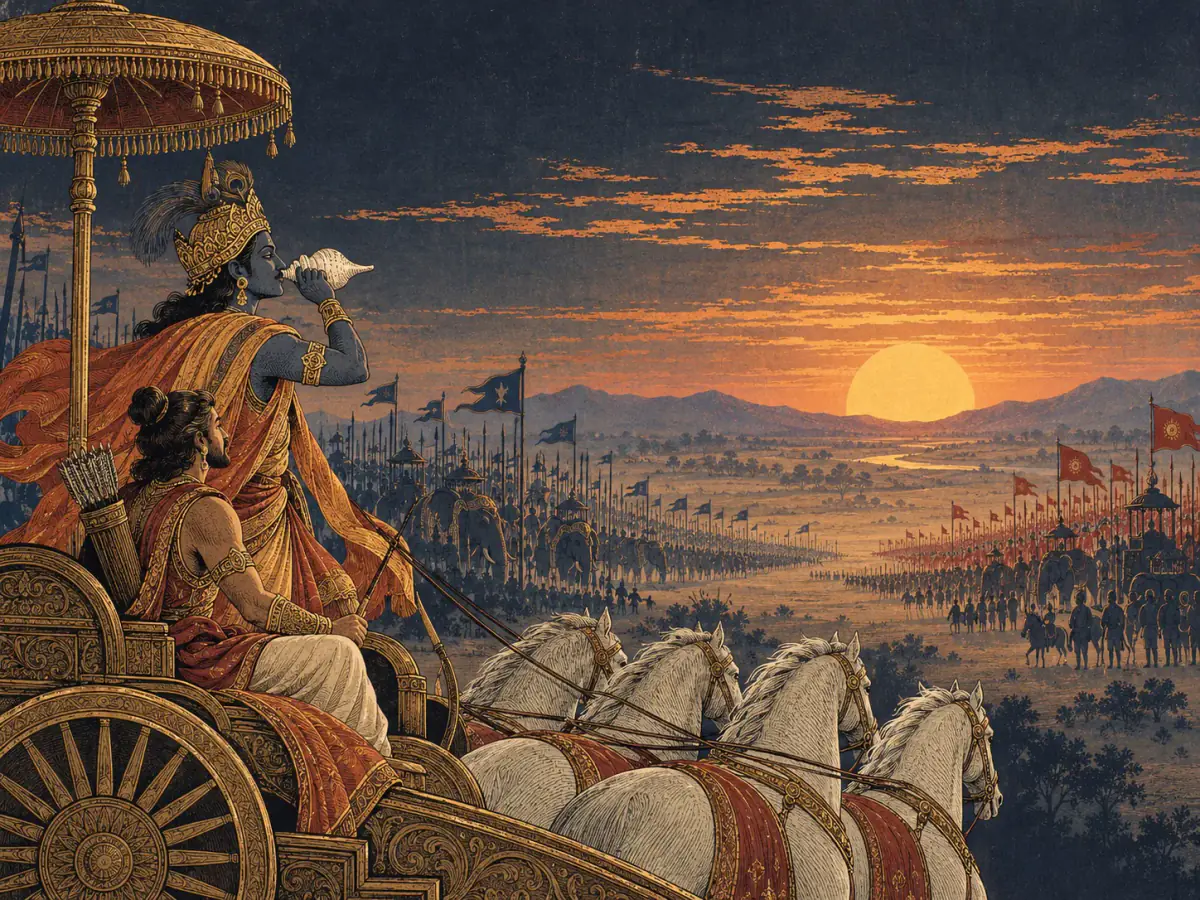
Essential teaching
Before the lesson begins
This is the first lesson, so there is no previous-lesson check. Everything you need for reading and practice is listed here before you begin.
Know Before You Begin
- This guide explains the Preface, Introduction, and Bhagavad-gītā 1.1 to 1.27.
- No outside page is needed to understand the lesson.
- Important Sanskrit terms and names are explained where they appear.
- The complete verse sequence appears below in simple words.
Keep This Ready
- This complete guide on your screen.
- A notebook, paper, or notes app.
- A way to type or speak with a partner if you join online.
- No printed cards, book, or special materials are required.
What Will You Make?
- A correct six-step map of 1.1 to 1.27.
- A complete conch-name reference.
- A distinction between verse, commentary, application, and unsupported claim.
- A clear preparation task for the next lesson.
Reference and enrichment
What Bhagavad-gītā is, and how this course approaches it
The lesson begins before verse 1.1. The Preface explains Śrīla Prabhupāda’s purpose. The Introduction explains the speaker, listener, subject matter, method, and goal of study.
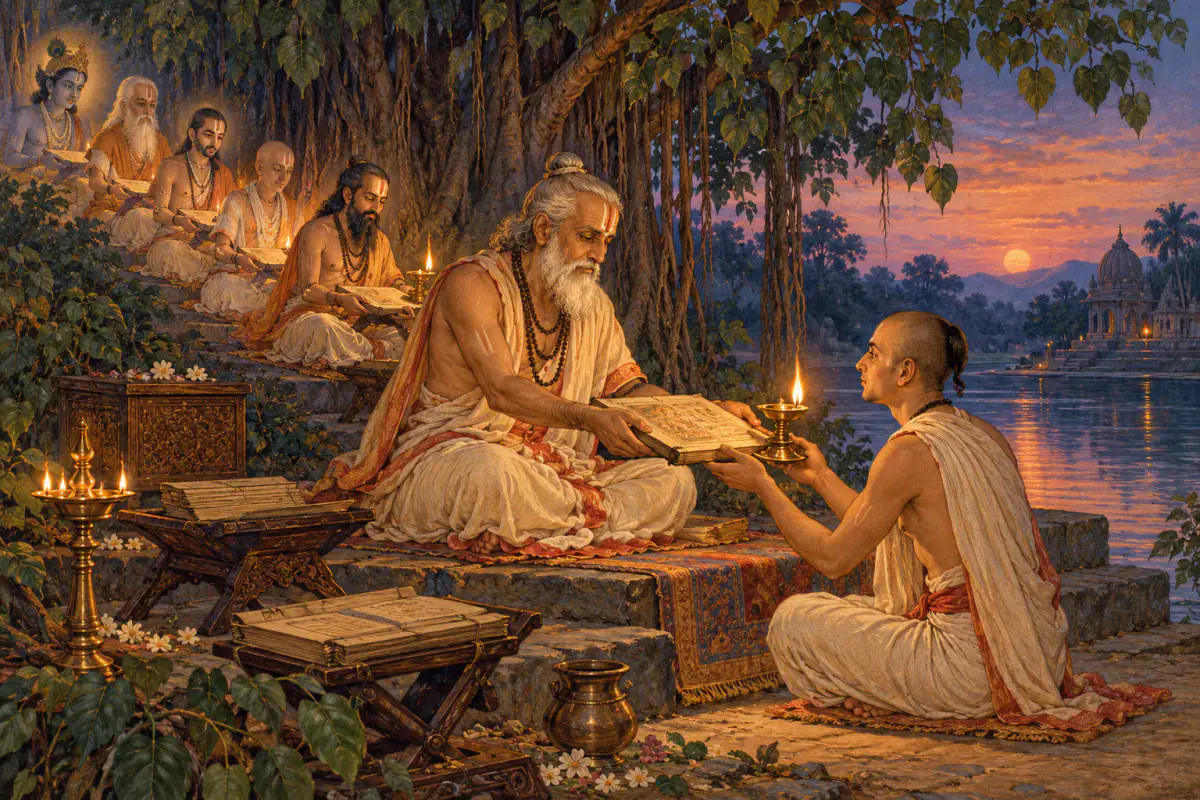
Presentation through paramparā
Śrīla Prabhupāda gives credit to his spiritual master. He says that his purpose is to present Kṛṣṇa's message without changing it to support a private idea.
Bhagavad-gītā should be received through the line of spiritual teachers. The teacher explains Kṛṣṇa's own message and does not replace Kṛṣṇa with an imaginary symbol or a personal theory.
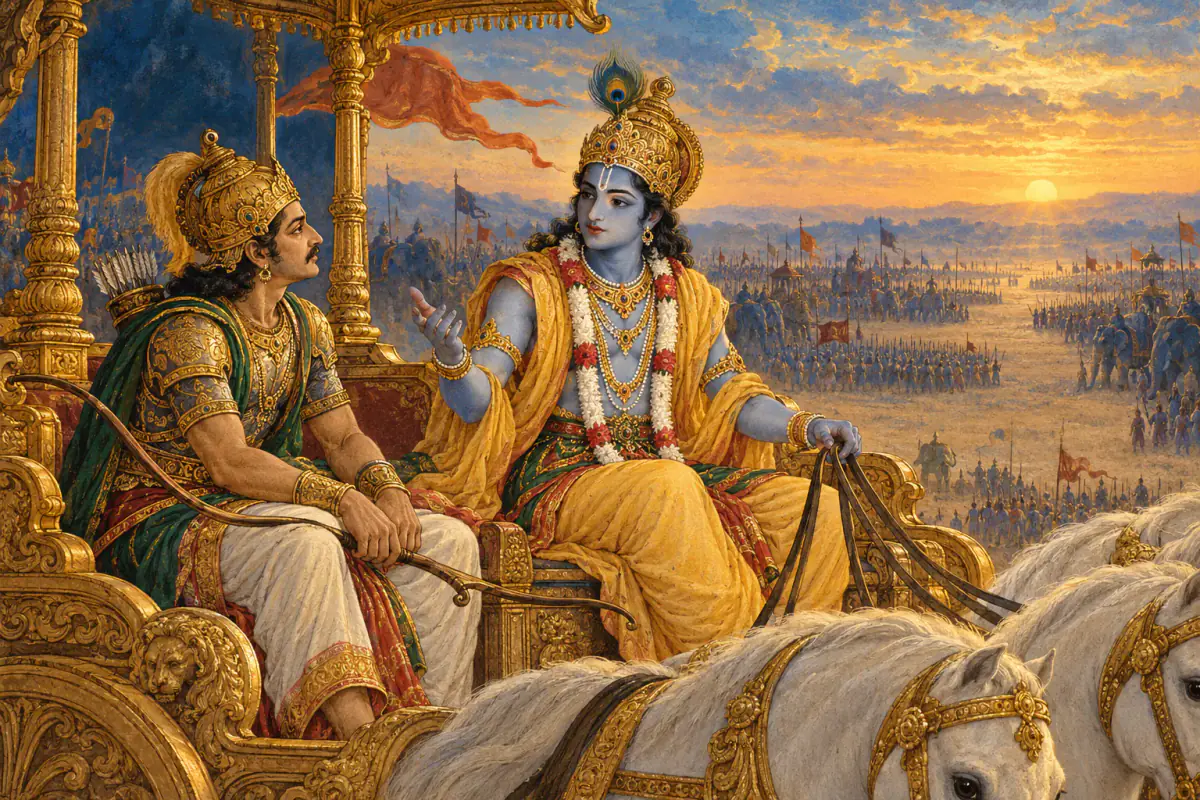
Speaker, listener, purpose, and subject
Kṛṣṇa is the speaker and Arjuna is the listener. Arjuna's difficulty leads him to ask about the real problems of life. The purpose of the Gītā is to free us from ignorance and awaken pure consciousness shown through service.
Sanātana means that which has no beginning and no end. Sanātana-dharma is the soul's eternal nature and service. It is not a temporary label that belongs only to one country, group or period of history.
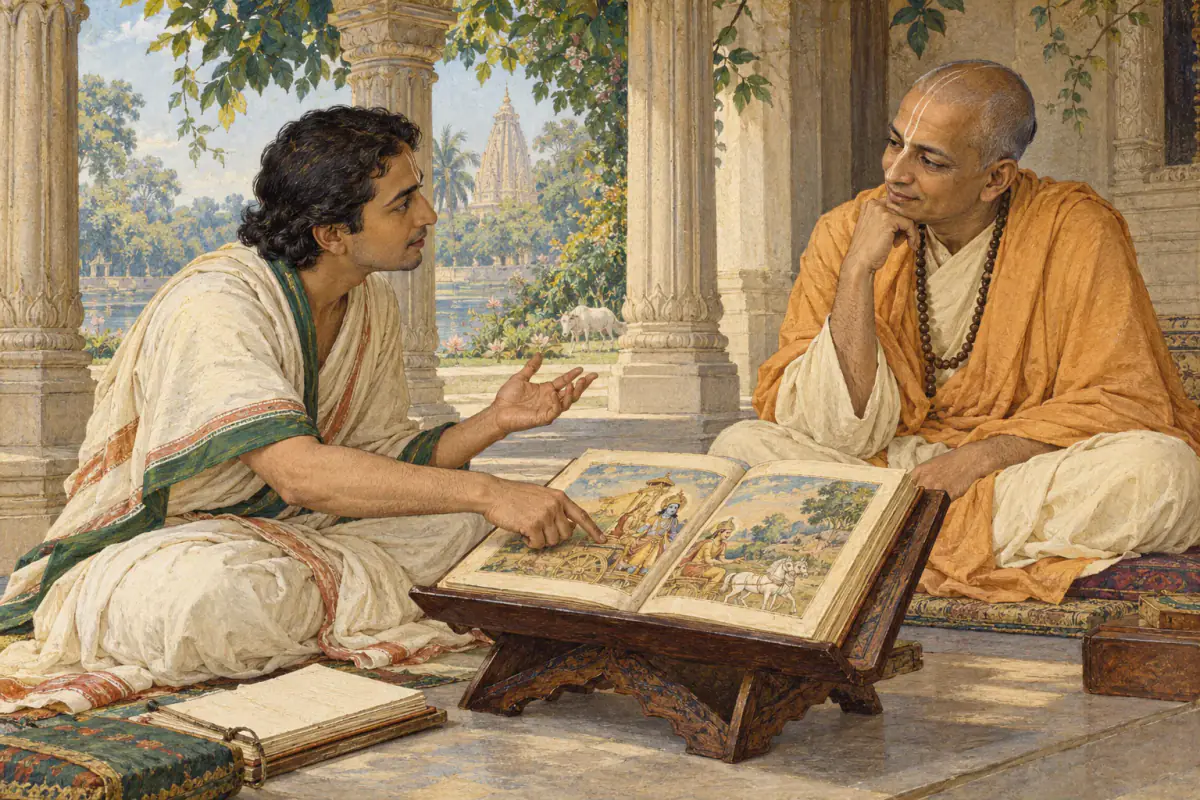
Humble questions are not blind acceptance
Arjuna asks serious questions throughout the Gītā. A humble student accepts Kṛṣṇa as the authority and still asks for clear reasons and practical meaning. Respect and clear thinking support each other.
Introduction, discussion of Arjuna’s acceptance and spirit of study
See each truth, its plain meaning, and its place in the complete picture.
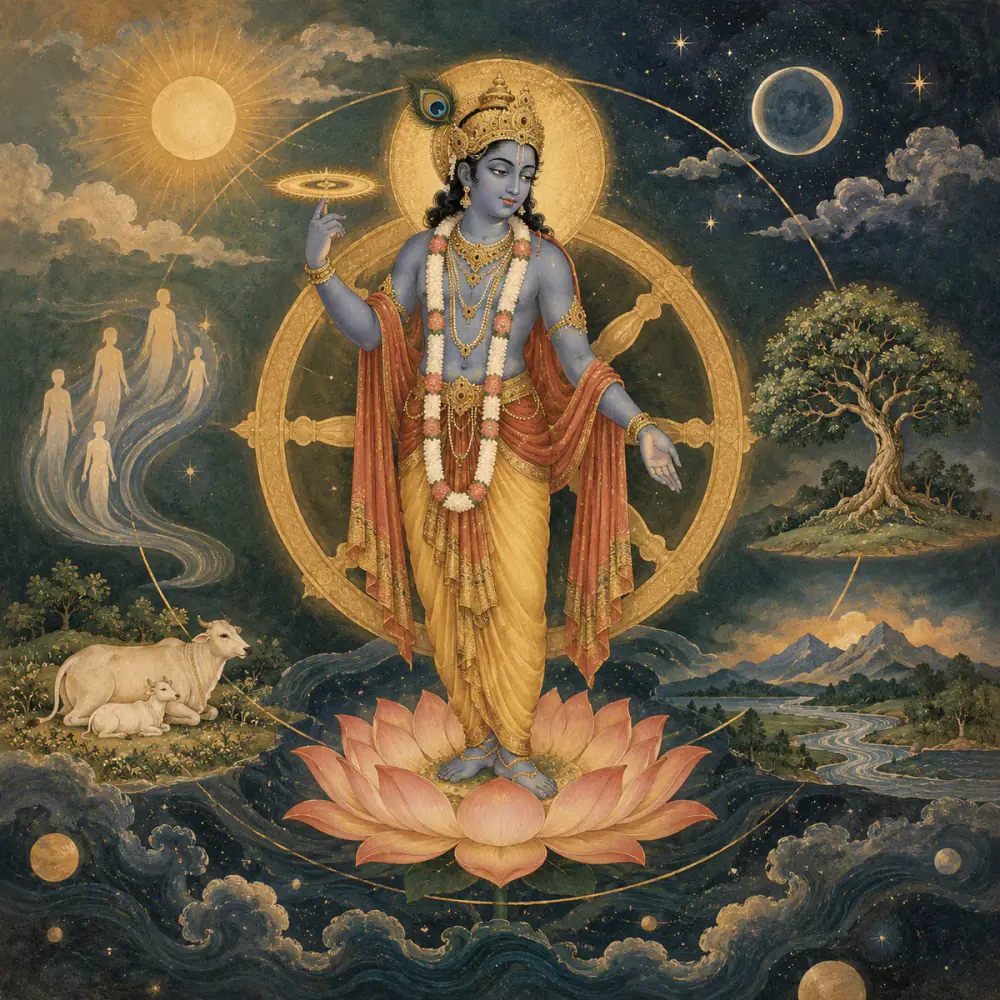
What is Īśvara?
The Supreme Controller. The other four subjects are understood in relationship with Him.
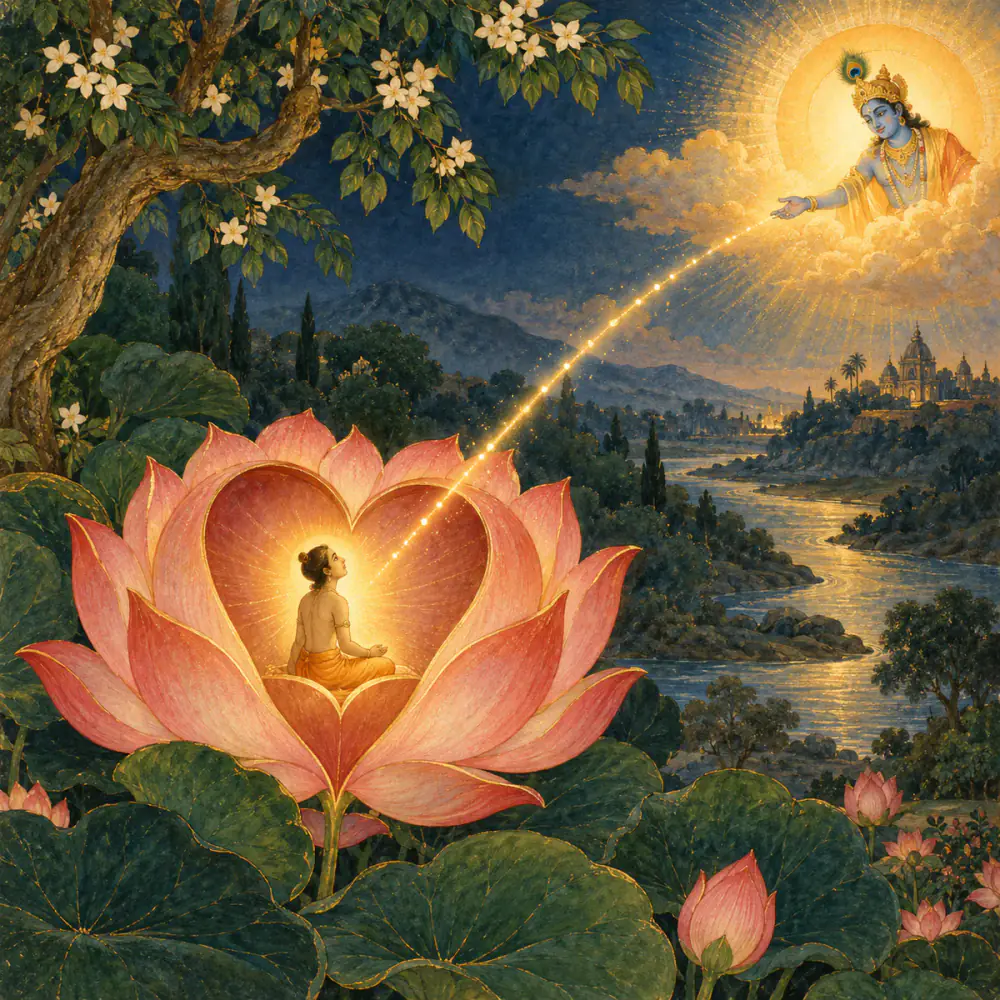
What is Jīva?
The living entity. The jīva is conscious and controlled, but shares spiritual quality with the Supreme.

What is Prakṛti?
Material nature. It is the field in which conditioned activity and embodiment take place.

What is Kāla?
Eternal time. Time carries change through material nature while the spiritual self remains distinct.
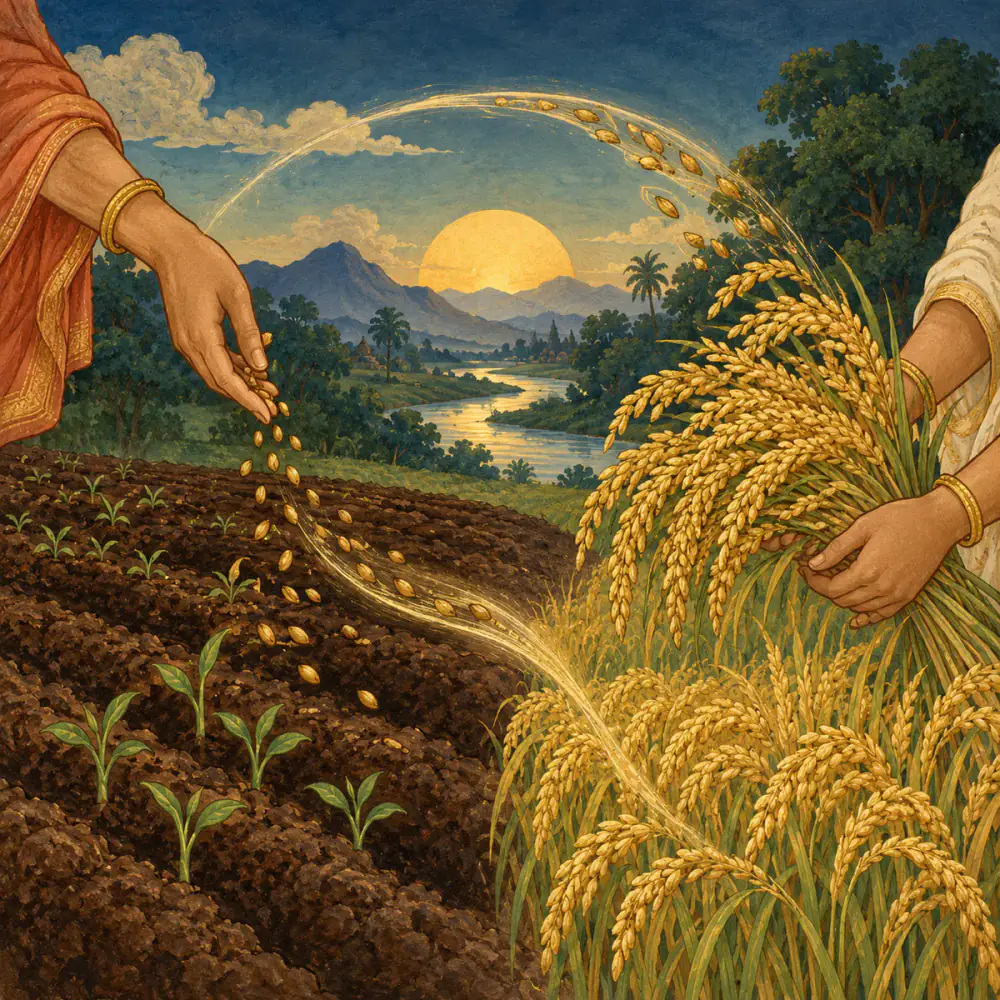
What is Karma?
Activity and reaction. Unlike the other four truths, karma is not eternal because its reactions can be changed.
The Introduction says the first four are eternal, while karma is not eternal because its reactions can be changed through perfected knowledge and purified action. This is a course map, not a claim that every concept is fully explained in Lesson 1.
Sources for this section
Reference and enrichment
How the conflict reached Kurukṣetra
Bhagavad-gītā opens after a long history. This short bridge supplies the minimum Mahābhārata context needed to understand why relatives, teachers, and friends are standing in opposing armies.
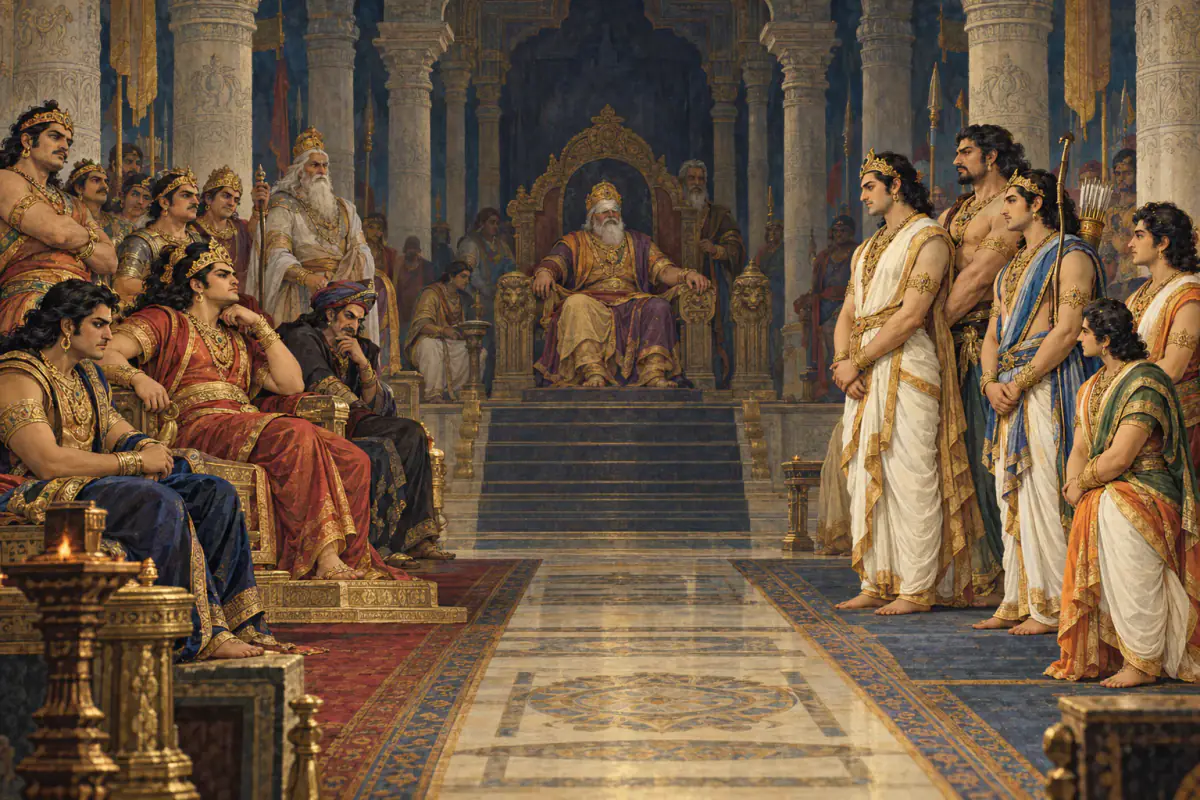
A divided Kuru family
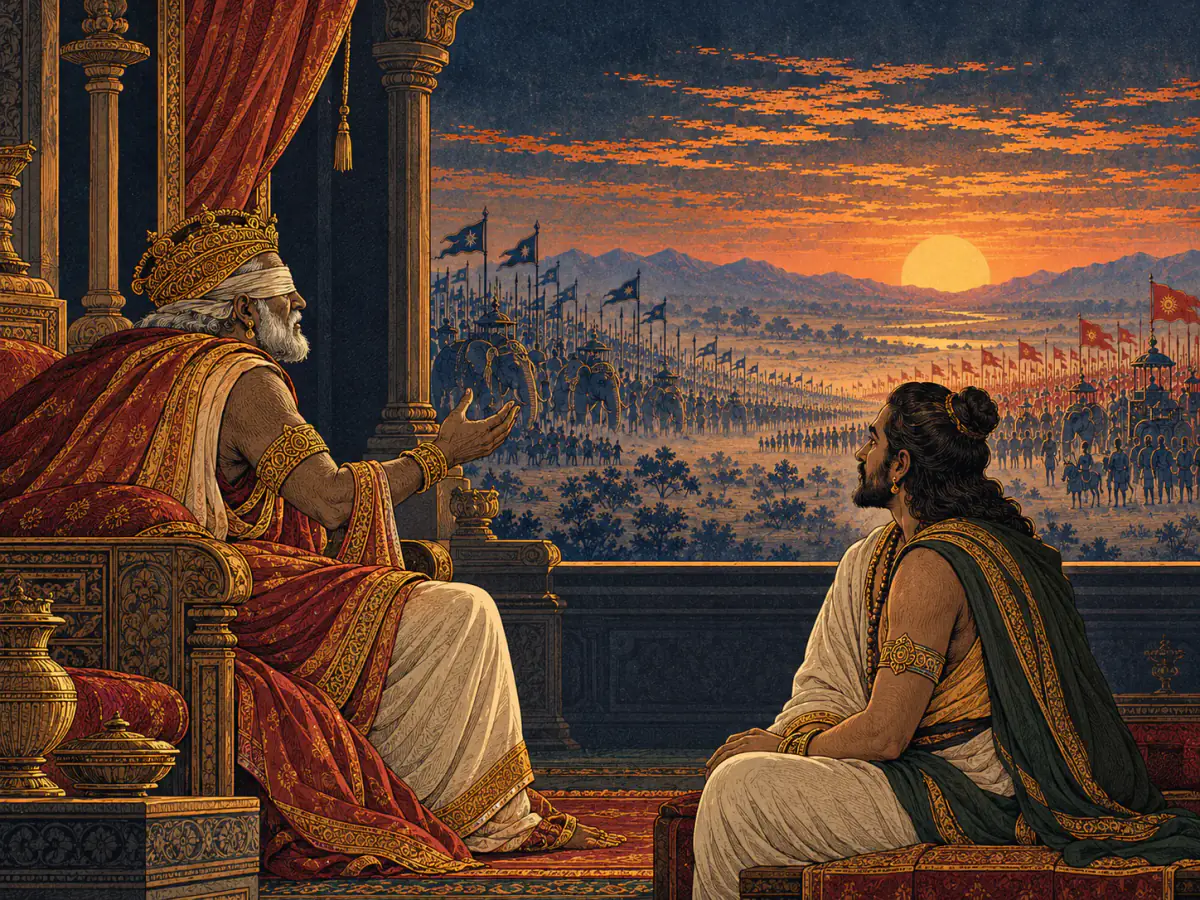
Dhṛtarāṣṭra’s sons, led by Duryodhana, and Pāṇḍu’s five sons grow into rival branches of the same royal family. Dhṛtarāṣṭra’s attachment to his sons repeatedly prevents him from restraining Duryodhana.
Why it matters in 1.1His words ‘my sons’ and ‘the sons of Pāṇḍu’ reveal that division before the battle report begins.
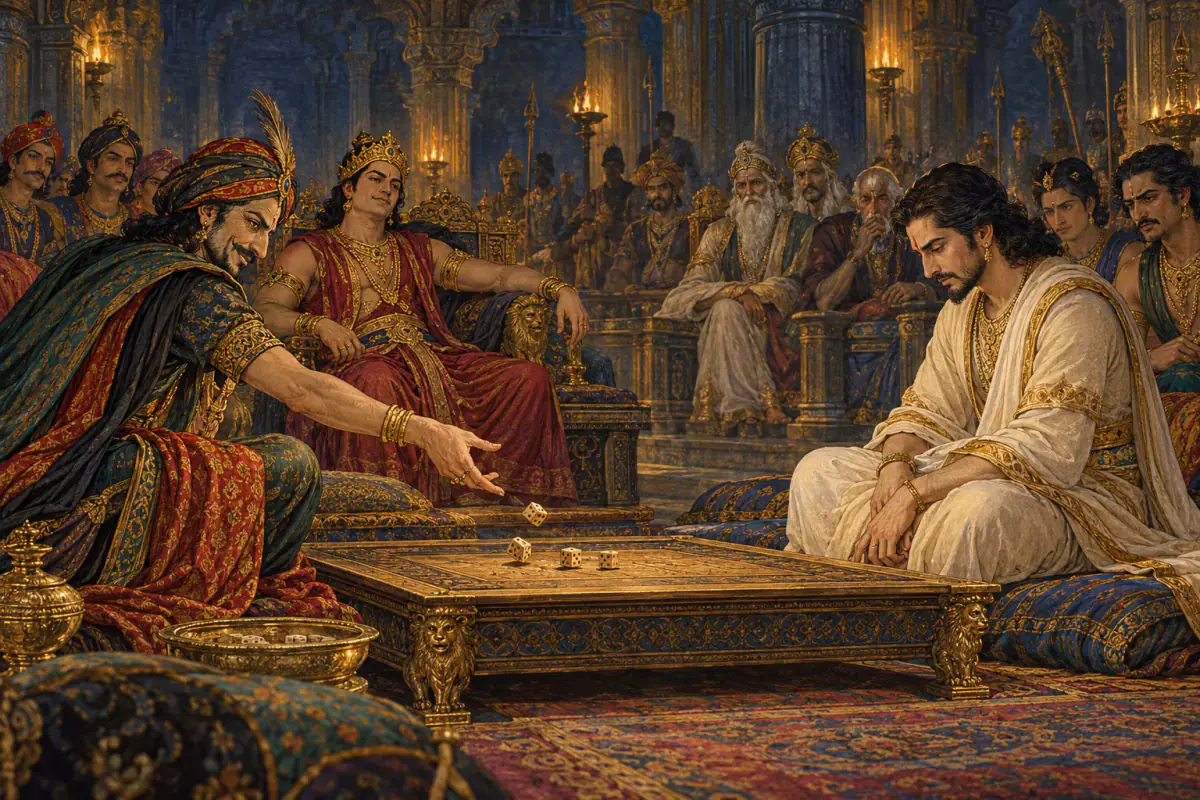
Jealousy becomes a dice plot
Duryodhana envies the Pāṇḍavas’ prosperity. With Śakuni’s help, a rigged dice match strips them of their kingdom and leads to Draupadī’s public humiliation.
Why it matters in 1.2 to 1.11Duryodhana’s battlefield diplomacy belongs to an established pattern of calculation, pressure, and refusal to accept the Pāṇḍavas’ rightful position.
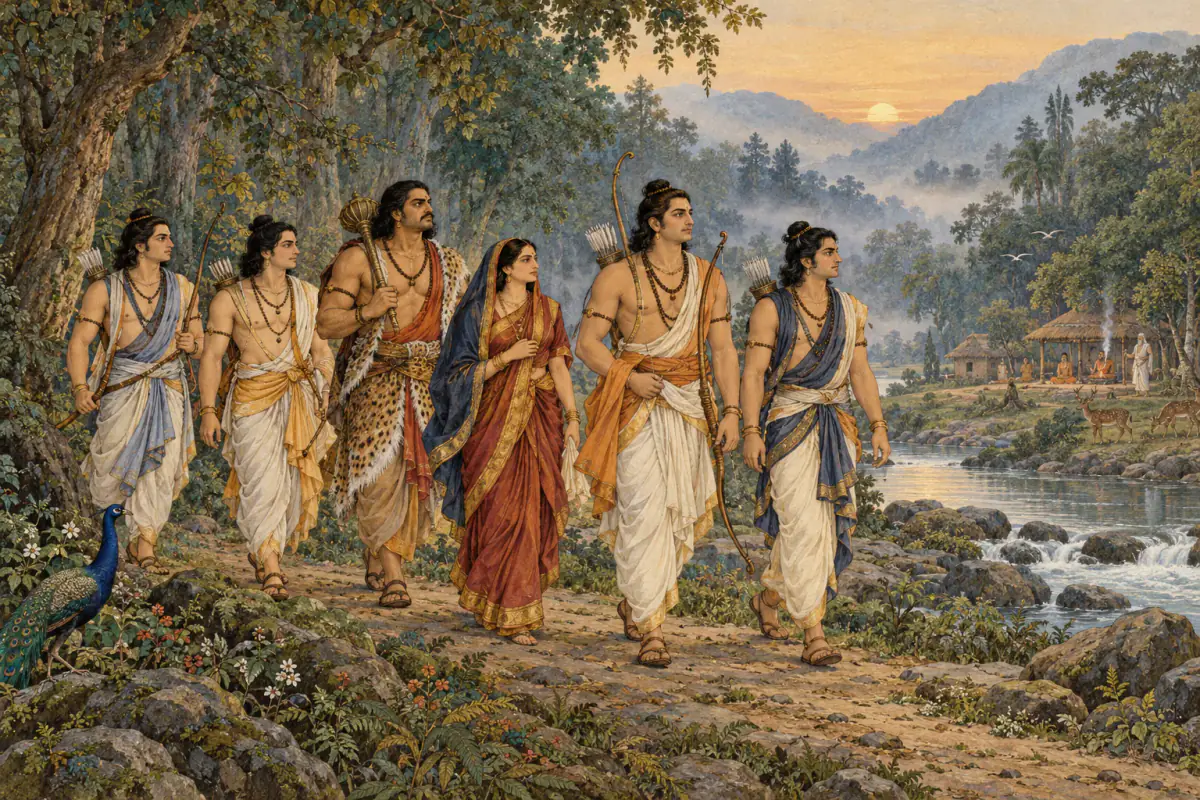
Thirteen years of exile
The final dice agreement sends the Pāṇḍavas into twelve years of forest exile followed by one year incognito. They complete the condition and return to seek restoration of their kingdom.
Why it matters in Chapter 1The armies do not gather because of a sudden personal quarrel. The field is the endpoint of a long unresolved dispute about justice, rule, and family duty.
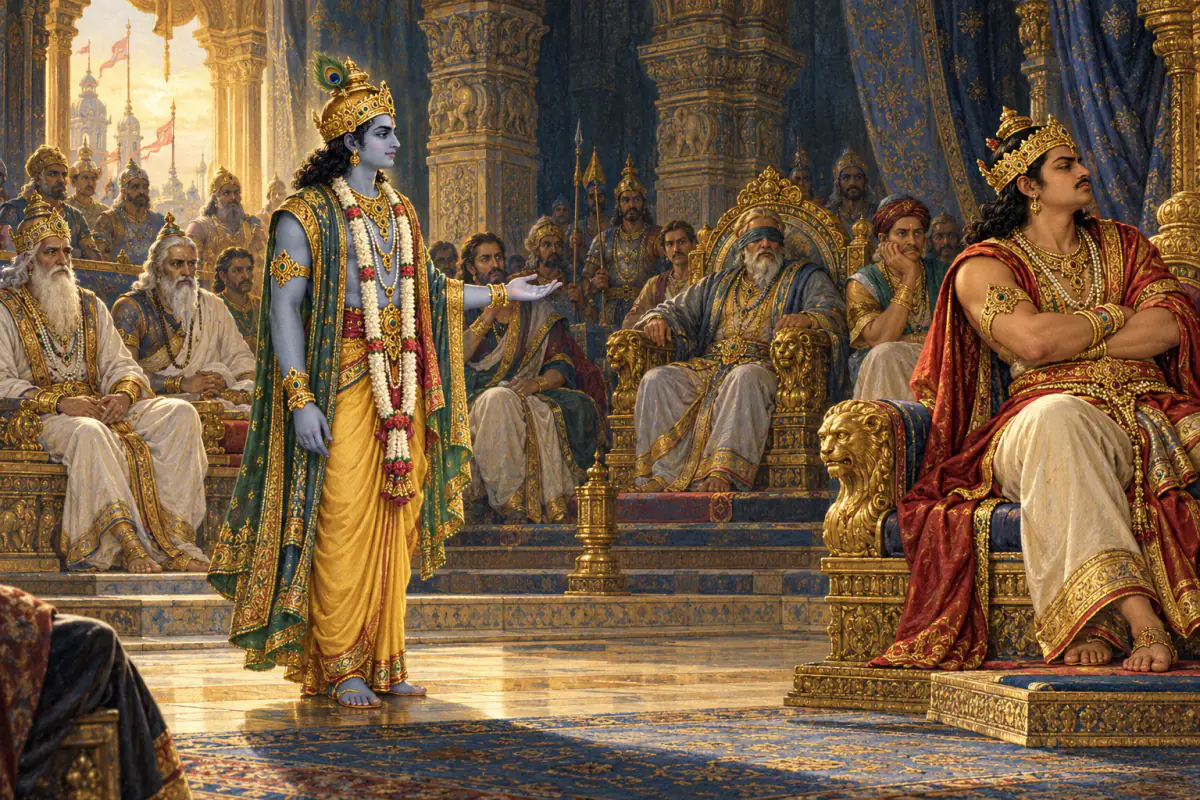
Peace efforts fail
Kṛṣṇa goes as a messenger for peace, but Duryodhana refuses to return the Pāṇḍavas’ kingdom. With settlement rejected, both sides call their allies and prepare for war.
Why it matters in 1.14 and 1.20Kṛṣṇa is present with Arjuna as his non-combatant charioteer, while the warriors on both sides have knowingly assembled to fight.
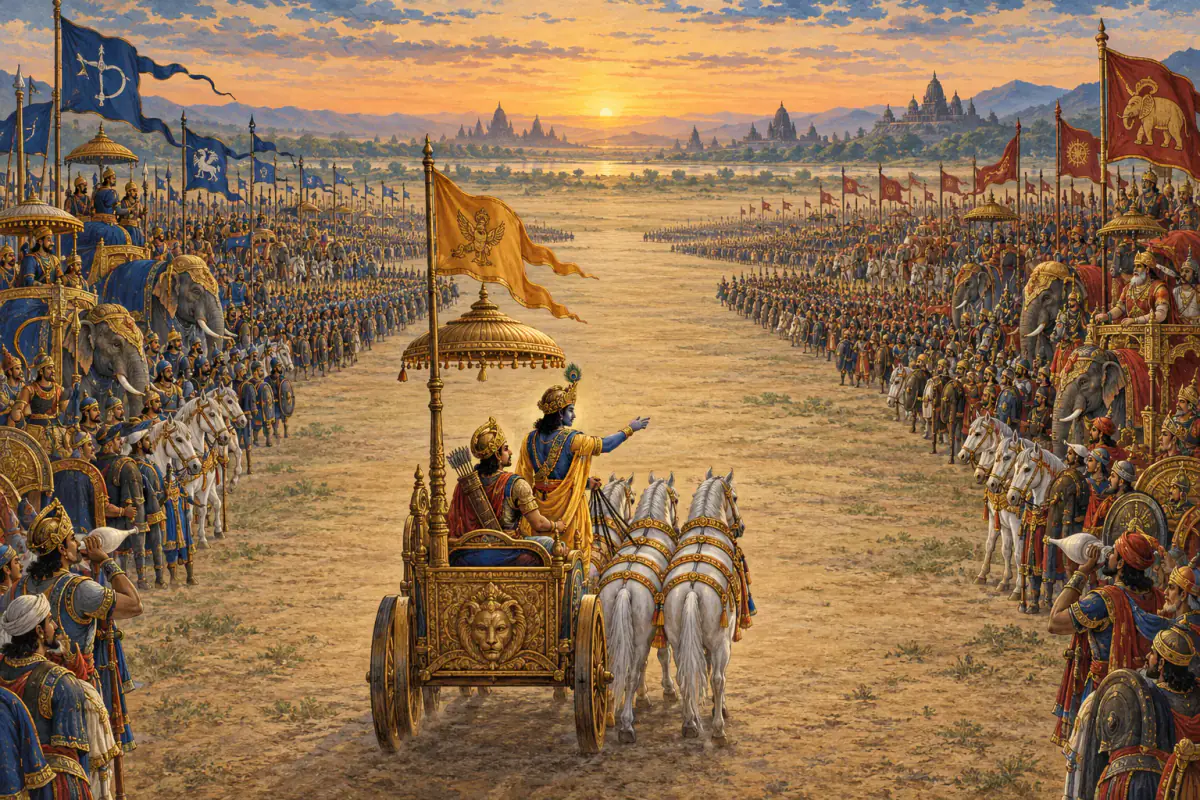
The Gītā begins before the first weapon is released
At Kurukṣetra, Dhṛtarāṣṭra asks Sañjaya what happened. The chapter moves from strategy and sound to Arjuna’s request to see, then to the compassion that prepares his crisis.
Why it matters for this lessonVerses 1.1 to 1.27 are the threshold of the teaching. Kṛṣṇa has not yet begun His philosophical instruction.
- 01Family division
Attachment separates the two branches of the Kuru family.
- 02Dice and exile
Cheating removes the Pāṇḍavas from their kingdom.
- 03Peace is refused
The final attempt at settlement fails.
- 04Kurukṣetra
The relatives and teachers meet in opposing armies.
Essential teaching
The complete movement of Bhagavad-gītā 1.1 to 1.27
The chapter moves through six connected stages: Dhṛtarāṣṭra's question, Duryodhana's assessment, the answering conches, Arjuna's request, Kṛṣṇa's positioning of the chariot, and Arjuna's compassion after seeing his relatives.
01Question1.1
Dhṛtarāṣṭra asks Sañjaya about the armies at dharma-kṣetra Kurukṣetra. His phrase ‘my sons and the sons of Pāṇḍu’ exposes a divided allegiance.
- Observe
- The place, the two groups, the speaker, and the person being addressed are all named in the opening question.
- Notice
- The key terms are dharma-kṣetre, māmakāḥ, pāṇḍavāḥ, and kim akurvata.
- Explain
- The opening question is not neutral. Place and attachment are already shaping the narrative.
02Strategic assessment1.2 to 1.11
Duryodhana sees the Pāṇḍava formation, approaches Droṇa, names strong opponents and allies, assesses strength, and orders protection of Bhīṣma.
- Observe
- The speech moves from Duryodhana’s first observation to his instruction to protect Bhīṣma.
- Notice
- Separate one accurate observation, one political move, and one sign of concern or confidence.
- Explain
- His speech combines information, loyalty management, and self-interest.
03Sound and response1.12 to 1.19
Bhīṣma rallies the Kaurava army. Kṛṣṇa, Arjuna, the Pāṇḍavas, and their allies respond. Six conches are named, and the combined sound shatters the hearts of Dhṛtarāṣṭra’s sons.
- Observe
- Bhīṣma sounds first, the other side answers, and six conches receive individual names.
- Notice
- Distinguish the effect stated in 1.19 from the signs explained in the purports.
- Explain
- The narrative contrasts the two sides through sound before any weapon is released.
04Readiness and request1.20 to 1.23
Arjuna raises Gāṇḍīva ready to fight. He then asks Acyuta to place the chariot between the armies so he can see whom he must face.
- Observe
- Arjuna’s raised bow shows readiness, while his request explains why he wants a closer view.
- Notice
- Arjuna is not unwilling from the start. His crisis develops only after he asks to see more closely.
- Explain
- The change begins through deliberate seeing, not through fear at a distance.
05Kṛṣṇa positions the chariot1.24 to 1.25
Hṛṣīkeśa obeys Guḍākeśa and stops before Bhīṣma, Droṇa, and the rulers. He tells Pārtha to behold the assembled Kurus.
- Observe
- Kṛṣṇa places the chariot directly before Bhīṣma, Droṇa, and the assembled rulers.
- Notice
- The chariot stops before elders and teachers, not before anonymous military units.
- Explain
- Kṛṣṇa serves His devotee and arranges the clear seeing from which the teaching will arise.
06Relationships come into view1.26 to 1.27
Arjuna sees relatives, teachers, friends, in-laws, and well-wishers on both sides. He becomes overwhelmed with compassion and prepares to speak.
- Observe
- The listed relationships are fathers, grandfathers, teachers, uncles, brothers, sons, grandsons, friends, fathers-in-law, and well-wishers.
- Notice
- The language changes from military ranks to fathers, grandfathers, teachers, sons, friends, and well-wishers.
- Explain
- The battlefield becomes a human and moral crisis, opening the need for spiritual instruction.
Open the three-part chapter structure
Preparations for war, 1.1 to 1.13: the field, armies, Duryodhana’s diplomacy, and Bhīṣma’s rallying sound.
Signs of victory, 1.14 to 1.20: Kṛṣṇa, the Pāṇḍavas, their named conches, and Hanumān’s flag.
Kṛṣṇa as bhakta-vatsala, 1.21 to 1.27: the Supreme Lord willingly serves His devotee as charioteer and brings Arjuna face to face with his relationships.
Reference and enrichment
Who is who on the field
This table turns a list of names into a relationship map. It includes the central figures needed to understand 1.1 to 1.27.
| Person | Identity | Function in this passage | Verse |
|---|---|---|---|
| Dhṛtarāṣṭra | Blind Kuru king and father of Duryodhana | Asks the opening question and reveals attachment through ‘my sons’ | 1.1 |
| Sañjaya | Student of Vyāsa and narrator to Dhṛtarāṣṭra | Sees the distant field by Vyāsa’s mercy and reports it | 1.1 to 1.2 |
| Duryodhana | Son of Dhṛtarāṣṭra and leader of the Kaurava cause | Assesses the armies, addresses Droṇa, and orders protection of Bhīṣma | 1.2 to 1.11 |
| Droṇa | Military teacher of both Kauravas and Pāṇḍavas | Receives Duryodhana’s carefully worded reminder about Dhṛṣṭadyumna | 1.3, 1.8 |
| Bhīṣma | Grandsire and senior Kaurava commander | Rallies the army with a lion-like conch blast | 1.8, 1.11 to 1.12 |
| Kṛṣṇa | Supreme Personality of Godhead and Arjuna’s charioteer | Sounds Pāñcajanya and lovingly carries out Arjuna’s request | 1.14 to 1.15, 1.21 to 1.25 |
| Arjuna | Pāṇḍava warrior, Kṛṣṇa’s friend, and future student | Sounds Devadatta, asks to see, then recognizes loved ones on both sides | 1.14 to 1.27 |
| Dhṛṣṭadyumna | Son of Drupada and disciple of Droṇa | Arranges the Pāṇḍava formation, making Duryodhana’s reminder to Droṇa pointed | 1.3 |
Open the full warrior roster named in 1.4 to 1.8
Pāṇḍava-side warriors named by Duryodhana
Yuyudhāna or Sātyaki, Virāṭa, Drupada, Dhṛṣṭaketu, Cekitāna, Kāśirāja, Purujit, Kuntibhoja, Śaibya, Yudhāmanyu, Uttamaujā, Abhimanyu, and the sons of Draupadī.
Bhagavad-gītā 1.4 to 1.6
Kaurava-side leaders named by Duryodhana
Droṇa, Bhīṣma, Karṇa, Kṛpa, Aśvatthāmā, Vikarṇa, and Bhūriśravā, the son of Somadatta.
Bhagavad-gītā 1.7 to 1.8
Essential teaching
The conches and the signs of victory
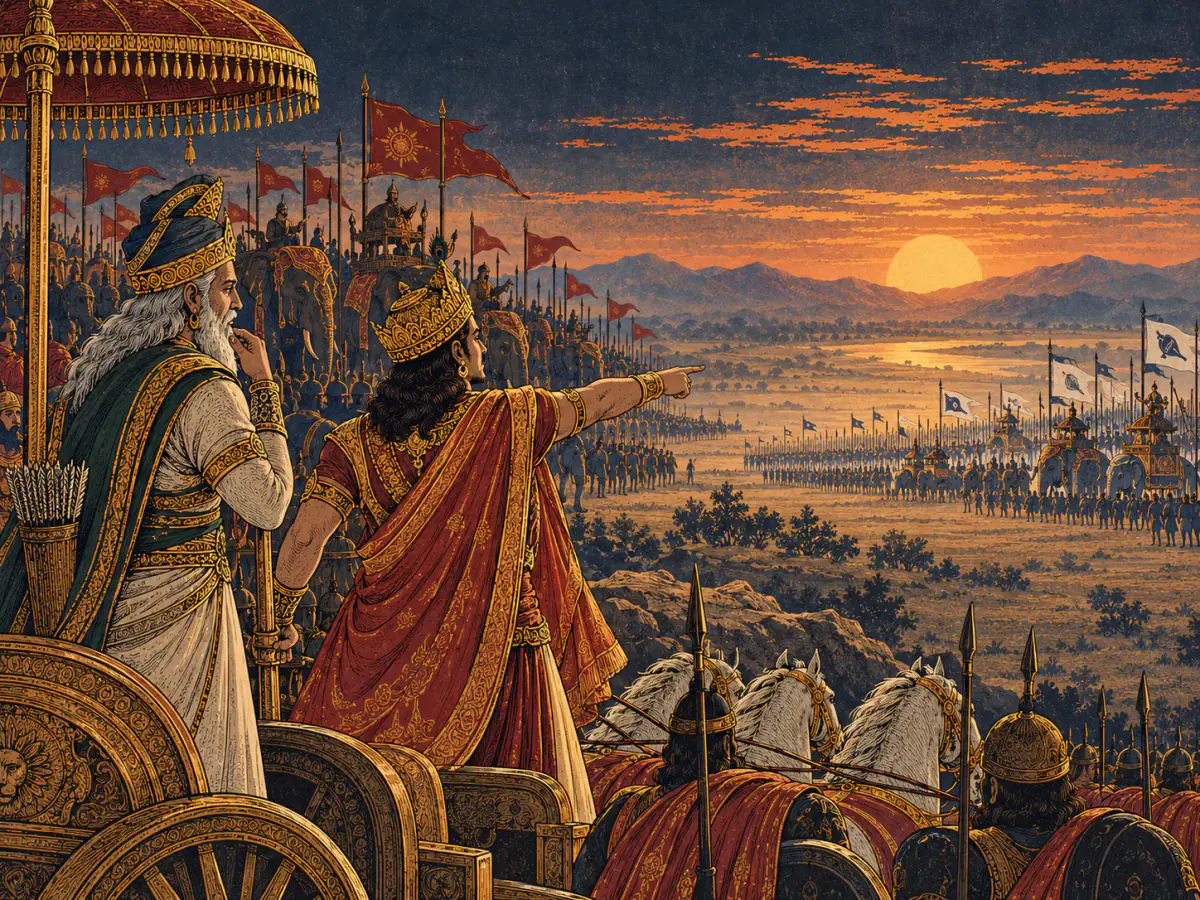
The text names six conches. Other warriors also blow conches, but verses 1.17 to 1.18 do not supply their conch names. Keeping that distinction prevents invented detail.

1.15
Pāñcajanya
KṛṣṇaKṛṣṇa is called Hṛṣīkeśa, the Lord of the senses.1.15
Devadatta
ArjunaArjuna is called Dhanañjaya, the winner of wealth.1.15
Pauṇḍra
BhīmaIt is described as a great and terrific conch.1.16
Anantavijaya
YudhiṣṭhiraThe king and son of Kuntī sounds it.1.16
Sughoṣa
NakulaOne of the twin Pāṇḍava brothers sounds it.1.16
Maṇipuṣpaka
SahadevaThe other twin Pāṇḍava brother sounds it.Dharma-kṣetra
Kurukṣetra’s sacred influence makes Dhṛtarāṣṭra fear for the outcome because the virtuous Pāṇḍavas stand with Kṛṣṇa.
Kṛṣṇa’s presence
Kṛṣṇa and Arjuna sit on a great chariot with white horses and sound divine conches. The purport explains that Kṛṣṇa’s presence is the most important sign of victory.
Named conches, stated effect
The conches are individually named, and their combined sound is directly said to shatter the hearts of Dhṛtarāṣṭra’s sons.
Hanumān on the flag
Hanumān’s emblem recalls his service with Lord Rāma. The purport identifies this as another sign of assured victory.
Reference and enrichment
Names that teach while the story moves
Vyāsa’s names are not decorative labels. Each name brings a relationship or quality into view.
Husband of the goddess of fortune. Used in 1.14 as the auspicious conches sound.
Winner of wealth. Used in 1.15 when Arjuna blows Devadatta.
Lord of the senses. First used in this passage in 1.15, then again in 1.20 and 1.24 as Kṛṣṇa guides and positions the chariot.
He whose flag bears Hanumān. Used in 1.20 as Arjuna raises his bow.
The infallible one. Used in 1.21 as Arjuna requests the Lord’s service as charioteer.
Conqueror of sleep or ignorance in the 1.24 purport. Used when Kṛṣṇa fulfils his request.
Son of Pṛthā or Kuntī. Used in 1.25 when Kṛṣṇa tells him to behold the Kurus.
Reference and enrichment
From military distance to moral nearness
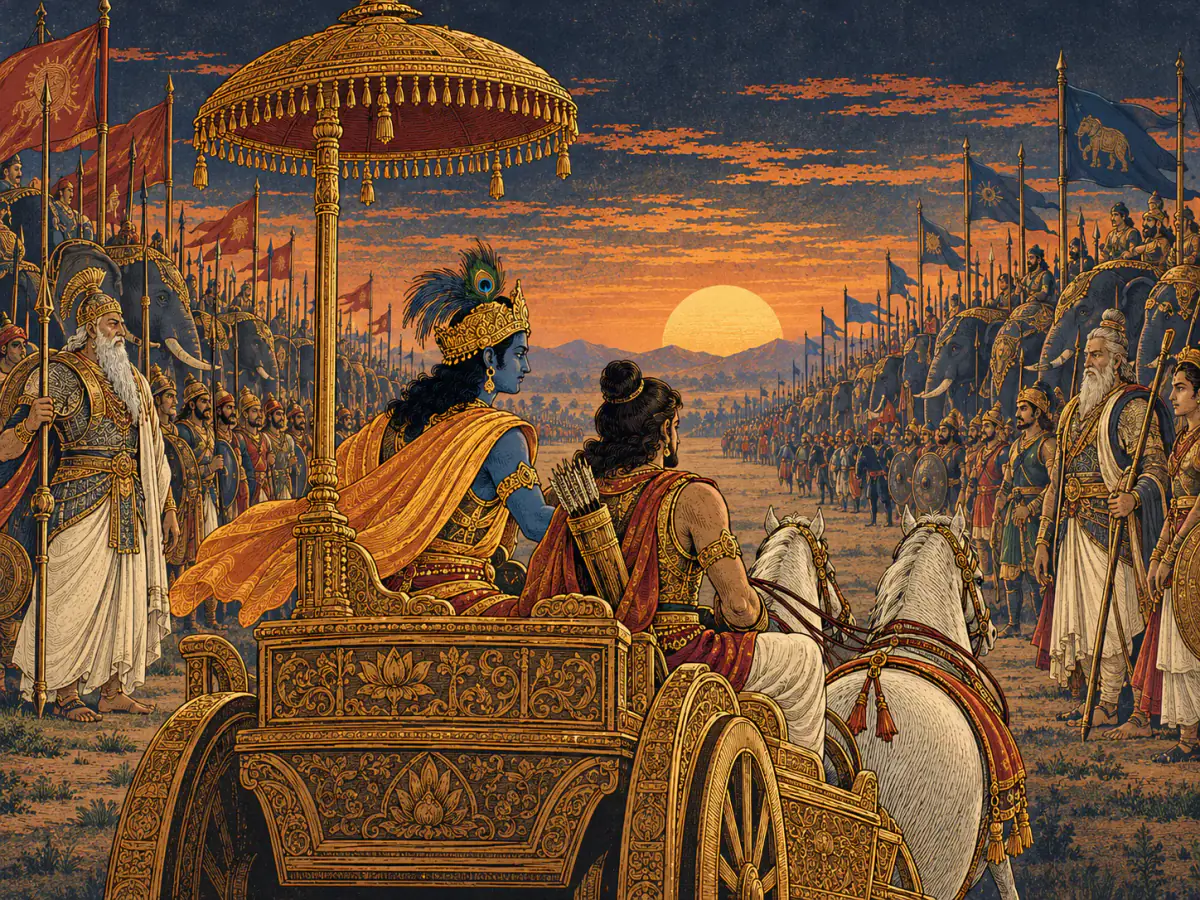
This diagram does not claim that every step is a separate doctrine. It shows how the narrative changes Arjuna’s field of attention, with a verse anchor at every transition.
Arjuna raises Gāṇḍīva.
He asks to see whom he must face.
Kṛṣṇa stops before Bhīṣma and Droṇa.
Ranks become relatives and teachers.
Essential practice
Activity 1: Put the story in order
What needs to be doneGive each event its correct position from 1 to 6. The events are scrambled whenever the page opens.
PurposeBuild an accurate mental map of Bhagavad-gītā 1.1 to 1.27.
SuccessAll six events are in order, and you can explain one verse anchor after checking.
Stop whenYou and a partner can reproduce the order without looking at the completed activity.
If You Are Studying On-Site
- Work alone first. Choose a number from 1 to 6 beside every event.
- Compare your sequence with one partner without submitting it yet.
- If you disagree, use the six-step chapter map already shown on this page.
- Submit the sequence, then take turns retelling it without looking at the selectors.
If You Are Studying Online
- Choose a number from 1 to 6 beside every event on your own screen.
- Share only your six-number sequence with a partner in chat or a breakout room.
- If you disagree, use the six-step chapter map already shown on this page before either person changes an answer.
- Submit the sequence, then one person retells it while the other checks the map.
- 01Place
Give every event one position from 1 to 6.
- 02Check
Compare your order with the chapter movement.
- 03Retell
Say the complete sequence without looking at the selectors.
After checking your sequence
Ask yourself: ‘Which transition was easiest to forget, and which verse repaired my memory?’ If the order is weak, return to the six-step movement and narrate it once with the verse ranges visible, then once without them. If the order is secure, explain why the movement from 1.20 to 1.27 is more than a change of location.
Complete information bank
Every verse from 1.1 to 1.27 in order
This section retells all twenty-seven verses in simple words. It explains what happens, why it matters, and how each verse leads to the next one. Nothing outside this page is needed.

The question and Duryodhana's first response
1.1. Dhṛtarāṣṭra asks Sañjaya what his sons and the sons of Pāṇḍu did after assembling at dharma-kṣetra Kurukṣetra, ready to fight. The first words establish the place, the conflict, the observer, and Dhṛtarāṣṭra’s division between ‘mine’ and the Pāṇḍavas.
1.2. Sañjaya begins his report. Duryodhana sees the Pāṇḍava army arranged for battle and approaches Droṇa. The narration moves from the blind king’s question to Duryodhana’s careful political response.
1.3. Duryodhana asks Droṇa to observe the army arranged by Dhṛṣṭadyumna, Droṇa’s intelligent disciple and Drupada’s son. The purport reads this as diplomatic pressure: Duryodhana reminds Droṇa that the opponent used the military knowledge Droṇa generously taught him.
Why this movement matters
The opening moves through three minds: Dhṛtarāṣṭra worries, Sañjaya sees, and Duryodhana calculates. Before the spiritual dialogue begins, the chapter shows how attachment shapes the questions people ask and the way they read the same field.
The purport reads this as diplomatic pressure: Duryodhana reminds Droṇa that the opponent used the military knowledge Droṇa generously taught him. By the end of 1.1 to 1.3, the story is ready for 1.4: Duryodhana names Yuyudhāna, Virāṭa, and Drupada among bowmen he compares with Bhīma and Arjuna.
The armies become people, loyalties, and strategy
1.4. Duryodhana names Yuyudhāna, Virāṭa, and Drupada among bowmen he compares with Bhīma and Arjuna. The catalogue shows that he is not ignoring the strength opposite him.
1.5. He names Dhṛṣṭaketu, Cekitāna, Kāśirāja, Purujit, Kuntibhoja, and Śaibya. The list broadens the network of powerful allies supporting the Pāṇḍavas.
1.6. He names Yudhāmanyu, Uttamaujā, Abhimanyu, and the sons of Draupadī. The opposing force includes established rulers, protectors, and a younger generation of warriors.
1.7. Duryodhana turns from the Pāṇḍava side to the leading captains of his own force. His speech is carefully balanced: first the threat, then his own resources.
1.8. He names Droṇa, Bhīṣma, Karṇa, Kṛpa, Aśvatthāmā, Vikarṇa, and Bhūriśravā. These are not anonymous armies. The coming conflict involves teachers, elders, friends, and relatives.
1.9. He says that many other heroes are ready to give their lives for him and are skilled in warfare. The words reveal loyalty and preparedness, while ‘for my sake’ keeps Duryodhana’s self-interest visible.
1.10. Duryodhana compares the two armies, describing his force under Bhīṣma and the Pāṇḍava force under Bhīma. His words sound confident, but they may also show worry. In the next verse he orders everyone to protect Bhīṣma, which shows how much his plan depends on Bhīṣma.
1.11. He orders the warriors to guard Bhīṣma from their planned positions. The command reveals Bhīṣma’s importance to the Kaurava formation.
Why this movement matters
Duryodhana's long list is not empty decoration. It shows that he can see strength clearly while still serving an unjust aim. Information and intelligence do not by themselves create wisdom; purpose and character decide how they are used.
The command reveals Bhīṣma’s importance to the Kaurava formation. By the end of 1.4 to 1.11, the story is ready for 1.12: Bhīṣma blows his conch loudly like a lion’s roar, giving Duryodhana joy.
One rallying sound receives a powerful answer
1.12. Bhīṣma blows his conch loudly like a lion’s roar, giving Duryodhana joy. The elder answers the political tension by rallying the army.
1.13. Conches, drums, bugles, trumpets, and horns suddenly create a tumultuous sound. The preparation section reaches its audible climax before the response from the other side.
1.14. Kṛṣṇa and Arjuna, on a great chariot drawn by white horses, sound their divine conches. The verse shifts attention to the Pāṇḍava side. The purport reads Kṛṣṇa’s presence, the white horses, the chariot, and the divine sound as auspicious.
Why this movement matters
The two sounds are not presented in the same way. Bhīṣma's roar encourages Duryodhana, while the answer comes from the chariot where Kṛṣṇa is present. The story begins to show moral and spiritual difference through sound before any arrow is released.
The verse shifts attention to the Pāṇḍava side. The purport reads Kṛṣṇa’s presence, the white horses, the chariot, and the divine sound as auspicious. By the end of 1.12 to 1.14, the story is ready for 1.15: Kṛṣṇa blows Pāñcajanya, Arjuna blows Devadatta, and Bhīma blows Pauṇḍra.
The named conches and their stated effect
1.15. Kṛṣṇa blows Pāñcajanya, Arjuna blows Devadatta, and Bhīma blows Pauṇḍra. Naming the conches gives the response identity and devotional significance, not only volume.
1.16. Yudhiṣṭhira blows Anantavijaya; Nakula and Sahadeva blow Sughoṣa and Maṇipuṣpaka. The five Pāṇḍava brothers and Kṛṣṇa are now heard through individually named conches.
1.17. The King of Kāśī, Śikhaṇḍī, Dhṛṣṭadyumna, Virāṭa, and Sātyaki also sound their conches. The sound belongs to an allied community, not one isolated warrior.
1.18. Drupada, the sons of Draupadī, and Abhimanyu sound their respective conches. The verse completes the Pāṇḍava-side roll call, though these conches are not named in the text.
1.19. Their combined sound vibrates through earth and sky and shatters the hearts of Dhṛtarāṣṭra’s sons. The text itself states the effect. No invented symbolic meaning is needed to establish the story point.
Why this movement matters
Six conches receive names, while the conches of later allies do not. This small limit matters. Careful study respects what the verse names and what it leaves unnamed, while still noticing the directly stated effect on Dhṛtarāṣṭra's sons.
The text itself states the effect. No invented symbolic meaning is needed to establish the story point. By the end of 1.15 to 1.19, the story is ready for 1.20: Arjuna, whose chariot flag bears Hanumān, raises Gāṇḍīva and looks at Dhṛtarāṣṭra’s sons.
Arjuna is ready, then asks to see
1.20. Arjuna, whose chariot flag bears Hanumān, raises Gāṇḍīva and looks at Dhṛtarāṣṭra’s sons. Arjuna is ready to fight at this moment. The purport identifies Hanumān’s presence on the flag as another sign of victory.
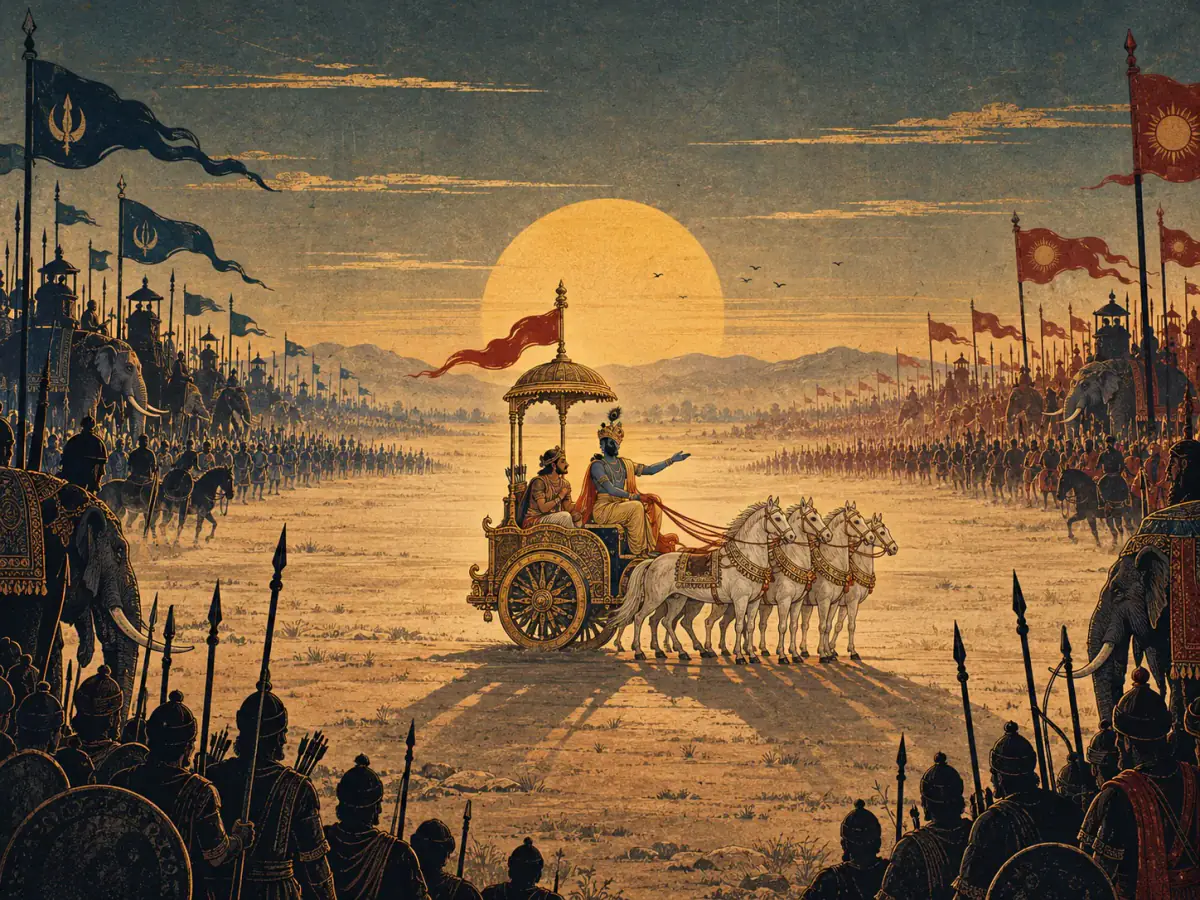
1.21. Arjuna addresses Kṛṣṇa as Acyuta and asks Him to place the chariot between the armies. Kṛṣṇa accepts the service of charioteer for His devotee. The request begins a movement from distant assessment to direct seeing.
1.22. Arjuna wants to see those with whom he must contend in battle. His request is practical and deliberate. His visible compassion comes only after Kṛṣṇa shows him the people involved.
1.23. Arjuna asks to see those who have assembled to please Duryodhana. He identifies the political centre of the opposing cause before his emotional crisis begins.
Why this movement matters
Arjuna first raises his bow. His crisis does not begin as simple cowardice from a distance. He asks for a clearer view, and that responsible act of looking brings him into a problem that military readiness alone cannot solve.
He identifies the political centre of the opposing cause before his emotional crisis begins. By the end of 1.20 to 1.23, the story is ready for 1.24: Kṛṣṇa, called Hṛṣīkeśa, places the chariot between the two armies after being addressed by Arjuna, called Guḍākeśa.
Kṛṣṇa brings relationships into view
1.24. Kṛṣṇa, called Hṛṣīkeśa, places the chariot between the two armies after being addressed by Arjuna, called Guḍākeśa. The names matter. Hṛṣīkeśa is the Lord of the senses; Guḍākeśa identifies Arjuna as a conqueror of sleep or ignorance in Śrīla Prabhupāda’s purport.
1.25. Kṛṣṇa positions the chariot before Bhīṣma, Droṇa, and the assembled rulers and tells Pārtha to behold the Kurus. Kṛṣṇa does not give Arjuna an abstract view. He places him before the elders whose presence makes the conflict personal.
1.26. Arjuna sees fathers, grandfathers, teachers, uncles, brothers, sons, grandsons, friends, fathers-in-law, and well-wishers on both sides. The verse names relationships rather than only military ranks. The battlefield becomes a family and moral crisis.
1.27. Seeing these relatives and friends, Arjuna becomes overwhelmed with compassion and prepares to speak. This is the hinge into the next lesson. The bodily symptoms and arguments begin in 1.28, not before.
Why this movement matters
Kṛṣṇa places the chariot before teachers and elders, not before an anonymous crowd. The language then changes from ranks to relationships. This deliberate nearness turns a public war into Arjuna's personal moral and spiritual crisis.
This is the hinge into the next lesson. The bodily symptoms and arguments begin in 1.28, not before. The scene is now complete. Arjuna has seen his own people, and the crisis that follows is no longer a distant idea.
Essential understanding
Four kinds of statements you will meet
This simple guide helps you know whether a sentence comes from a verse, a purport, a daily-life lesson, or only someone’s opinion.
Verse
A statement directly found in the Sanskrit, synonyms, or translation. Example: 1.19 states that the sound shattered the hearts of Dhṛtarāṣṭra’s sons.
Question to askWhere is it written?
Purport or commentary
An explanation given by a named ācārya. Example: the 1.14 purport explains that Kṛṣṇa’s presence and the divine conches are good signs for the Pāṇḍavas.
Question to askWho explains it, and at which verse?
Daily-life lesson
A careful way to use the teaching in our life today. It should agree with the passage, but we should not say that these exact words are in the verse.
Question to askWhat teaching are we using, and where does the comparison stop?
Opinion without support
A person may say that scripture supports an idea even though no verse or commentary has been given. The idea may also go further than the verse allows.
Question to askWhich verse or explanation is missing?
Use the path in order: first find the words in the verse. Next, see what the purport explains. After that, say clearly when you are giving a daily-life lesson. If a sentence has no support, correct it before repeating it.
Essential practice
Activity 2: Say what kind of claim it is
What needs to be doneRead each statement and choose verse, commentary, application, or unsupported.
PurposeKeep the words of the passage, a commentator’s explanation, your application, and an unsupported opinion from being mixed together.
SuccessYou classify every statement and can name the evidence for at least one answer.
Stop whenYou can correct a wrong classification by identifying the missing source or by relabelling the application.
If You Are Studying On-Site
- Read one statement at a time.
- Show one, two, three, or four fingers for verse, commentary, application, or unsupported.
- Ask one person to name a verse or purport reference before the group checks.
- If the wording overclaims, rewrite it together and label the new version correctly.
If You Are Studying Online
- Choose an option below for every statement.
- Before submitting, place one source reference in chat for a statement of your choice.
- After feedback appears, rewrite one unsupported statement as a careful application.
- Share the revision and state one limit that keeps it from being presented as a verse.
- 01Verse
The words or event are stated in the passage.
- 02Commentary
A named ācārya explains the meaning.
- 03Daily-life lesson
We use the teaching carefully in our own situation.
- 04Not supported
The claim has no clear verse or commentary behind it.
- 01Ready
In 1.20 Arjuna raises Gāṇḍīva.
- 02Requests
In 1.21 to 1.23 he asks to see the opponents.
- 03Sees
In 1.24 to 1.26 Kṛṣṇa brings the relationships close.
- 04Feels compassion
In 1.27 the crisis is about to begin.
Pause and decide
Quick check: which sentence is stated in the verse?
Why this check exists: it helps you recognise the verse itself before you discuss its meaning or a daily-life lesson.
What your answer tells you
If you selected the second statement and can point to 1.20, you are ready to continue. If you selected another statement, read the 1.20 explanation above once more. Ask which option is in the verse and which options are broad opinions. Then try the same check with 1.19: ‘The sound shattered the hearts of Dhṛtarāṣṭra’s sons.’
Reference and enrichment
Common misunderstandings and clear answers
Each answer tells you which verse or purport clears the misunderstanding.
‘A humble student should ask no questions.’
No. Arjuna’s questions make the Gītā possible. Humility means hearing from the proper teacher with respect. It does not mean giving up honest questions or clear thinking.
‘Dharma-kṣetra means no one can make a wrong choice there.’
No. The verse names a sacred field, while the chapter still displays attachment, calculation, loyalty, and agency. The 1.1 purport explains the field’s favourable influence without erasing choice.
‘Every warrior’s conch is named.’
No. Six conches are named in 1.15 to 1.16. Later warriors blow their respective conches, but those names are not supplied in these verses.
‘Arjuna was unwilling from the start.’
No. In 1.20 he raises his bow ready to fight. His crisis begins after he requests a closer view and recognizes relationships in 1.26 to 1.27.
- 01Questions are welcome
Arjuna learns by asking honest questions.
- 02A sacred place does not remove choice
People still act from different motives at Kurukṣetra.
- 03Six conches are named
Other conches are sounded, but their names are not supplied here.
- 04Arjuna begins ready
His crisis comes after he sees his own people.
Essential summary
The complete lesson in clear statements
- 01
The Preface presents Bhagavad-gītā As It Is as service to Kṛṣṇa’s mission through disciplic succession.
- 02
The Introduction gives five basic truths: īśvara, jīva, prakṛti, kāla, and karma.
- 03
Dhṛtarāṣṭra’s first question reveals both fear about dharma-kṣetra and attachment to ‘my sons.’
- 04
Duryodhana’s speech is a strategic report shaped by diplomacy, loyalty, and self-interest.
- 05
The six named conches belong to Kṛṣṇa, Arjuna, Bhīma, Yudhiṣṭhira, Nakula, and Sahadeva.
- 06
Kṛṣṇa’s presence, the divine conches, their effect, and Hanumān’s flag are signs of Pāṇḍava victory in the verses and purports.
- 07
Kṛṣṇa as charioteer reveals bhakta-vatsala, loving affection for His devotee, without ceasing to be the Supreme Lord.
- 08
Arjuna is first ready to fight. His crisis begins when he sees the opponents as teachers, relatives, friends, and well-wishers.
Do not leave without this
Prepare for the next lesson
Bhagavad-gītā 1.28 to 1.46 and 2.1 to 2.10. Mark every reason Arjuna gives for not fighting.
Create five headings in your notes: compassion, enjoyment, fear of sin, family and society, and uncertainty. Add verse ranges under them.
Begin memorising Bhagavad-gītā 2.7. This is preparation for Lesson 2, where the class reaches Arjuna’s surrender.
Bring one question about the difference between honest moral concern and confusion about duty.
- 01Remember the movement
Question, assessment, sound, request, seeing, compassion.
- 02Read Arjuna's reasons
Notice compassion, fear of sin, family duty, and uncertainty.
- 03Reach 2.7
Arjuna stops arguing alone and asks Kṛṣṇa to teach him.
Interactive self-check
How deeply do you want to check your understanding?
Choose 10, 20, or 30 questions. You will see one question at a time. Submit an answer, read the simple explanation, and then move to the next question.