Bhagavad-gītā Chapters 1 to 6 Part 02 of 12
Bhagavad-gītā 1.28 to 2.10: Arjuna's Crisis, Thinking about what is right and wrong and Surrender
Bhagavad-gītā 1.28 to 46; 2.1 to 10
When does honest distress become readiness to learn?
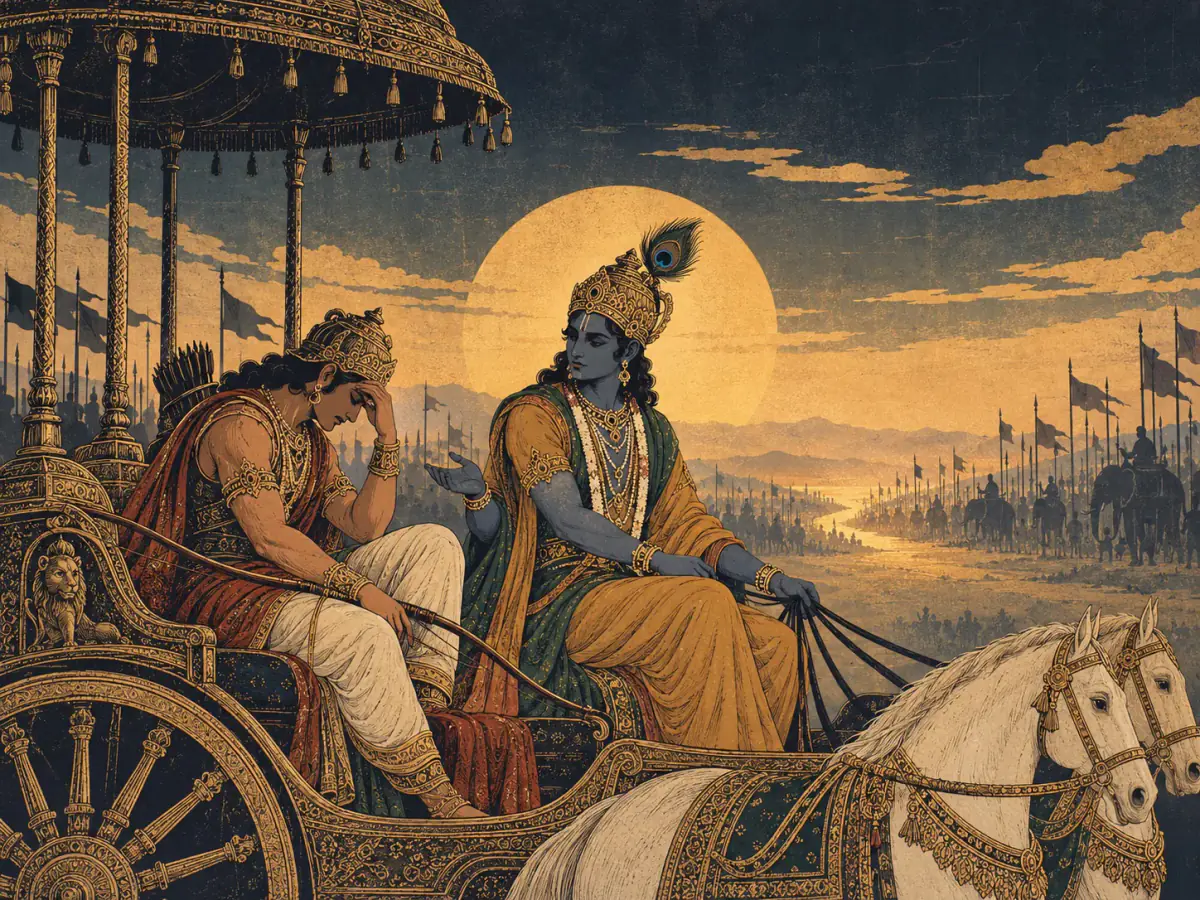
Essential preparation
Before the lesson begins
Start by checking the preparation from the previous guide. Then keep the passage and a place to record your reasoning ready.
Check the Previous Preparation
Preview: 1.28 to 46 and 2.1 to 10. Prepare a five-column table of Arjuna’s reasons for not fighting and one question about his surrender. Begin memorising 2.7.
The present guide includes the complete explanation you need, even if you did not complete the preview.
Know Before You Begin
- This guide retells and explains Bhagavad-gītā 1.28 to 46; 2.1 to 10 in order.
- No outside page is needed to understand the lesson.
- Important Sanskrit terms are explained where they appear.
Keep This Ready
- This complete guide on your screen.
- A notebook, paper, or notes app.
- A way to speak or type with a partner.
- No printed cards, book, or special materials are required.
What Will You Make?
- A correct map of the passage movement.
- A five-branch argument map and a two-sentence response that acknowledges concern before offering a based on the verses next step.
- A two-sentence counsel response
- A preparation plan for the next guide.
Reference and enrichment
See the complete passage before examining the details
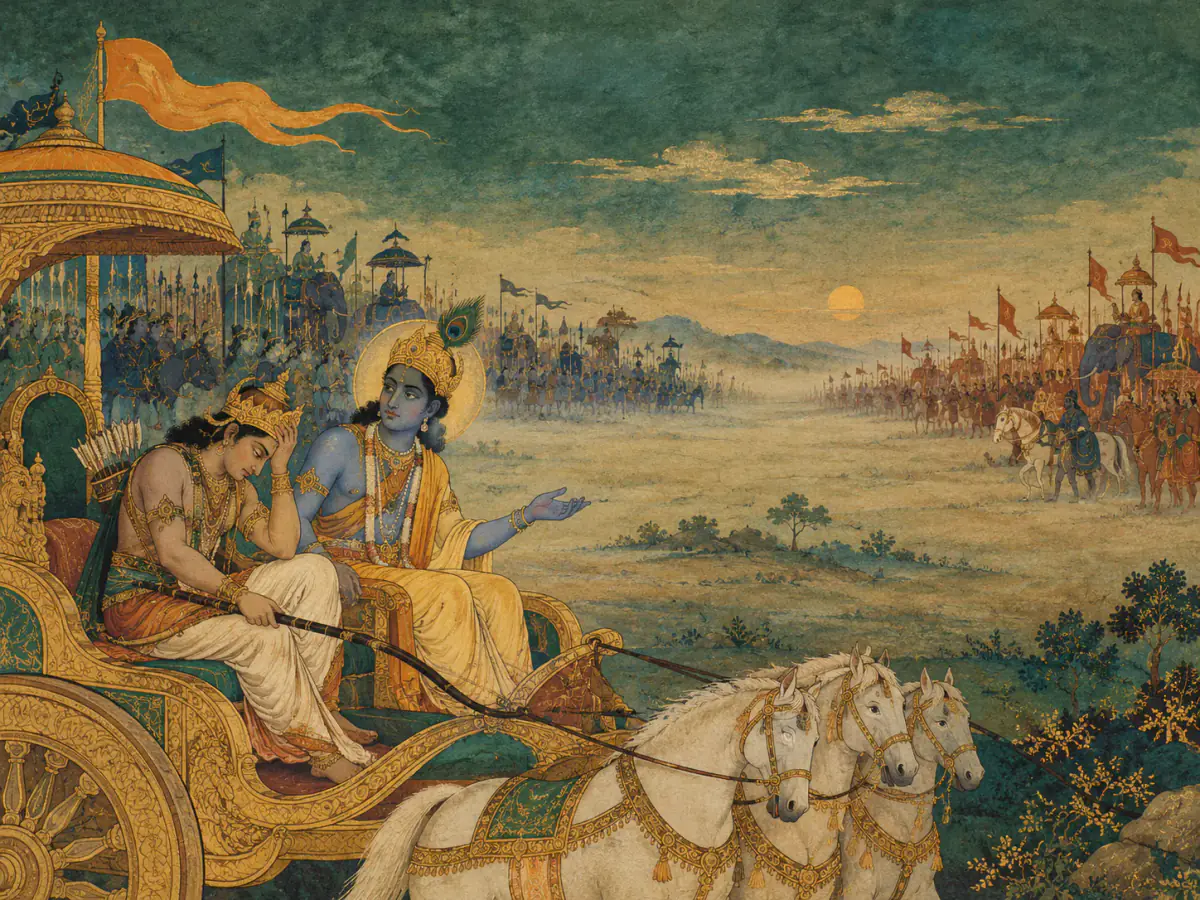
Learners need to distinguish compassion from confusion, trace Arjuna’s five reasons, and recognise why surrender to guidance from a proper teacher changes the conversation. The visual map below gives the movement first, so every later detail has a place.
- Classify Arjuna’s five reasons for not fighting and cite the verse range for each.
- Compare Kṛṣṇa’s initial response in 2.2 to 3 with Arjuna’s further doubts in 2.4 to 6 without caricaturing either speaker.
- Derive one responsibly bounded personal principle from 2.7 to 10 and state what the passage does not automatically justify.
Arjuna’s five-part argument
The branches are distinct reasons that grow from one central problem.
- 01Compassion
- 02Sinful reaction
- 03No enjoyment
- 04Family and society
- 05Uncertainty
Essential teaching in verse order
The verses move from the first point to the conclusion
Each section gives the verse range, its meaning in simple words, and the connection to the next part of Kṛṣṇa's answer.
The body registers the crisis
Arjuna describes weakness, trembling, dry mouth and a reeling mind. His distress is embodied and should be read before it is judged.
Arjuna's body reacts before he gives any argument. His shaking, weakness and dry mouth show that the crisis is real. But strong feelings alone cannot tell him what his duty is.
Five lines of thinking about what is right and wrong
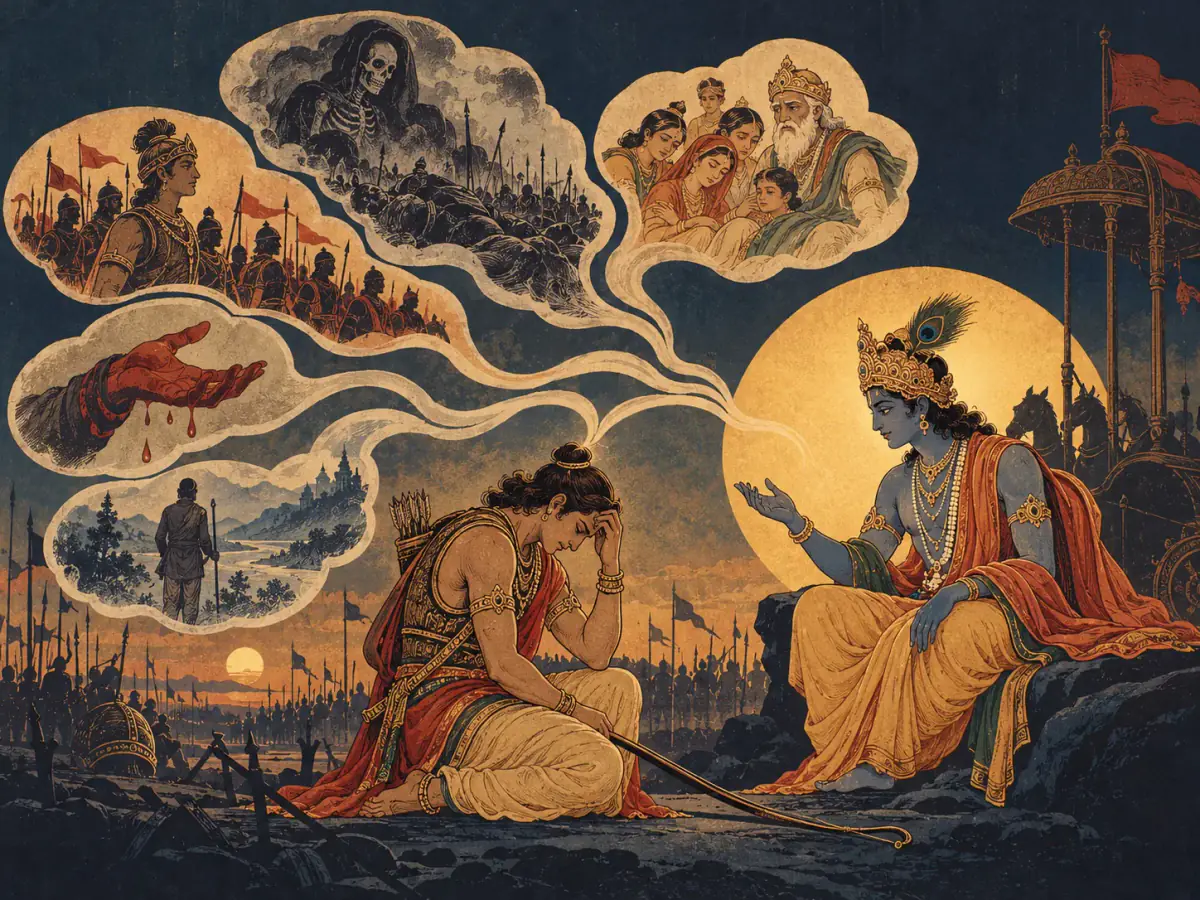
He argues from compassion, enjoyment, fear of sin, family destruction and effects on family and society. Some concerns are serious even though his conclusion remains incomplete.
Arjuna gives serious reasons for not fighting. He speaks about compassion, sin, family duty and harm to society. These concerns must be heard carefully, but his understanding is still incomplete because he has not yet understood the soul or Kṛṣṇa's instruction.
Challenge does not immediately resolve confusion
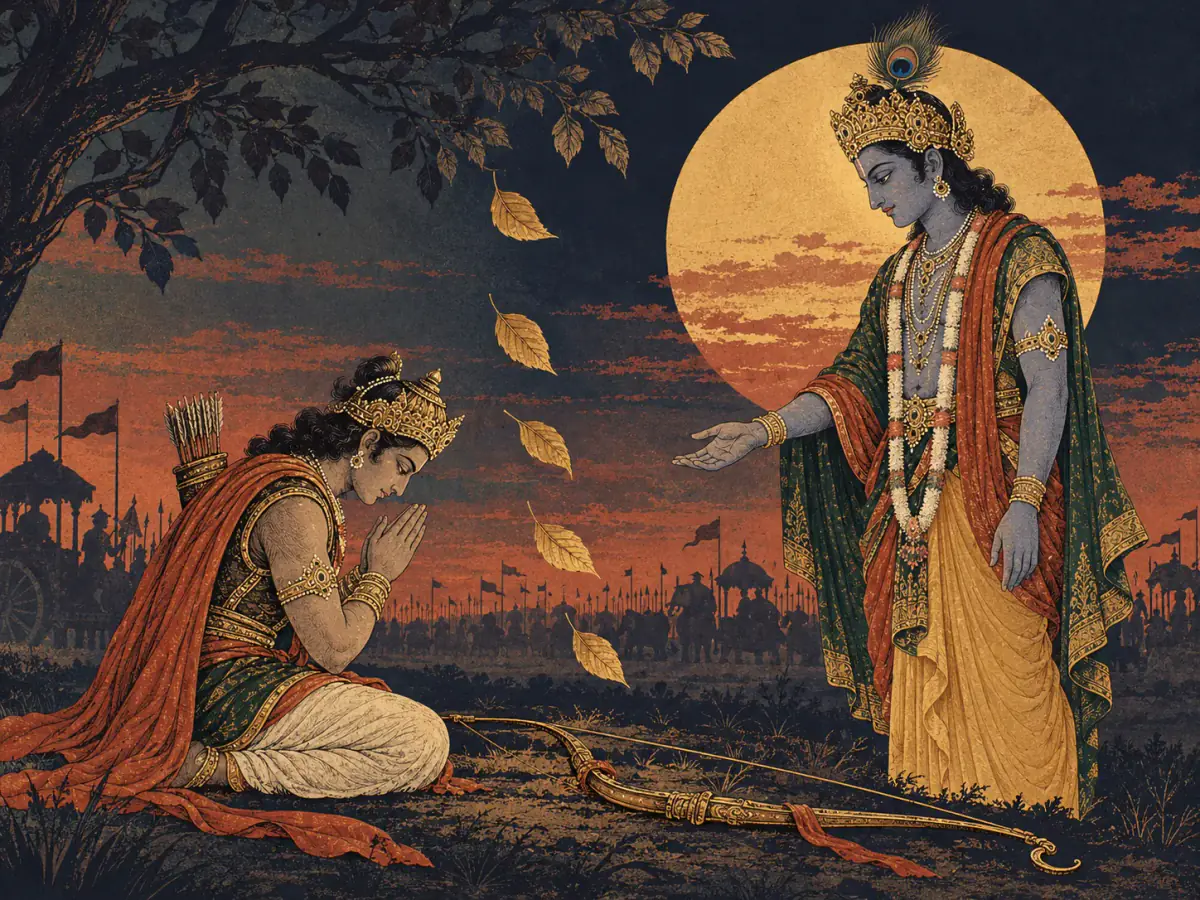
Kṛṣṇa calls Arjuna to rise, but Arjuna continues to weigh honour, violence and uncertainty. The dialogue does not pretend that a rebuke alone produces understanding.
Kṛṣṇa tells Arjuna to give up weakness and rise. Arjuna still cannot decide what is right. This shows that courage alone is not enough; he also needs clear spiritual knowledge.
Surrender creates a learning relationship
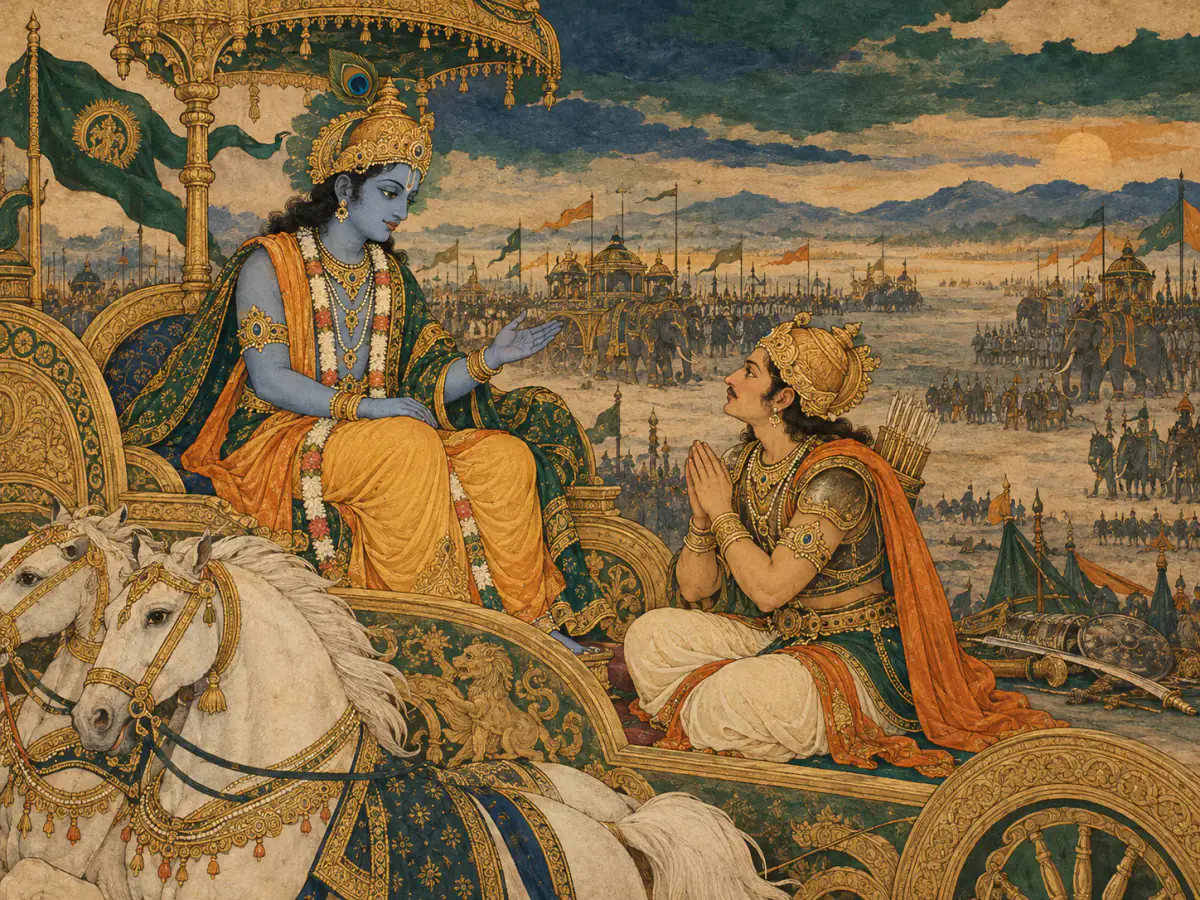
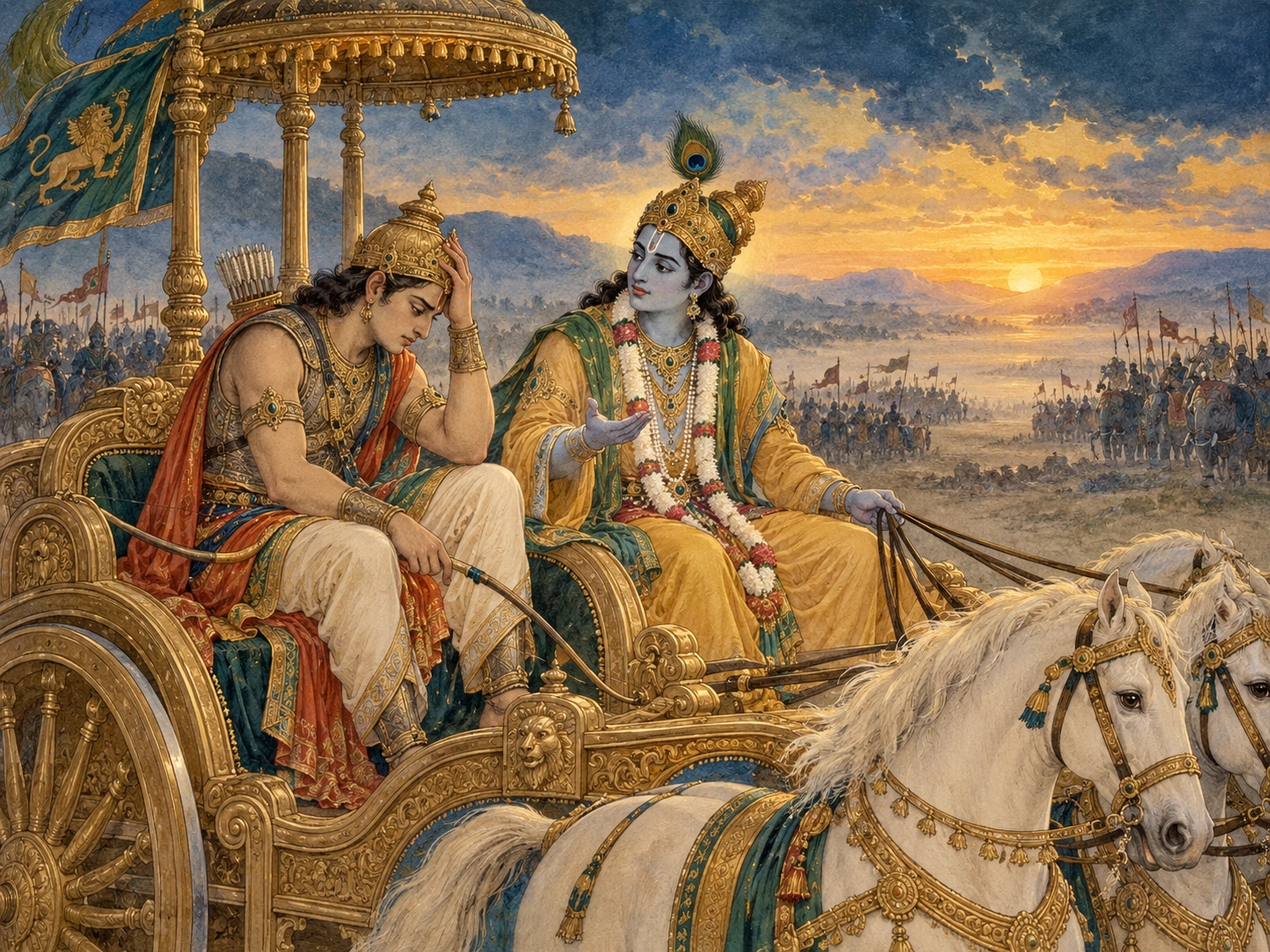
Arjuna names his dharma-confusion, asks what is truly beneficial and accepts instruction. The battlefield remains, but the mode of inquiry changes.
The main change happens in 2.7. Arjuna admits that he is confused, asks what is truly good for him and accepts Kṛṣṇa as his teacher. Now Kṛṣṇa can begin the main teaching of the Gītā.
Essential practice
Activity 1: Argument clinic: diagnose Arjuna's crisis
What needs to be doneClassify each statement, then write the question that would help Arjuna move from argument to teachability. Then use the on-site or online instructions, receive one specific response, and revise the answer or work that others can see and check.
PurposeSeparate bodily symptoms, compassion, reasons about what is right and wrong, indecision, and surrender instead of calling the whole crisis weakness.
SuccessA five-part diagnosis and one respectful next question
Stop whenThe product is complete, one verse point has been checked, and one improvement has been made from feedback.
If You Are Studying On-Site
- Classify alone first.
- Compare one disputed choice with a partner.
- Give the verse range that settled it.
- Revise one classification.
If You Are Studying Online
- Classify on your own screen.
- Share only one disputed choice in chat.
- Explain your verse anchor in one sentence.
- Revise before submitting.
- 01Notice
Classify each statement, then write the question that would help Arjuna move from argument to teachability.
- 02Explain
Separate bodily symptoms, compassion, moral arguments, indecision, and surrender instead of calling the whole crisis weakness.
- 03Improve
A five-part diagnosis and one respectful next question
Complete information bank
Complete verse guide for Bhagavad-gītā 1.28 to 46; 2.1 to 10
These blocks give the full movement, the purport meaning in simple words, the central terms and the deeper conclusion of every assigned section.
Every verse included in this lesson
The numbered markers give the complete assigned range. The explanations below tell the story, give the meaning, define the central ideas, and show how Kṛṣṇa's teaching develops from one movement to the next.
The body speaks
Arjuna describes trembling, weakness, dry mouth, and a mind that reels before the conflict.
Arjuna's soft heart is real, but compassion guided only by bodily relationship cannot yet settle his duty. The symptoms reveal the force of his identification and attachment.
The body speaks: the deeper meaning
Notice the order: Arjuna's body reacts before he gives a reason. The chapter first lets us see the strength of the crisis, then lets us examine the ideas he builds upon it.
The body announces the crisis before the argument begins. Symptoms now develops into Compassion.
Verses included here: 1.28, 1.29, 1.30.
No taste for victory
He questions victory, kingdom, and pleasure when those for whom they are desired stand before him.
Arjuna cannot imagine enjoyment apart from the people with whom he would share it. His reasoning exposes how material success depends on bodily and social identification.
No taste for victory: the deeper meaning
Arjuna addresses Kṛṣṇa through names connected with protection and relationship. His words show that he is not cold or selfish. His problem is that affection alone cannot yet show him the whole duty.
No loved ones, no taste for victory. Compassion now develops into Fear of sin.
Verses included here: 1.31, 1.32, 1.33, 1.34, 1.35.
Consequences feared
He argues from sin, family destruction, disorder in family and society, and damage across generations.
Arjuna moves from personal grief to sin, family tradition, social order, and future generations. The concerns widen, but he still reasons without a clear understanding of the eternal self and Kṛṣṇa's will.
Consequences feared: the deeper meaning
Arjuna's argument grows in circles. It begins with the people before him, then reaches sin, family tradition, society, and future generations. This widening shows both moral concern and increasing confusion.
The argument widens from family pain to social consequence. Fear of sin now develops into Effects on family and society.
Verses included here: 1.36, 1.37, 1.38, 1.39, 1.40, 1.41, 1.42, 1.43, 1.44.
Kṛṣṇa challenges
Kṛṣṇa rejects weakness and calls Arjuna to rise.
Kṛṣṇa rejects despair that presents itself as noble compassion. His challenge does not deny Arjuna's feelings; it denies that those feelings alone establish the right action.
Kṛṣṇa challenges: the deeper meaning
Kṛṣṇa does not begin the full philosophy immediately. He first challenges Arjuna's conclusion and asks him to rise. Arjuna's reply shows that encouragement without knowledge is still not enough.
Kṛṣṇa challenges the conclusion, not the fact of distress. Effects on family and society now develops into Indecision.
Verses included here: 2.2, 2.3.
The dilemma remains
Arjuna still cannot decide whether fighting or refusing would be better.
Arjuna answers Kṛṣṇa by naming the moral weight of fighting revered teachers. Unable to decide which outcome is better, he reaches the limit of argument based only on his present judgement.
The dilemma remains: the deeper meaning
Bhīṣma and Droṇa are both loved elders and military authorities. Arjuna so faces more than fear of injury. His roles as family member, student, warrior, and servant of dharma seem to pull in different directions.
Reverence and duty collide. Indecision now develops into Discipleship.
Verses included here: 2.4, 2.5, 2.6.
The learning relationship changes
Arjuna names his confusion, becomes a disciple, and asks for definite instruction.
The decisive change is relational. Arjuna admits that his own reasoning cannot determine śreyas, accepts Kṛṣṇa as guru, and asks for definite instruction.
The learning relationship changes: the deeper meaning
Verse 2.7 changes the kind of conversation. Arjuna stops defending a ready-made answer, names his confusion, asks what will truly help him, and becomes willing to be taught.
From defending a position to asking to be taught. Discipleship now develops into Symptoms.
Verses included here: 2.7.
The turn at 2.7
The middle steps explain how the starting condition becomes the concluding condition.
- 01I argue
- 02I name confusion
- 03I ask what is best
- 04I become a disciple
- 05I listen
Arjuna's argument under examination
Compare the columns. The important point is how the ideas differ and how they work together.
- 01What he feels
- 02What he fears
- 03What he predicts
- 04What he cannot yet decide
The complete lesson on one screen
Each row joins a verse range to its movement, central terms and main conclusion. The full explanation appears directly above the chart.
| Verse range | Movement | Key terms | Memory cue |
|---|---|---|---|
| 1.28 to 30 | The body speaks | kampate, roma-harṣa, gāṇḍīva, bodily symptoms | The body announces the crisis before the argument begins. |
| 1.31 to 35 | No taste for victory | Govinda, Madhusūdana, kingdom, enjoyment, relationship | No loved ones, no taste for victory. |
| 1.36 to 44 | Consequences feared | ātatāyī, pāpa, kula-dharma, varṇa-saṅkara, ancestral duty | The argument widens from family pain to social consequence. |
| 2.2 to 3 | Kṛṣṇa challenges | Bhagavān, anārya, klaibya, hṛdaya-daurbalya | Kṛṣṇa challenges the conclusion, not the fact of distress. |
| 2.4 to 6 | The dilemma remains | Bhīṣma, Droṇa, worshipable elders, victory or defeat | Reverence and duty collide. |
| 2.7 | The learning relationship changes | kārpaṇya-doṣa, dharma-sammūḍha, śiṣya, prapanna | From defending a position to asking to be taught. |
Why this verse guide comes between the two activities
The first activity helps you remember the order. This section gives the full meaning of the verses in simple words. The second activity then helps you explain and use what you have learnt. The pattern is explanation, practice, more explanation, and more practice.
Essential practice
Activity 2: Counsel clinic
What needs to be doneRespond to a fictional dilemma in two sentences. First acknowledge the concern. Then offer one text-grounded next question without silencing distress.
PurposePractise the lesson's central relationship by producing something that can be checked and improved.
SuccessComplete a two-sentence counsel response and connect it to at least one passage or visual map.
Stop whenYou can explain how the product changed after the discussion: Did the response preserve both compassion and responsibility?
Listen
Begin with the exact situation or claim in the task.
Paraphrase
Connect this move to the passage, not only to a personal reaction.
Anchor
Connect this move to the passage, not only to a personal reaction.
Invite inquiry
Finish with a response that can be explained and improved.
If You Are Studying On-Site
- Make your own first draft.
- Explain it to one partner. Your partner checks whether the verse point and your reason are clear.
- Receive one clear question or correction.
- Improve the product before the class discussion.
If You Are Studying Online
- Write the first draft in the response box or in your own notes.
- Share only the part you want checked in chat or a breakout room.
- Use the checklist after your partner has heard your verse point and reason.
- Improve one sentence and say what you changed.
Build the product one move at a time
Each box corresponds to one step in this lesson's activity. Write enough that another reader could understand your reasoning without hearing an extra explanation.
Use this self-check before you finish
Expected product: A two-sentence counsel response
Debrief this activity
Did the response preserve both compassion and responsibility?
Reference and enrichment
Use the visual summary to check your explanation
The map below helps you compare your answer with the reasoning and conclusion of the verses.
A clear path through confusion
Read from left to right. Each step creates the condition for the next.
- 01Name the conflict
- 02State the reasons
- 03Admit the limit
- 04Seek guidance from a proper teacher
- 05Listen before concluding
Pause and decide
Quick check: is the main idea clear?
Why this check is here: the next lesson will build on this idea, so you should be able to explain it in your own words.
What your answer tells you
Proceed when learners can explain that surrender changes the learning relationship even though the external problem remains. If you are not sure, use the explanation and visual map directly above. Say why each of the other options does not fit the meaning explained on this page, then try again.
- 01The body speaks
Arjuna describes trembling, weakness, dry mouth, and a mind that reels before the conflict.
- 02Kṛṣṇa challenges
Kṛṣṇa rejects weakness and calls Arjuna to rise.
- 03The learning relationship changes
Arjuna names his confusion, becomes a disciple, and asks for definite instruction.
Reference and enrichment
Common misunderstandings and clear answers
These short answers show where a correct idea is sometimes used in the wrong way.
Distress is not the whole diagnosis
Arjuna's feelings are real, while Kṛṣṇa will examine the assumptions and identity beneath them.
Full explanation: Arjuna's soft heart is real, but compassion guided only by bodily relationship cannot yet settle his duty. The symptoms reveal the force of his identification and attachment. Notice the order: Arjuna's body reacts before he gives a reason. The chapter first lets us see the strength of the crisis, then lets us examine the ideas he builds upon it.
Surrender is not passive avoidance
Arjuna asks for guidance so that he can understand clearly and act, not so that responsibility disappears.
Full explanation: Arjuna cannot imagine enjoyment apart from the people with whom he would share it. His reasoning exposes how material success depends on bodily and social identification. Arjuna addresses Kṛṣṇa through names connected with protection and relationship. His words show that he is not cold or selfish. His problem is that affection alone cannot yet show him the whole duty.
- 01Distress is not the whole diagnosis
Arjuna's feelings are real, while Kṛṣṇa will examine the assumptions and identity beneath them.
- 02Surrender is not passive avoidance
Arjuna asks for guidance so that he can discern and act, not so that responsibility disappears.
Essential summary
The complete lesson in clear statements
- 01
Arjuna's crisis includes physical, emotional, moral and social dimensions.
- 02
His arguments deserve accurate hearing even when their conclusion is challenged.
- 03
Kṛṣṇa distinguishes compassion from weakness rooted in misidentification.
- 04
Verse 2.7 marks the transition from debate to discipleship.
- 05
Surrender begins responsible learning; it does not erase the difficult decision.
Do not leave without this
Prepare for the next lesson
2.11 to 30. The next guide will retell and explain this full section, so this preview is preparation rather than a missing part of the present lesson.
A two-sentence counsel response. Keep the revised version for later retrieval.
Build a one-page ‘body changes / self continues’ explanation using 2.13, 2.20, and 2.22. Continue 2.7 and start 2.13.
Bring one question that arose from the verse guide, one point you can explain confidently, and one point that still needs checking.
- 01Remember
Surrender begins responsible learning; it does not erase the difficult decision.
- 02Keep
A two-sentence counsel response
- 03Continue
Bhagavad-gītā 2.11 to 30: The Eternal Self, Reincarnation and Change
Interactive self-check
How deeply do you want to check your understanding?
Choose 10, 20, or 30 questions. You will see one question at a time. Submit an answer, study the explanation and its on-page reference, then continue. A correct answer brings a small celebration.