Bhagavad-gītā Chapters 1 to 6 Part 03 of 12
Bhagavad-gītā 2.11 to 30: The Eternal Self, Reincarnation and Change
Bhagavad-gītā 2.11 to 30
What changes, what continues, and who is the witness of change?
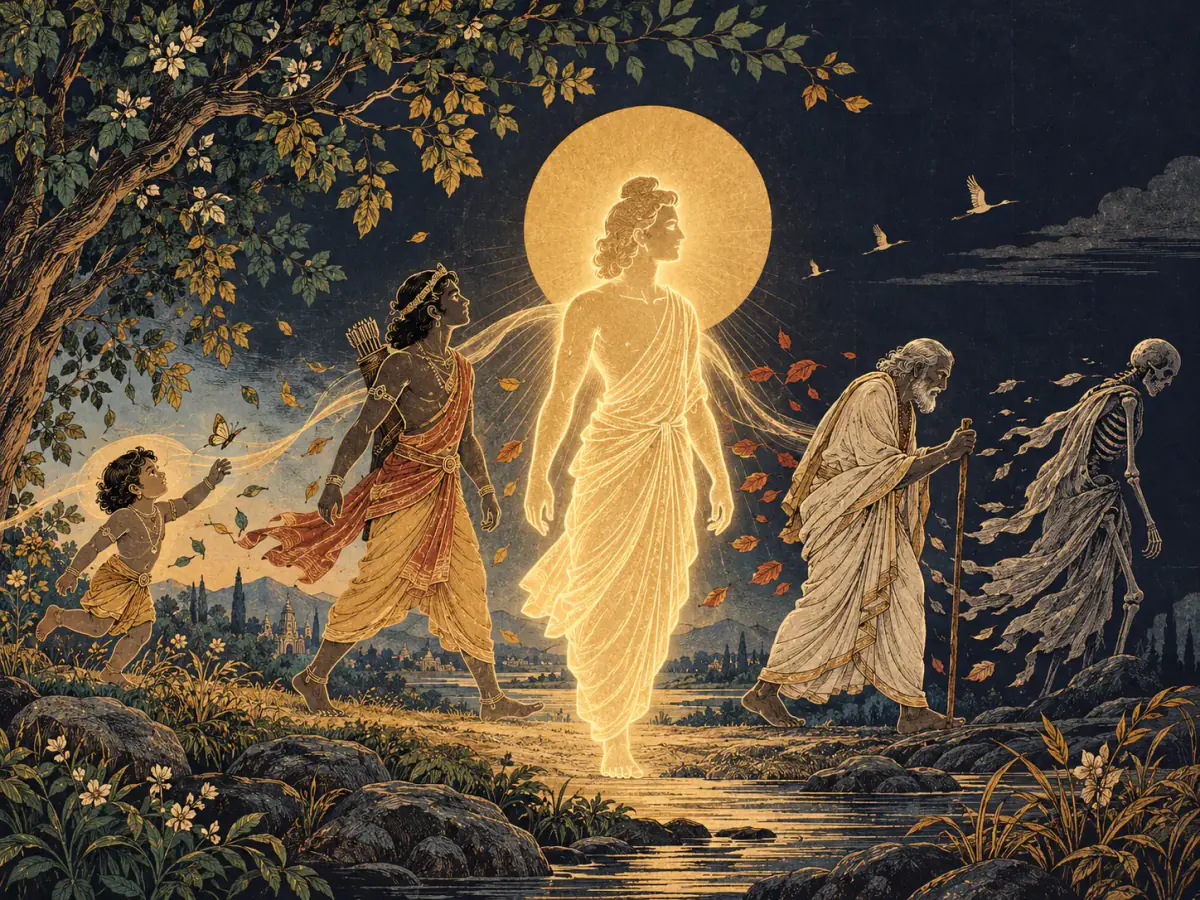
Essential preparation
Before the lesson begins
Start by checking the preparation from the previous guide. Then keep the passage and a place to record your reasoning ready.
Check the Previous Preparation
Preview: 2.11 to 30. Build a one-page ‘body changes / self continues’ explanation using 2.13, 2.20, and 2.22. Continue 2.7 and start 2.13.
The present guide includes the complete explanation you need, even if you did not complete the preview.
Know Before You Begin
- This guide retells and explains Bhagavad-gītā 2.11 to 30 in order.
- No outside page is needed to understand the lesson.
- Important Sanskrit terms are explained where they appear.
Keep This Ready
- This complete guide on your screen.
- A notebook, paper, or notes app.
- A way to speak or type with a partner.
- No printed cards, book, or special materials are required.
What Will You Make?
- A correct map of the passage movement.
- A revised concise explanation plus a one-sentence pastoral boundary.
- A concise explanation and one careful boundary sentence
- A preparation plan for the next guide.
Reference and enrichment
See the complete passage before examining the details
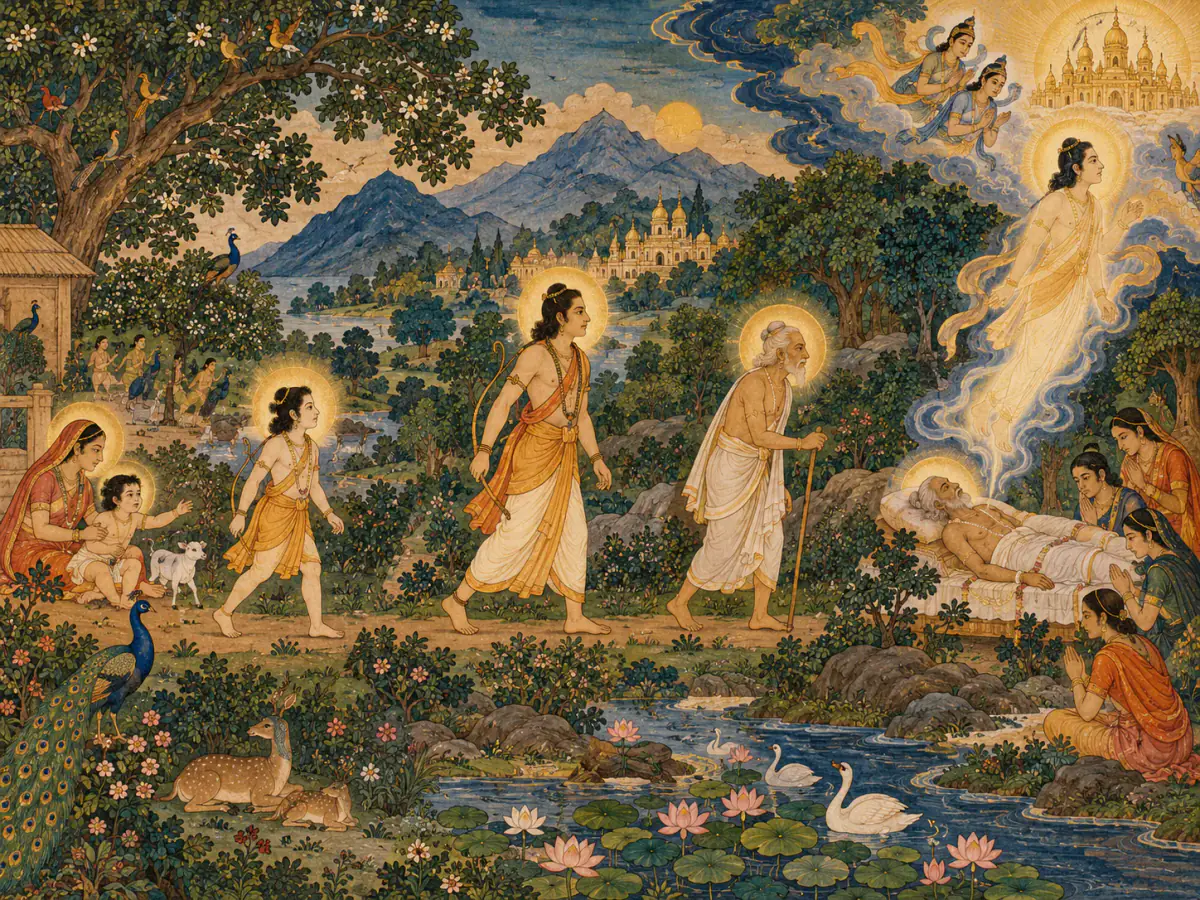
Learners need a coherent explanation of the difference between body and self, supported by verses and analogies, while avoiding careless application around grief or violence. The visual map below gives the movement first, so every later detail has a place.
- Explain transmigration using 2.13 and 2.22 with one accurate analogy and one stated limit of the analogy.
- Use 2.12, 2.17, and 2.20 to 24 to defend the individuality and continuity of the self in a concise explanation.
- Respond to a sensitive question about grief or violence with textual accuracy, compassion, and clear scope limits.
Change and continuity
Read from left to right. Each step creates the condition for the next.
- 01Child body
- 02Youth body
- 03Older body
- 04Another body
- 05Same conscious self
Essential teaching in verse order
The verses move from the first point to the conclusion
Each section gives the verse range, its meaning in simple words, and the connection to the next part of Kṛṣṇa's answer.

Wisdom begins with the right subject
Kṛṣṇa challenges lamentation grounded in the belief that I am only this body and teaches that Kṛṣṇa, Arjuna and all the people on the battlefield continue to exist as individuals.
Kṛṣṇa begins by correcting Arjuna's idea of the person. The body changes and dies, but the individual soul continues. Kṛṣṇa, Arjuna and all the kings remain individual persons.
Continuity through visible change
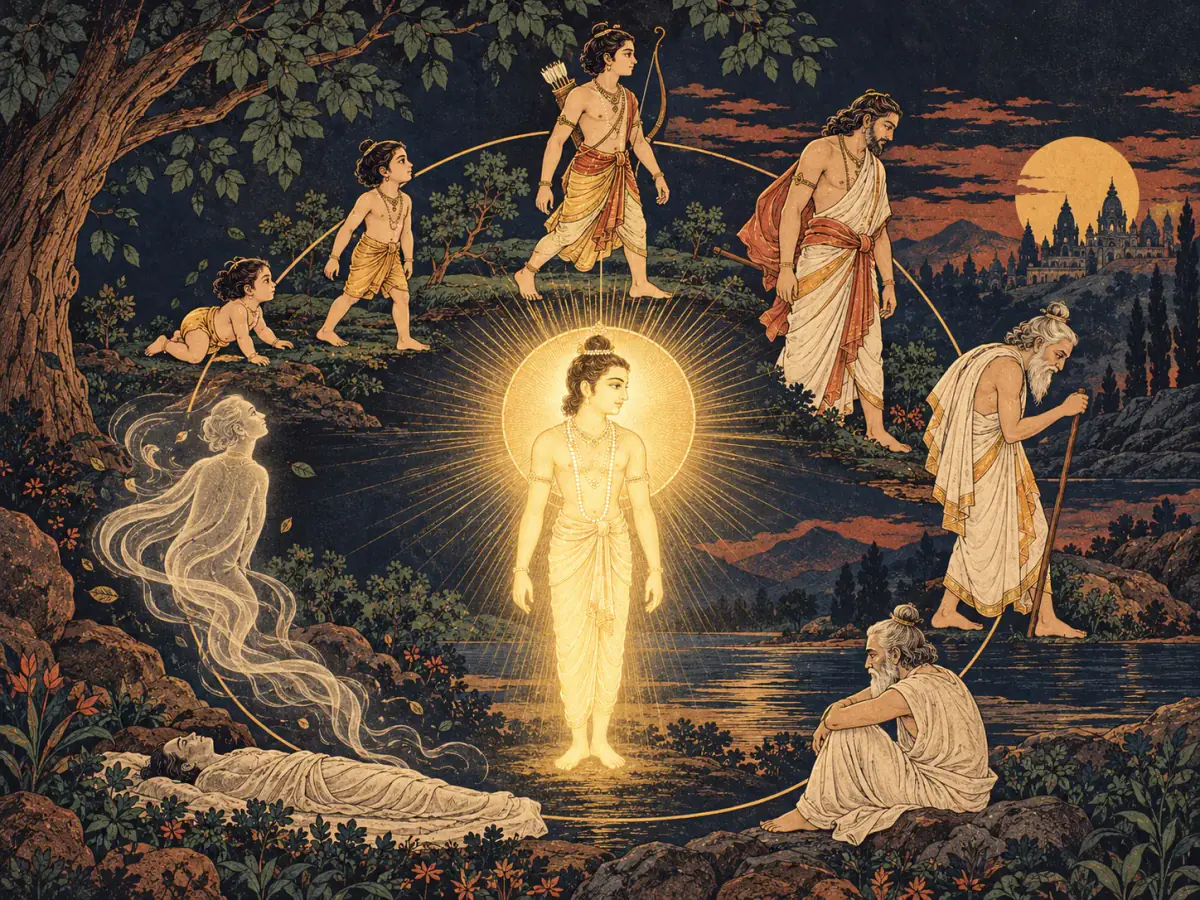
The body passes through childhood, youth and age while the soul living in the body continues. The familiar sequence prepares the mind to understand a further change of body.
We remain the same person while the body changes from childhood to youth and old age. In the same way, the soul continues when it receives another body. A wise person understands this change without losing clear judgement.
Temporary sensations call for tolerance
Pleasure and pain arise through contact and pass like seasons. Tolerance here supports clear duty, not neglect of harm that can be avoided.
Heat and cold, pleasure and pain come when the senses meet the world. They do not stay forever. Tolerance means remaining steady and doing the right thing while they pass; it does not mean ignoring pain or avoidable harm.
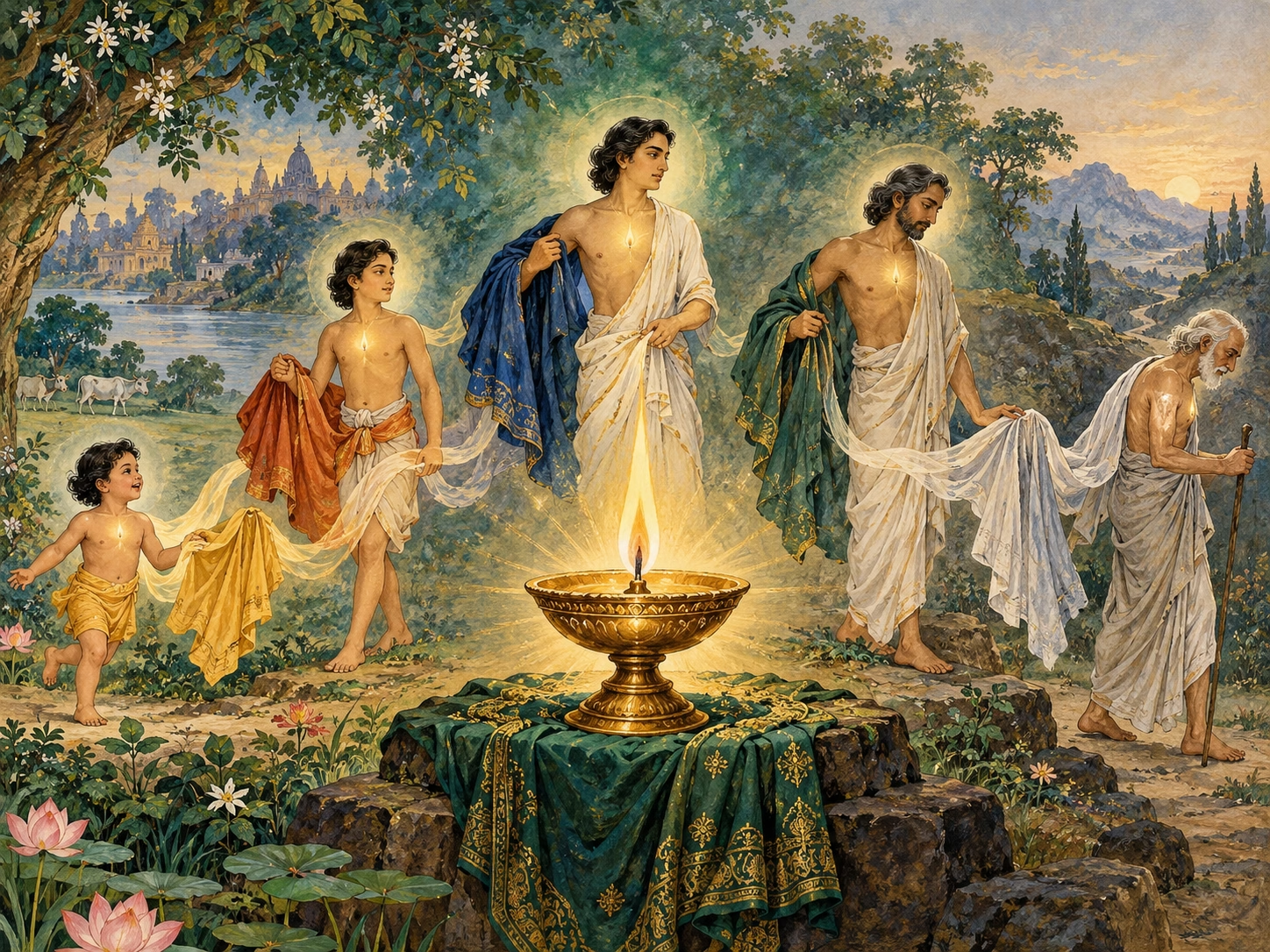
The self is not a material object
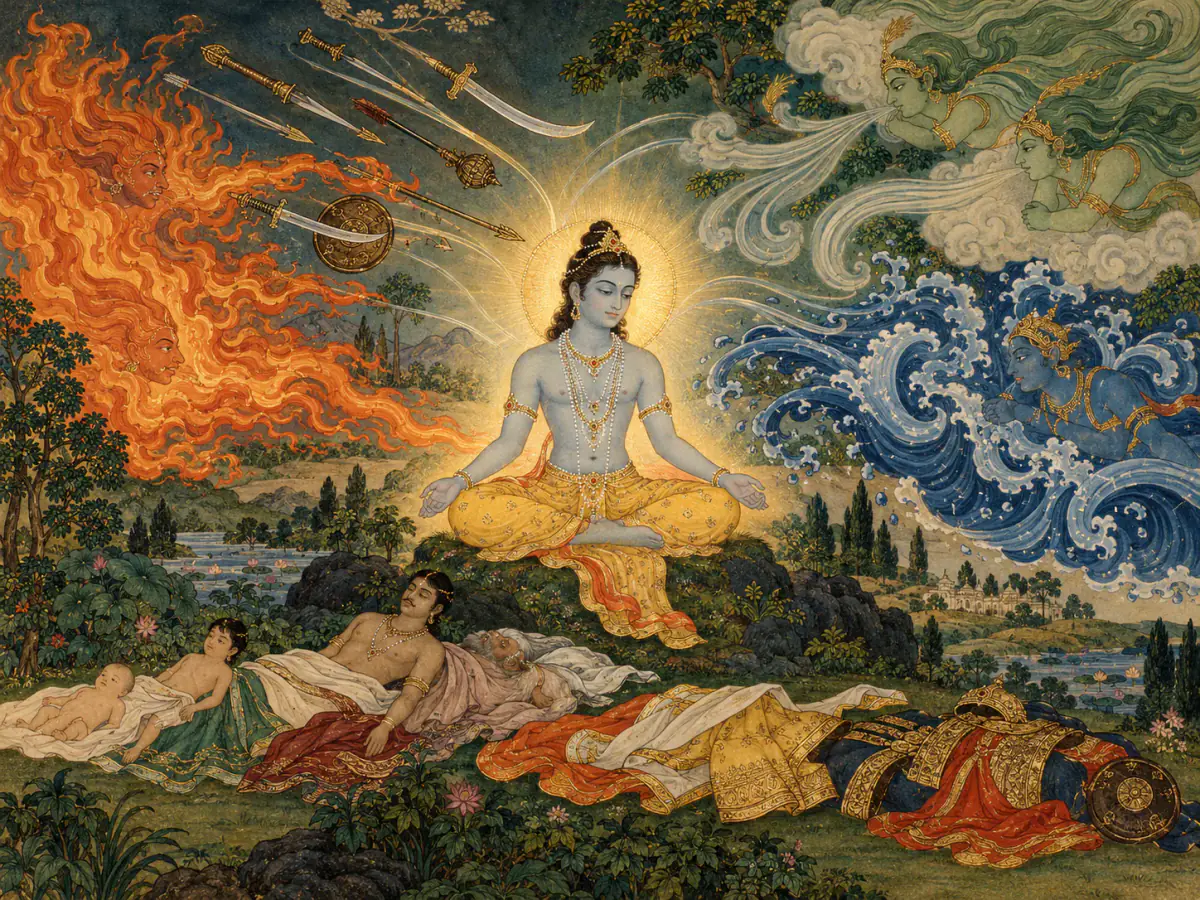
The self pervades the body through consciousness and is described as unborn, eternal and unable to be harmed by material things. These points work together and cannot be explained by one analogy alone.
The soul is not made of matter. Weapons cannot cut it, fire cannot burn it, water cannot wet it and wind cannot dry it. The body can be harmed, but the soul itself is unborn, eternal and cannot be destroyed.
Essential practice
Activity 1: Analogy practice: body, self, and the limit of comparison
What needs to be doneComplete the analogy chart, identify what continues, and state one limit of each comparison. Then use the on-site or online instructions, receive one specific response, and revise the answer or work that others can see and check.
PurposeUse the childhood and garments analogies accurately without making them prove more than the passage claims.
SuccessTwo accurate analogy cards with limits
Stop whenThe product is complete, one verse point has been checked, and one improvement has been made from feedback.
If You Are Studying On-Site
- Draft both cards alone.
- Exchange one card with a partner.
- Underline the claim and circle the limit.
- Revise any overstatement.
If You Are Studying Online
- Write both cards in the fields.
- Paste one claim and its limit in chat.
- Ask a partner what the analogy does not prove.
- Revise one sentence.
- 01Notice
Complete the analogy chart, identify what continues, and state one limit of each comparison.
- 02Explain
Use the childhood and garments analogies accurately without making them prove more than the passage claims.
- 03Improve
Two accurate analogy cards with limits
Complete information bank
Complete verse guide for Bhagavad-gītā 2.11 to 30
These blocks give the full movement, the purport meaning in simple words, the central terms and the deeper conclusion of every assigned section.
Every verse included in this lesson
The numbered markers give the complete assigned range. The explanations below tell the story, give the meaning, define the central ideas, and show how Kṛṣṇa's teaching develops from one movement to the next.
Wisdom begins
Kṛṣṇa distinguishes wise vision from lamentation and teaches that every person continues to exist as an individual.
Kṛṣṇa begins by correcting the subject of Arjuna's grief. Wise analysis starts with the continuing individual persons, not with the temporary body alone.
Wisdom begins: the deeper meaning
Kṛṣṇa begins with continuing persons, not an unnamed spiritual substance. His statement includes Himself, Arjuna, and all the kings. Individuality is present before, during, and after the bodily event.
Before asking what to do, ask who the person is. Childhood now develops into Youth.
Verses included here: 2.11, 2.12.
Change of body
The self remains through childhood, youth, age, and the passage to another body.
Visible bodily changes within one life provide a bridge for understanding another change of body. The sober person is not bewildered because the soul living in the body continues.
Change of body: the deeper meaning
The childhood example uses a change we have already lived through. We did not become a different self each time the body changed. Kṛṣṇa uses this familiar continuity to prepare us for a less visible change of body.
Different bodies, continuing soul living in the body. Youth now develops into Age.
Verses included here: 2.13.
Temporary contact
Pleasure and pain arise and pass through sense contact, calling for steady tolerance.
Sense contact produces temporary dualities. Tolerance means preserving clear spiritual purpose while they pass, not ignoring harm that can be avoided or refusing compassionate care.
Temporary contact: the deeper meaning
Tolerance stands between knowledge and duty. It prevents temporary comfort or pain from becoming the only guide for action. It is so active steadiness, not silent neglect of suffering.
Temporary contact calls for steady tolerance. Age now develops into Death.
Verses included here: 2.14, 2.15.
The indestructible self
The self pervades the body, is unborn and eternal, and is not destroyed with the body.
The self is not a material product and cannot be destroyed by the destruction of the body. Consciousness pervading the body indicates the presence of the individual self.
The indestructible self: the deeper meaning
The verses give two related teachings. The self pervades the body through consciousness, and the self does not begin or end with the body. One point concerns presence; the other concerns eternal nature.
The body can be injured; the self is not destroyed. Death now develops into Another body.
Verses included here: 2.17, 2.18, 2.19, 2.20.
Garments
Changing bodies is compared to changing worn garments for new ones.
The garment image clarifies the self's change of body. Its job is limited: it illustrates continuity through exchange and does not by itself explain every feature of karma, memory, or divine guidance.
Garments: the deeper meaning
The garment image explains exchange and continuity. It does not say that bodies are worthless or that grief should disappear at once. An analogy becomes safe when we know both its use and its limit.
The wearer is not the garment. Another body now develops into The self continues.
Verses included here: 2.22.
Beyond material damage
No material element can cut, burn, wet, or dry the self, and the soul living in the body is always unable to be harmed.
A sequence of material forces is denied power over the self. Kṛṣṇa also argues that even alternative views of repeated birth and death do not justify paralysing lamentation.
Beyond material damage: the deeper meaning
Kṛṣṇa names cutting, burning, wetting, and drying because these are material ways of changing objects. The repeated denial makes one point clear: the self is not another material object hidden inside the body.
No material element reaches the self. The self continues now develops into Childhood.
Verses included here: 2.23, 2.24, 2.25, 2.26, 2.27, 2.28, 2.29, 2.30.
Three truths to keep distinct
Keep all three truths together. Removing one distorts the relationship.
- 01Body changes
- 02Individual self continues
- 03Supreme guides and teaches
Body and self: keep the claims distinct
Compare the columns. The important point is how the ideas differ and how they work together.
- 01Body: changing
- 02Self: continuing
- 03Sensation: temporary
- 04Consciousness: symptom of the self
The complete lesson on one screen
Each row joins a verse range to its movement, central terms and main conclusion. The full explanation appears directly above the chart.
| Verse range | Movement | Key terms | Memory cue |
|---|---|---|---|
| 2.11 to 12 | Wisdom begins | paṇḍita, lamentation, individuality, past and future | Before asking what to do, ask who the person is. |
| 2.13 | Change of body | dehin, kaumāra, yauvana, jarā, dehāntara | Different bodies, continuing soul living in the body. |
| 2.14 to 15 | Temporary contact | mātrā-sparśa, heat and cold, pleasure and pain, titikṣā | Temporary contact calls for steady tolerance. |
| 2.17 to 20 | The indestructible self | sat, asat, avināśi, unborn, eternal, indestructible | The body can be injured; the self is not destroyed. |
| 2.22 | Garments | vāsāṁsi, worn garments, new garments, dehī | The wearer is not the garment. |
| 2.23 to 30 | Beyond material damage | weapons, fire, water, wind, acintya, avikārya | No material element reaches the self. |
Why this verse guide comes between the two activities
The first activity helps you remember the order. This section gives the full meaning of the verses in simple words. The second activity then helps you explain and use what you have learnt. The pattern is explanation, practice, more explanation, and more practice.
Essential practice
Activity 2: Three-minute identity explanation
What needs to be doneExplain the difference between body and self to a sincere newcomer using three verse anchors and one analogy with its limit.
PurposePractise the lesson's central relationship by producing something that can be checked and improved.
SuccessComplete a concise explanation and one careful boundary sentence and connect it to at least one passage or visual map.
Stop whenYou can explain how the product changed after the discussion: Where might a true doctrine be used without compassion? Revise that sentence.
State the claim
Begin with the exact situation or claim in the task.
Anchor it
Connect this move to the passage, not only to a personal reaction.
Use one analogy
Connect this move to the passage, not only to a personal reaction.
Name the analogy’s limit
Finish with a response that can be explained and improved.
If You Are Studying On-Site
- Make your own first draft.
- Explain it to one partner. Your partner checks whether the verse point and your reason are clear.
- Receive one clear question or correction.
- Improve the product before the class discussion.
If You Are Studying Online
- Write the first draft in the response box or in your own notes.
- Share only the part you want checked in chat or a breakout room.
- Use the checklist after your partner has heard your verse point and reason.
- Improve one sentence and say what you changed.
Build the product one move at a time
Each box corresponds to one step in this lesson's activity. Write enough that another reader could understand your reasoning without hearing an extra explanation.
Use this self-check before you finish
Expected product: A concise explanation and one careful boundary sentence
Debrief this activity
Where might a true doctrine be used without compassion? Revise that sentence.
Reference and enrichment
Use the visual summary to check your explanation
The map below helps you compare your answer with the reasoning and conclusion of the verses.
How the argument develops
Read from left to right. Each step creates the condition for the next.
- 01Individuality
- 02Change within life
- 03Temporary sensation
- 04Indestructible self
- 05No material weapon reaches the self
Pause and decide
Quick check: is the main idea clear?
Why this check is here: the next lesson will build on this idea, so you should be able to explain it in your own words.
What your answer tells you
Proceed when learners select the second option and can state that an analogy supports a relationship, not every doctrinal conclusion. If you are not sure, use the explanation and visual map directly above. Say why each of the other options does not fit the meaning explained on this page, then try again.
- 01Wisdom begins
Kṛṣṇa distinguishes wise vision from lamentation and affirms the continuing individuality of all persons.
- 02The indestructible self
The self pervades the body, is unborn and eternal, and is not destroyed with the body.
- 03Beyond material damage
No material element can cut, burn, wet, or dry the self, and the embodied self is always inviolable.
Reference and enrichment
Common misunderstandings and clear answers
These short answers show where a correct idea is sometimes used in the wrong way.
Eternal self does not trivialise grief
Spiritual teaching should be communicated with compassion and never used to silence a grieving person.
Full explanation: Kṛṣṇa begins by correcting the subject of Arjuna's grief. Wise analysis starts with the continuing individual persons, not with the temporary body alone. Kṛṣṇa begins with continuing persons, not an unnamed spiritual substance. His statement includes Himself, Arjuna, and all the kings. Individuality is present before, during, and after the bodily event.
An analogy has a defined job
Garments illustrate change of body; they do not by themselves establish every truth about soul, God or duty.
Full explanation: Visible bodily changes within one life provide a bridge for understanding another change of body. The sober person is not bewildered because the soul living in the body continues. The childhood example uses a change we have already lived through. We did not become a different self each time the body changed. Kṛṣṇa uses this familiar continuity to prepare us for a less visible change of body.
- 01Eternal self does not trivialise grief
Metaphysical teaching should be communicated with compassion and never used to silence a grieving person.
- 02An analogy has a defined job
Garments illustrate change of body; they do not by themselves establish every truth about soul, God or duty.
Essential summary
The complete lesson in clear statements
- 01
Kṛṣṇa begins instruction by distinguishing the self from the body.
- 02
Verse 2.13 links changes within one life to the transition to another body.
- 03
Tolerance means steady clear understanding during temporary sensation.
- 04
Consciousness is presented as evidence of the soul's presence throughout the body.
- 05
Scriptural analogies illuminate one relationship and must not be stretched beyond it.
Do not leave without this
Prepare for the next lesson
2.31 to 53. The next guide will retell and explain this full section, so this preview is preparation rather than a missing part of the present lesson.
A concise explanation and one careful boundary sentence. Keep the revised version for later retrieval.
Mark the shifts from jñāna to duty, karma-kāṇḍa, and buddhi-yoga. Memorise 2.20 and review 2.7, 2.13.
Bring one question that arose from the verse guide, one point you can explain confidently, and one point that still needs checking.
- 01Remember
Scriptural analogies illuminate one relationship and must not be stretched beyond it.
- 02Keep
A three-minute explanation and one careful boundary sentence
- 03Continue
Bhagavad-gītā 2.31 to 53: Duty, Karma-yoga and Focused Intelligence
Interactive self-check
How deeply do you want to check your understanding?
Choose 10, 20, or 30 questions. You will see one question at a time. Submit an answer, study the explanation and its on-page reference, then continue. A correct answer brings a small celebration.