From Navadvīpa outward
Śrī Chaitanya was born in Māyāpur within Navadvīpa in February 1486, on the full-moon evening of Phālguna. His parents were Jagannātha Miśra and Śacī Devī. Known in his youth as Nimāi, he became a celebrated scholar before revealing the devotional life for which he is remembered.
He gathered companions for kīrtana, accepted sannyāsa, travelled through India, and spent his later years in Jagannātha Purī. His life joined rigorous theological understanding with an intense, vulnerable longing for Kṛṣṇa.
The movement outward began with a transformation inward. The brilliant young scholar became absorbed in the holy name, and learning that once established distinction became an instrument of devotion.
Born in the sacred landscape of Navadvīpa.
Known as Nimāi, a gifted scholar and teacher.
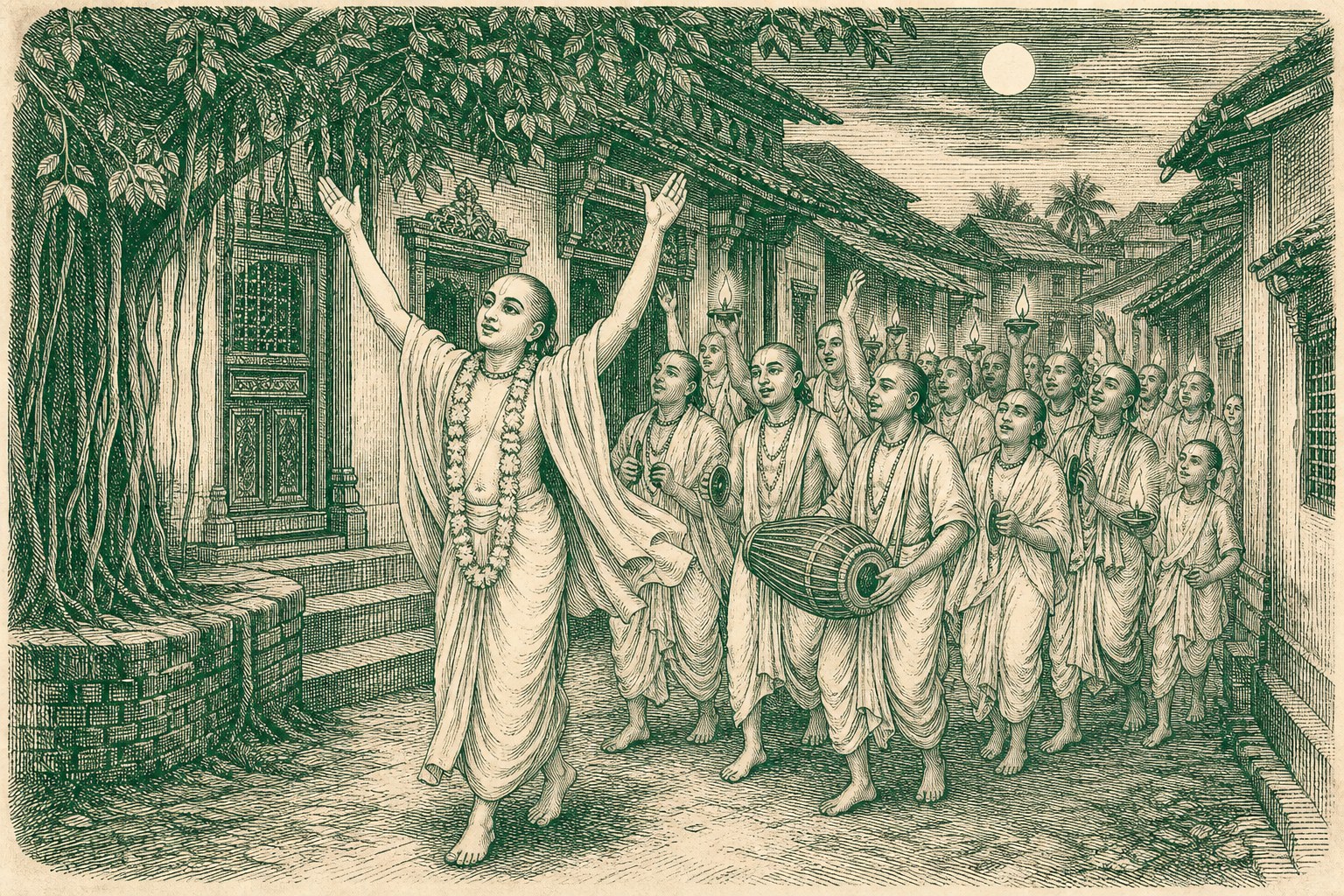
Gathered devotees for congregational chanting.
Accepted the renounced order and travelled widely.
Spent his later years in deep devotion near Jagannātha.
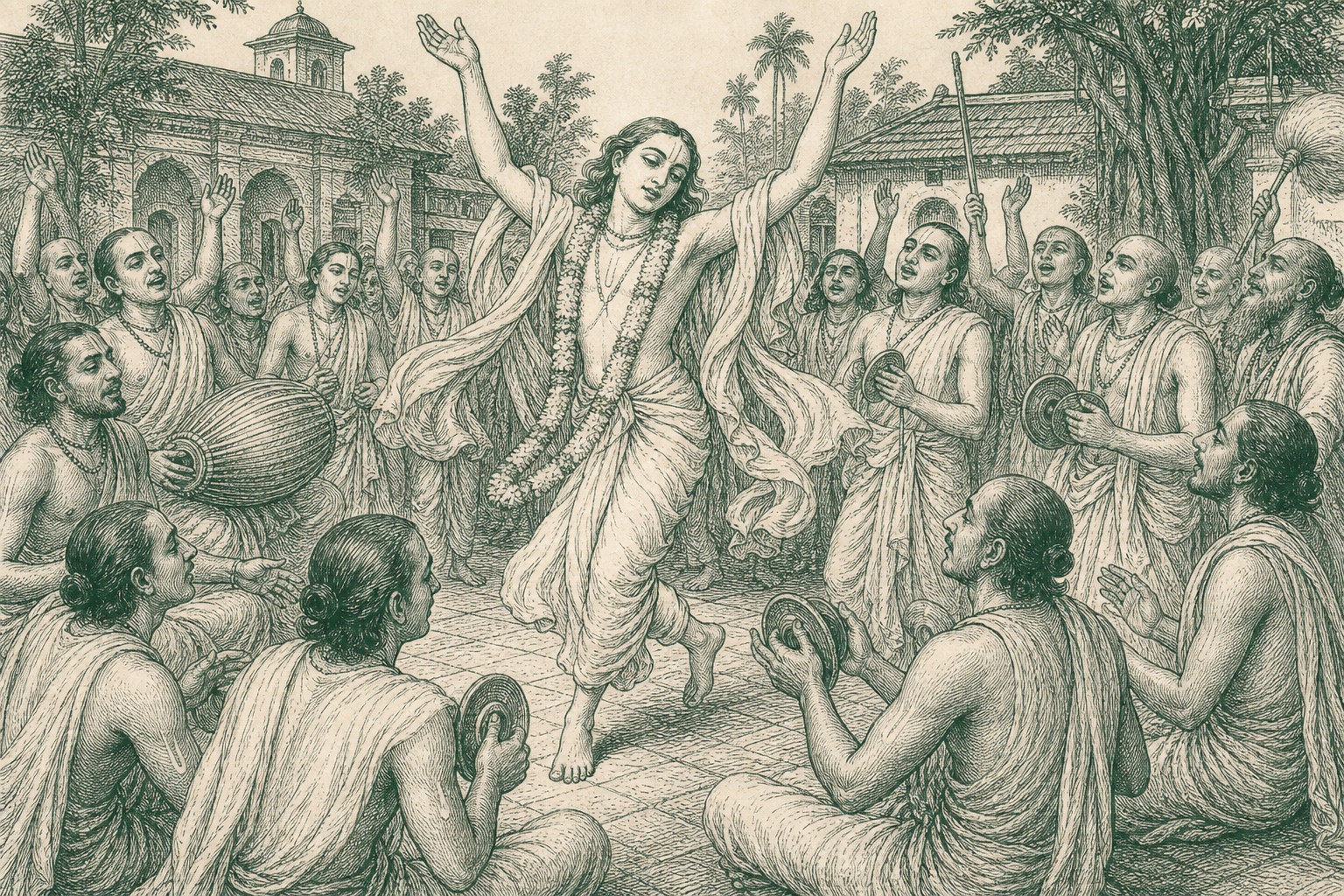
Saṅkīrtana becomes shared remembrance
The chanting of the holy name can be practiced alone, but saṅkīrtana gives remembrance a communal body. Breath, rhythm, listening, and response bring many separate minds into a single act of attention.
No one voice needs to carry everything. The drum steadies the pace, the cymbals brighten it, and each person is supported by the sound made together. Spiritual practice becomes participatory rather than observed.
What he gave
- Kṛṣṇa is the Supreme Person and the object of the soul’s loving relationship
- The chanting of Kṛṣṇa’s holy names is the central practice for this age
- Bhakti is open beyond boundaries of birth, status, or scholarship
- Humility, respect, and freedom from the demand for honor sustain genuine chanting
- The highest spiritual aspiration is selfless love of Kṛṣṇa
- Spiritual feeling and careful philosophical understanding can deepen one another
Name
Kṛṣṇa becomes present in sound.
Company
Voices support one another in remembrance.
Humility
The heart makes room by releasing demand.
Love
Practice ripens toward selfless relationship.
The inner mood of the golden Lord
For the Gaudiya Vaiṣṇava tradition, Śrī Chaitanya is not only a reformer or saint. He is understood as Kṛṣṇa in the mood and golden complexion of Śrīmatī Rādhārāṇī, appearing to taste and distribute love of God.
This understanding places divine longing at the center of theology. The Supreme is not distant from love’s vulnerability. In Śrī Chaitanya, Kṛṣṇa seeks to understand the depth of Rādhā’s love and freely shares the path of that love through the holy name.
His tears, songs, friendships, and states of separation show devotion as something lived by the whole person. Bhakti is not reduced to composure. Longing itself becomes a form of knowledge.
The holy name is carried together. That may be one reason kirtana can reach places in the heart that argument cannot.
A path carried through places
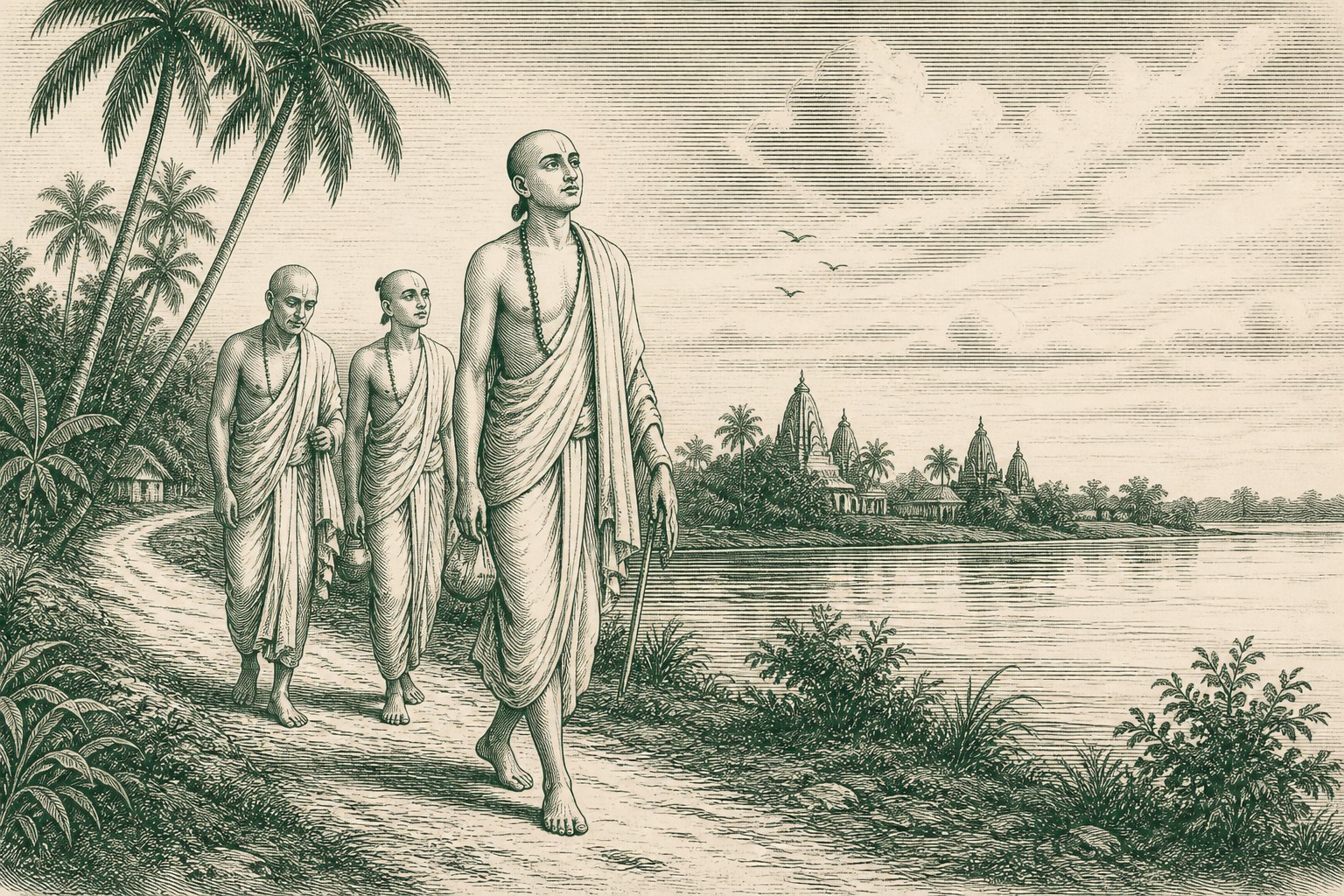
Navadvīpa, the roads of South India, and Jagannātha Purī are not merely points on a biography. They hold different movements of his devotional life: learning, awakening, public chanting, pilgrimage, meeting, separation, and deep inward absorption.
Remembering these places gives the story texture. The teaching travelled by foot, boat, song, conversation, and hospitality. It moved through bodies and landscapes before it reached books and institutions.
Navadvīpa
Learning, awakening, and the flowering of kīrtana.
The road
Pilgrimage, encounter, and the sharing of the holy name.
Purī
Jagannātha, intimate companions, and deep separation.
What his example asks of me
Śrī Chaitanya’s life makes it difficult to separate devotion from how one treats other people. Humility, respect, friendship, hospitality, and shared chanting are not secondary manners around the practice. They are part of its substance.
His example also challenges spiritual self-protection. He allowed love of Kṛṣṇa to become visible, embodied, and vulnerable. The invitation is not to imitate extraordinary states, but to become less guarded in sincere hearing and chanting.
When kīrtana is honest, the voice does not perform certainty. It calls. It listens. It joins others. It lets the holy name carry what the individual cannot carry alone.