From Calcutta to a worldwide mission
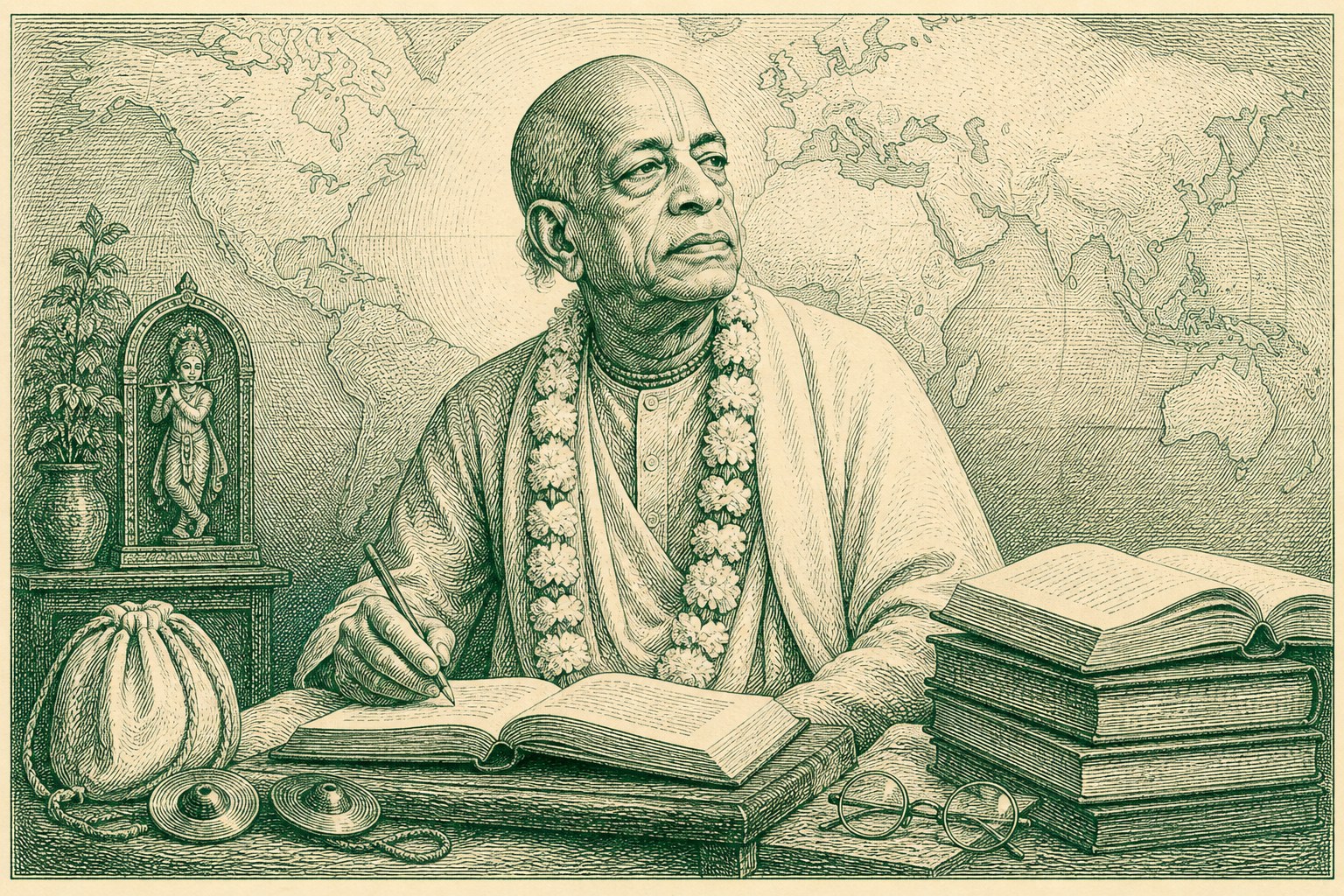
Śrīla Prabhupāda was born Abhay Charan De in Calcutta on 1 September 1896. In 1922 he met Śrīla Bhaktisiddhānta Sarasvatī Ṭhākura, who asked him to communicate the message of Lord Chaitanya in English. He received formal initiation in 1933.
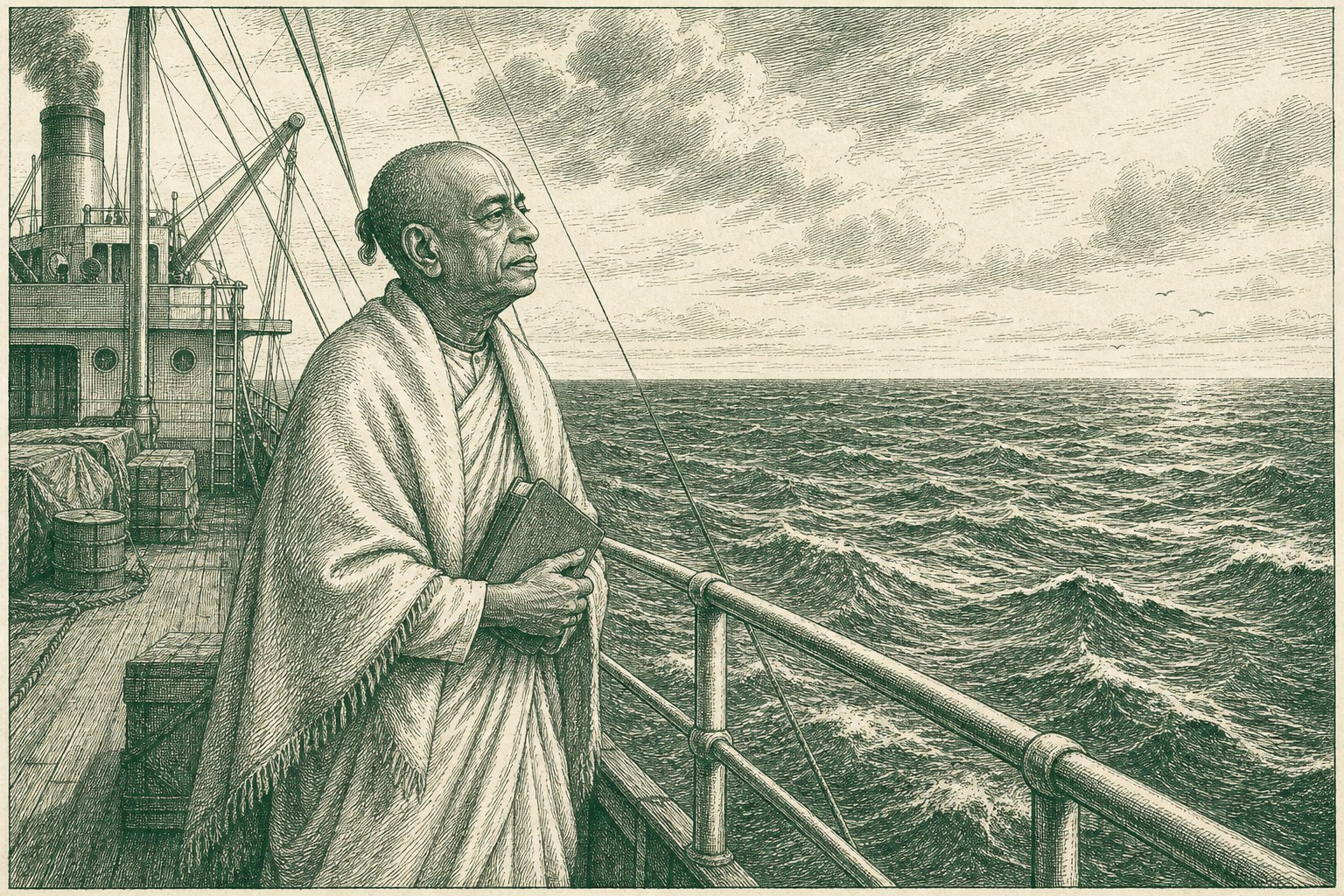
In 1965, at the age of sixty-nine, he travelled by cargo ship to New York. He began speaking in small rooms and public parks, translating and explaining Sanskrit texts while establishing a daily culture of chanting, study, worship, and service. The International Society for Krishna Consciousness was incorporated in New York in July 1966.
The scale of what followed can make the beginning seem inevitable. It was not. The beginning was an elderly Vaiṣṇava arriving with little money, carrying his teacher’s instruction, his books, and a determination that did not depend on visible support.
Born in Calcutta as Abhay Charan De.
Met Śrīla Bhaktisiddhānta Sarasvatī Ṭhākura.
Received formal initiation.
Sailed from India to New York aboard the Jaladuta.
Incorporated the International Society for Krishna Consciousness.
Completed his earthly pastimes in Vṛndāvana on 14 November.
An instruction becomes a life
Śrīla Prabhupāda received the request to communicate Lord Chaitanya’s message in English long before the conditions for a worldwide movement appeared. He carried that instruction across decades of work, family responsibility, writing, and preparation.
This long interval matters to me. Service does not always open quickly. Sometimes faithfulness means protecting an instruction through years when the visible result is small and the next step is not obvious.
Receive
An instruction from the spiritual master.
Prepare
Years of study, writing, and perseverance.
Cross
A solitary ocean journey in later life.
Gather
Chanting and teaching in simple places.
Entrust
Books, communities, and service passed onward.
Books as the foundation
Śrīla Prabhupāda translated and commented on foundational works including Bhagavad-gītā As It Is, Śrīmad-Bhāgavatam, and Śrī Chaitanya-charitāmṛta. His purports bring earlier Vaiṣṇava commentaries into conversation with the questions of modern readers.
He treated publication as service, not ornament. The books were meant to be read, discussed, distributed, and used to form communities whose daily life made their teachings visible.
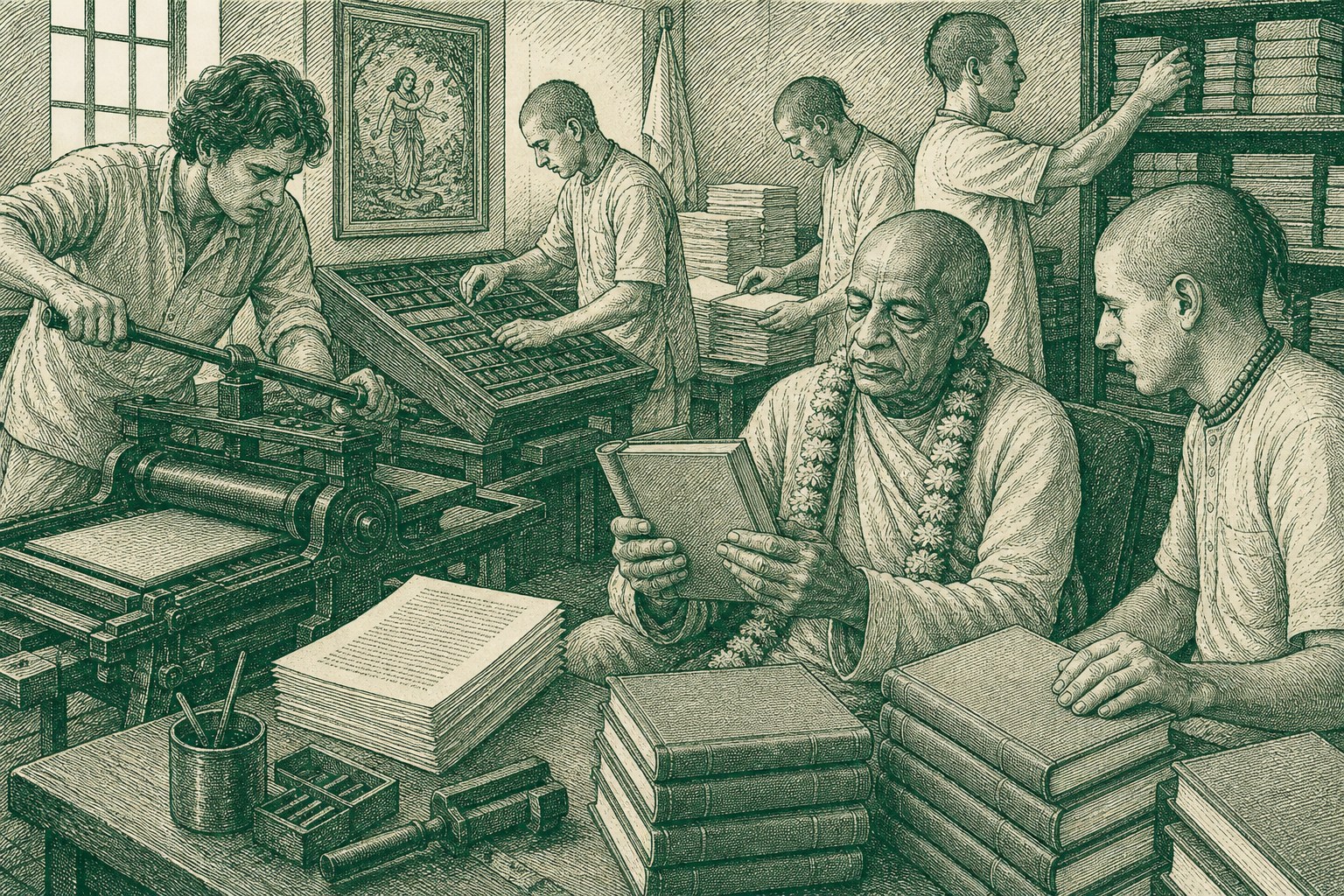
The physical labor surrounding those books also belongs to the story. Manuscripts were typed, edited, typeset, printed, packed, carried, and placed into people’s hands. Philosophy moved through very practical acts of cooperation.
A culture that could be lived
Śrīla Prabhupāda did not present bhakti as an idea to admire from a distance. He established a daily rhythm in which philosophy, worship, food, music, friendship, discipline, and service supported one another.
A temple morning, a shared plate of prasāda, a public kīrtana, a book discussion, or the care of a sacred space could all become ways of remembering Kṛṣṇa. The inheritance was theological and thoroughly practical at the same time.
- Chanting the Hare Kṛṣṇa mahā-mantra individually and together
- Regular hearing and discussion of Bhagavad-gītā and Śrīmad-Bhāgavatam
- Temple worship, prasāda, festivals, and communities of service
- A global publishing effort grounded in disciplic succession
- Simple daily practices that bring spiritual intention into the body and the home
Holy name
Chanting as the shared center.
Books
Study that gives practice direction.
Prasāda
Grace received and shared through food.
Worship
Care offered through form and ritual.
Service
Ability placed in Kṛṣṇa’s circle.
Global reach, personal encounter
The movement became international, but its power still rests in personal encounters. Someone hears the mahā-mantra for the first time. Someone opens a book. Someone tastes prasāda, meets a devotee, or discovers that spiritual life can be practiced now rather than postponed.
Śrīla Prabhupāda crossed cultures without treating devotion as a fashionable export. He asked people to take up a complete practice and to become responsible for carrying it with integrity.
That combination of openness and seriousness remains striking. Everyone could come, yet coming was an invitation to change.
What remains alive
For me, Śrīla Prabhupāda’s legacy is present whenever his books are read with attention, the holy name is chanted with dependence, and service is offered without reducing bhakti to identity or display.
His achievement was immense, but admiration alone is not the response it asks for. The practical response is to read, chant, cooperate, serve, and help create spaces where another person can encounter Kṛṣṇa.
The inheritance becomes real when it moves from the shelf into the day.