Bhagavad-gītā Chapters 1 to 6 Part 11 of 12
Bhagavad-gītā 6.1 to 32: Mind Control, Meditation and the Practice of Yoga
Bhagavad-gītā 6.1 to 32
How can the restless mind become a friend in yoga?

Essential preparation
Before the lesson begins
Start by checking the preparation from the previous guide. Then keep the passage and a place to record your reasoning ready.
Check the Previous Preparation
Preview: 6.1 to 32. Sketch the mind as friend/enemy, list conditions of aṣṭāṅga-yoga in 6.10 to 17, and note the movement toward equal vision in 6.28 to 32. Memorise 5.22.
The present guide includes the complete explanation you need, even if you did not complete the preview.
Know Before You Begin
- This guide retells and explains Bhagavad-gītā 6.1 to 32 in order.
- No outside page is needed to understand the lesson.
- Important Sanskrit terms are explained where they appear.
Keep This Ready
- This complete guide on your screen.
- A notebook, paper, or notes app.
- A way to speak or type with a partner.
- No printed cards, book, or special materials are required.
What Will You Make?
- A correct map of the passage movement.
- A seven-day regulation experiment with one visible behaviour and one recovery step.
- A seven-day practice card
- A preparation plan for the next guide.
Reference and enrichment
See the complete passage before examining the details
Learners need to connect karma-yoga to meditation, understand the mind as friend or enemy, describe the demanding aṣṭāṅga conditions, and recognise the chapter’s movement toward equal vision and devotional perfection. The visual map below gives the movement first, so every later detail has a place.

- Explain the connection between Chapters 5 and 6 and distinguish the beginning and advanced stages of yoga in 6.1 to 4.
- Use 6.5 to 6 and 6.10 to 26 to design a regulation plan that identifies environment, body, habits, attention, and recovery from distraction.
- Explain the perfection of yoga in 6.28 to 32 with a based on the verses account of equal vision and relation to the Supreme.
The attention loop
Follow the complete circle. A broken link weakens the whole relationship.
- 01Set purpose
- 02Attend
- 03Notice wandering
- 04Return gently
- 05Stabilize
- 06Set purpose
Essential teaching in verse order
The verses move from the first point to the conclusion
Each section gives the verse range, its meaning in simple words, and the connection to the next part of Kṛṣṇa's answer.

Yoga begins with careful and controlled action
One who works without attachment is the true renunciant. The mind can elevate or degrade the self, so friendship and enmity begin with how it is trained.
A true renunciant does not simply stop working. A beginner grows through duty done without attachment, while an advanced yogī becomes steady within. Both stages require freedom from selfish results.

Meditation depends on regulated conditions
Place, seat, posture, gaze, mind, food, sleep, work and recreation are ordered. Too much or too little are rejected because steadiness requires a possible to continue embodied practice.
The mind becomes our friend when it follows spiritual intelligence. It becomes our enemy when it controls us. This training is seen in how steadily we meet praise and blame, comfort and discomfort, friend and opponent.

Concentration is repeated return
The windless lamp pictures a settled mind, but the practice includes what happens when attention wanders. One notices and brings it back, again and again, under spiritual direction.
Meditation needs proper support: a clean place, steady posture, controlled habits, moderate food and sleep, and a clear spiritual purpose. Too much or too little makes steady practice difficult.
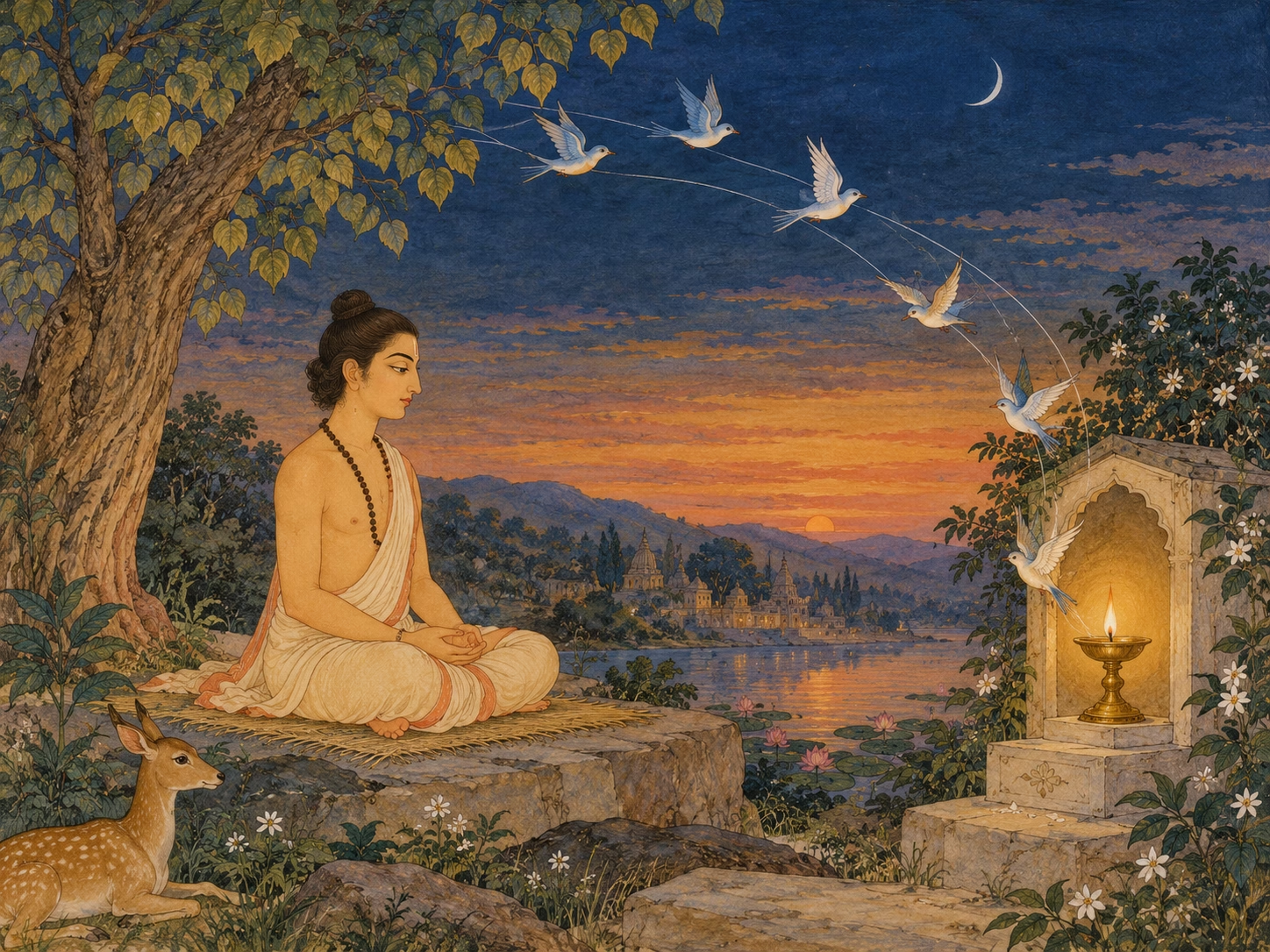
Perfection expands vision and empathy
The yogī experiences peace by contact with the Supreme and sees Kṛṣṇa in all beings. Equal vision reaches its full meaning in taking others' happiness and distress seriously.
When the mind wanders, the yogī notices it and brings it back. This return may be needed many times. As practice matures, the yogī sees Kṛṣṇa in all beings and cares about the happiness and pain of others.
Essential practice
Activity 1: Guided practice design: train the returning mind
What needs to be doneMentally rehearse one practice period, then design a seven-day experiment with a gentle return plan. Then use the on-site or online instructions, receive one specific response, and revise the answer or work that others can see and check.
PurposeTranslate posture, moderation, attention, wandering, and return into a realistic practice instead of an too much or too little ideal.
SuccessA seven-day regulation and attention card
Stop whenThe product is complete, one verse point has been checked, and one improvement has been made from feedback.
If You Are Studying On-Site
- Listen to the short guided rehearsal.
- Write privately before discussion.
- Share only the practice design, not personal confession.
- A partner tests whether it is moderate and repeatable.
If You Are Studying Online
- Turn off notifications during the rehearsal.
- Write the design in the page or private notes.
- Share the cue and return plan in chat.
- Revise any condition that is too too much or too little.
- 01Notice
Mentally rehearse one practice period, then design a seven-day experiment with a gentle return plan.
- 02Explain
Translate posture, moderation, attention, wandering, and return into a realistic practice instead of an extreme ideal.
- 03Improve
A seven-day regulation and attention card
Complete information bank
Complete verse guide for Bhagavad-gītā 6.1 to 32
These blocks give the full movement, the purport meaning in simple words, the central terms and the deeper conclusion of every assigned section.
Every verse included in this lesson
The numbered markers give the complete assigned range. The explanations below tell the story, give the meaning, define the central ideas, and show how Kṛṣṇa's teaching develops from one movement to the next.
The true yogī
Duty without attachment defines real renunciation, while action and stillness serve different stages of yoga.
Renunciation and yoga meet in freedom from fruitive dependence. Action supports the beginner's ascent, while deep cessation and steadiness characterize the advanced stage.
The true yogī: the deeper meaning
The same person may need action at one stage and deeper stillness at another. The chapter does not flatten stages. It shows how disciplined work prepares the inner steadiness required for meditation.
Action prepares; steadiness matures. Duty without fruit now develops into Raise the self.
Verses included here: 6.1, 6.2, 6.3, 6.4.
Friend or enemy
The mind can elevate or degrade, becoming a friend when governed and an enemy when uncontrolled.
The mind becomes friend when governed by the self and enemy when it governs the person. Victory is shown through steadiness in heat, cold, honour, dishonour, friend, and opponent.
Friend or enemy: the deeper meaning
Calling the mind friend or enemy makes training personal without making it hopeless. The mind is not permanently fixed in either role. Repeated guidance can change the relationship.
Train the mind or live under its changing alliances. Raise the self now develops into Regulate life.
Verses included here: 6.5, 6.6, 6.7, 6.8, 6.9.
Conditions for practice
Place, posture, attention, food, sleep, work, and recreation are regulated rather than too much or too little.
Meditation is supported by an ordered environment, body, habits, and purpose. The historical discipline should be described accurately before drawing modest modern practice principles.
Conditions for practice: the deeper meaning
Place, posture, gaze, food, sleep, fearlessness, and purpose form one support system. Meditation is not a single technique added to an unregulated life; several conditions work together.
Place, posture, habits, purpose. Regulate life now develops into Focus attention.
Verses included here: 6.10, 6.11, 6.12, 6.13, 6.14, 6.15, 6.16, 6.17.
A steady flame
Withdrawn from distraction, the mind rests in clear spiritual understanding, compared to a lamp protected from wind.
A steady lamp images concentrated consciousness. In samādhi, the practitioner experiences the self beyond sense pleasure and is not moved from truth by severe difficulty.
A steady flame: the deeper meaning
The windless lamp shows collected attention, but the surrounding verses add more: awareness of the self, happiness beyond the senses, and steadiness even in great difficulty.
A windless lamp pictures collected attention. Focus attention now develops into Return when distracted.
Verses included here: 6.18, 6.19, 6.20, 6.21, 6.22, 6.23.
Return the mind
Desire is restrained gradually, and whenever the mind wanders it is brought back under spiritual direction.
Desire born from mental construction is given up gradually. Whenever the mind wanders, it is brought back under the self's direction without denial, panic, or violence.
Return the mind: the deeper meaning
The instruction says to bring the mind back whenever it wanders. The word whenever makes return part of the practice itself. A wandering moment becomes a place to practise, not a final verdict.
Notice, release, remember, return. Return when distracted now develops into See the Supreme in all.
Verses included here: 6.24, 6.25, 6.26.
Peace and equal vision
The yogī sees the Supreme in all beings and relates to others’ happiness and distress as to one’s own.
Contact with the Supreme brings peace and expanded vision. The mature yogī sees Kṛṣṇa in all beings and measures others' happiness and distress in relation to one's own.
Peace and equal vision: the deeper meaning
Meditation widens into vision and empathy. The mature yogī does not remain closed inside private peace. Seeing Kṛṣṇa in all beings changes the way another person's joy and pain are regarded.
Inner steadiness becomes equal vision and care. See the Supreme in all now develops into Duty without fruit.
Verses included here: 6.27, 6.28, 6.29, 6.30, 6.31, 6.32.
Five conditions of practice
Use the arrangement to explain how the ideas relate, not only to recite the labels.
- 01Place
- 02Body
- 03Habits
- 04Attention
- 05Relationship to the Supreme
A possible to continue practice architecture
Compare the columns. The important point is how the ideas differ and how they work together.
- 01Place and posture
- 02Food and sleep
- 03Attention and return
- 04Relationship and purpose
The complete lesson on one screen
Each row joins a verse range to its movement, central terms and main conclusion. The full explanation appears directly above the chart.
| Verse range | Movement | Key terms | Memory cue |
|---|---|---|---|
| 6.1 to 4 | The true yogī | true sannyāsī, unattached duty, ārurukṣu, yogārūḍha | Action prepares; steadiness matures. |
| 6.5 to 9 | Friend or enemy | elevate the self, mind as friend or enemy, steadiness in success and failure | Train the mind or live under its changing alliances. |
| 6.10 to 17 | Conditions for practice | secluded place, seat, posture, gaze, fearlessness, celibacy, moderation | Place, posture, habits, purpose. |
| 6.18 to 23 | A steady flame | controlled mind, windless lamp, samādhi, spiritual happiness | A windless lamp pictures collected attention. |
| 6.24 to 26 | Return the mind | saṅkalpa, gradual practice, wandering mind, repeated return | Notice, release, remember, return. |
| 6.27 to 32 | Peace and equal vision | peace, freedom from passion, seeing Kṛṣṇa everywhere, empathy | Inner steadiness becomes equal vision and care. |
Why this verse guide comes between the two activities
The first activity helps you remember the order. This section gives the full meaning of the verses in simple words. The second activity then helps you explain and use what you have learnt. The pattern is explanation, practice, more explanation, and more practice.
Essential practice
Activity 2: Regulation design studio
What needs to be doneDesign a seven-day experiment for one study or sādhana period. Include a cue, a moderate condition, a distraction response, and one visible measure.
PurposePractise the lesson's central relationship by producing something that can be checked and improved.
SuccessComplete a seven-day practice card and connect it to at least one passage or visual map.
Stop whenYou can explain how the product changed after the discussion: Which part is realistic enough to repeat after a difficult day?
Choose one period
Begin with the exact situation or claim in the task.
Set moderate conditions
Connect this move to the passage, not only to a personal reaction.
Plan the return
Connect this move to the passage, not only to a personal reaction.
Record one behaviour
Finish with a response that can be explained and improved.
If You Are Studying On-Site
- Make your own first draft.
- Explain it to one partner. Your partner checks whether the verse point and your reason are clear.
- Receive one clear question or correction.
- Improve the product before the class discussion.
If You Are Studying Online
- Write the first draft in the response box or in your own notes.
- Share only the part you want checked in chat or a breakout room.
- Use the checklist after your partner has heard your verse point and reason.
- Improve one sentence and say what you changed.
Build the product one move at a time
Each box corresponds to one step in this lesson's activity. Write enough that another reader could understand your reasoning without hearing an extra explanation.
Use this self-check before you finish
Expected product: A seven-day practice card
Debrief this activity
Which part is realistic enough to repeat after a difficult day?
Reference and enrichment
Use the visual summary to check your explanation
The map below helps you compare your answer with the reasoning and conclusion of the verses.
When the mind wanders
Read from left to right. Each step creates the condition for the next.
- 01Notice without denial
- 02Release the distraction
- 03Remember the chosen object
- 04Return attention
- 05Repeat patiently
Pause and decide
Quick check: is the main idea clear?
Why this check is here: the next lesson will build on this idea, so you should be able to explain it in your own words.
What your answer tells you
Proceed when learners select the second option and can name repetition without self-condemnation. If you are not sure, use the explanation and visual map directly above. Say why each of the other options does not fit the meaning explained on this page, then try again.
- 01The true yogī
Duty without attachment defines real renunciation, while action and stillness serve different stages of yoga.
- 02A steady flame
Withdrawn from distraction, the mind rests in spiritual realization, compared to a lamp protected from wind.
- 03Peace and equal vision
The yogī sees the Supreme in all beings and relates to others’ happiness and distress as to one’s own.
Reference and enrichment
Common misunderstandings and clear answers
These short answers show where a correct idea is sometimes used in the wrong way.
Mind control is not violent suppression
The method is moderate regulation, patient return and higher absorption, not self-hatred.
Full explanation: Renunciation and yoga meet in freedom from fruitive dependence. Action supports the beginner's ascent, while deep cessation and steadiness characterize the advanced stage. The same person may need action at one stage and deeper stillness at another. The chapter does not flatten stages. It shows how disciplined work prepares the inner steadiness required for meditation.
Meditation is not posture alone
The chapter integrates conduct, environment, habits, attention, realization and relationship to the Supreme.
Full explanation: The mind becomes friend when governed by the self and enemy when it governs the person. Victory is shown through steadiness in heat, cold, honour, dishonour, friend, and opponent. Calling the mind friend or enemy makes training personal without making it hopeless. The mind is not permanently fixed in either role. Repeated guidance can change the relationship.
- 01Mind control is not violent suppression
The method is moderate regulation, patient return and higher absorption, not self-hatred.
- 02Meditation is not posture alone
The chapter integrates conduct, environment, habits, attention, realization and relationship to the Supreme.
Essential summary
The complete lesson in clear statements
- 01
True renunciation includes unattached action rather than only stopping work.
- 02
The trained mind becomes a friend; the untrained mind acts as an enemy.
- 03
Yoga rejects too much or too little of eating, sleeping, work and recreation.
- 04
Verse 6.26 teaches repeated return whenever the mind wanders.
- 05
Mature yoga expresses equal vision and empathy grounded in relation to the Supreme.
Do not leave without this
Prepare for the next lesson
6.33 to 47. The next guide will retell and explain this full section, so this preview is preparation rather than a missing part of the present lesson.
A seven-day practice card. Keep the revised version for later retrieval.
Prepare Arjuna’s objection, Kṛṣṇa’s response, the destinations of the unsuccessful yogī, and a complete yoga-ladder diagram. Memorise 5.29.
Bring one question that arose from the verse guide, one point you can explain confidently, and one point that still needs checking.
- 01Remember
Mature yoga expresses equal vision and empathy grounded in relation to the Supreme.
- 02Keep
A seven-day practice card
- 03Continue
Bhagavad-gītā 6.33 to 47: Practice, Detachment and the Topmost Yogī
Interactive self-check
How deeply do you want to check your understanding?
Choose 10, 20, or 30 questions. You will see one question at a time. Submit an answer, study the explanation and its on-page reference, then continue. A correct answer brings a small celebration.