Bhagavad-gītā Chapters 1 to 6 Part 10 of 12
Bhagavad-gītā Chapter 5: Devotional Action, Equal Vision and the Peace Formula
Bhagavad-gītā Chapter 5
How does devotional action unite detachment, equal vision, and peace?
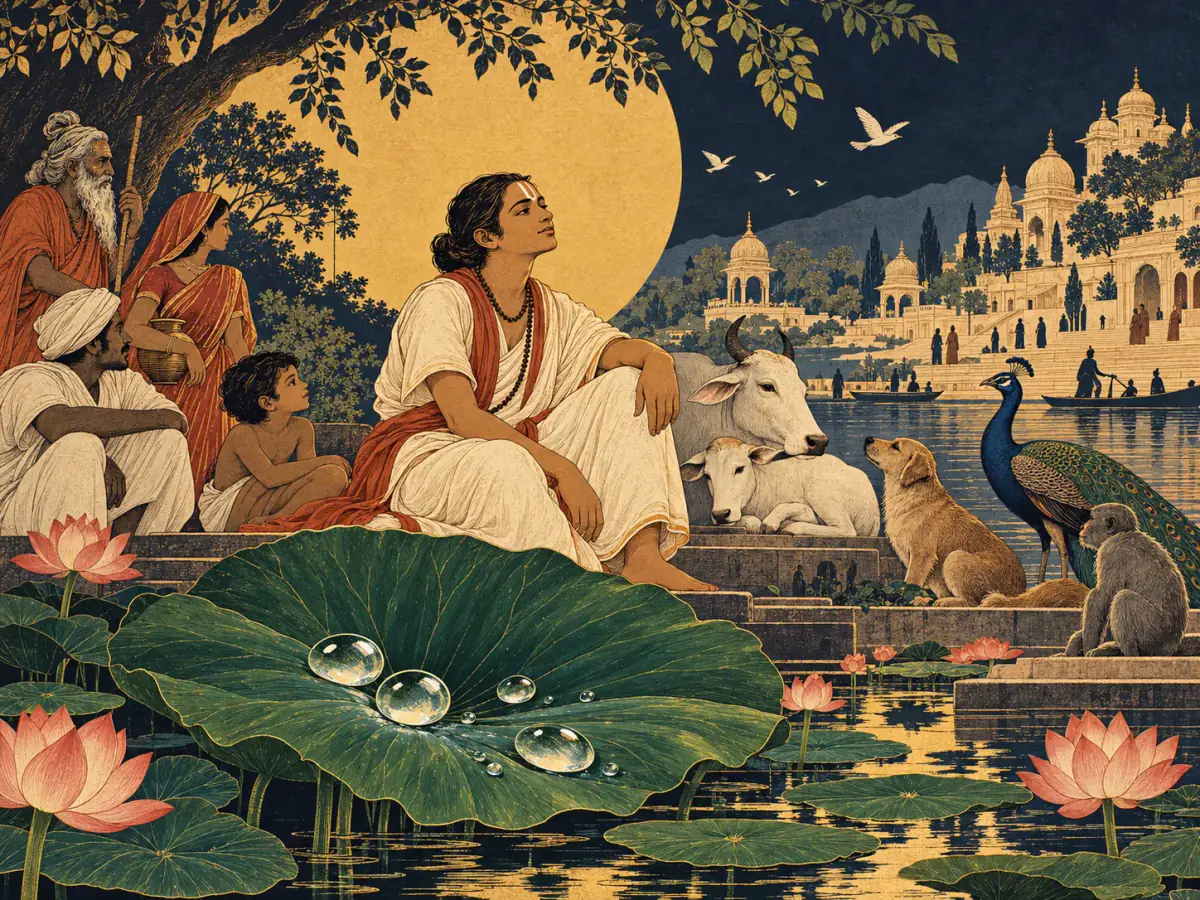
Essential preparation
Before the lesson begins
Start by checking the preparation from the previous guide. Then keep the passage and a place to record your reasoning ready.
Check the Previous Preparation
Preview: Chapter 5. Build a comparison of karma-sannyāsa and karma-yoga, then collect verse anchors for lotus-leaf detachment, equal vision, inner happiness, and the peace formula. Memorise 4.34.
The present guide includes the complete explanation you need, even if you did not complete the preview.
Know Before You Begin
- This guide retells and explains Bhagavad-gītā Chapter 5 in order.
- No outside page is needed to understand the lesson.
- Important Sanskrit terms are explained where they appear.
Keep This Ready
- This complete guide on your screen.
- A notebook, paper, or notes app.
- A way to speak or type with a partner.
- No printed cards, book, or special materials are required.
What Will You Make?
- A correct map of the passage movement.
- A four-part response and a two-minute explanation connecting 5.18 or 5.29 to the decision.
- A four-part response with one verse anchor
- A preparation plan for the next guide.
Reference and enrichment
See the complete passage before examining the details
Learners need a coherent Chapter 5 summary that joins the ideas: why devotional action surpasses dry renunciation, how detachment works, what equal vision means, and why 5.29 is presented as a formula for peace. The visual map below gives the movement first, so every later detail has a place.
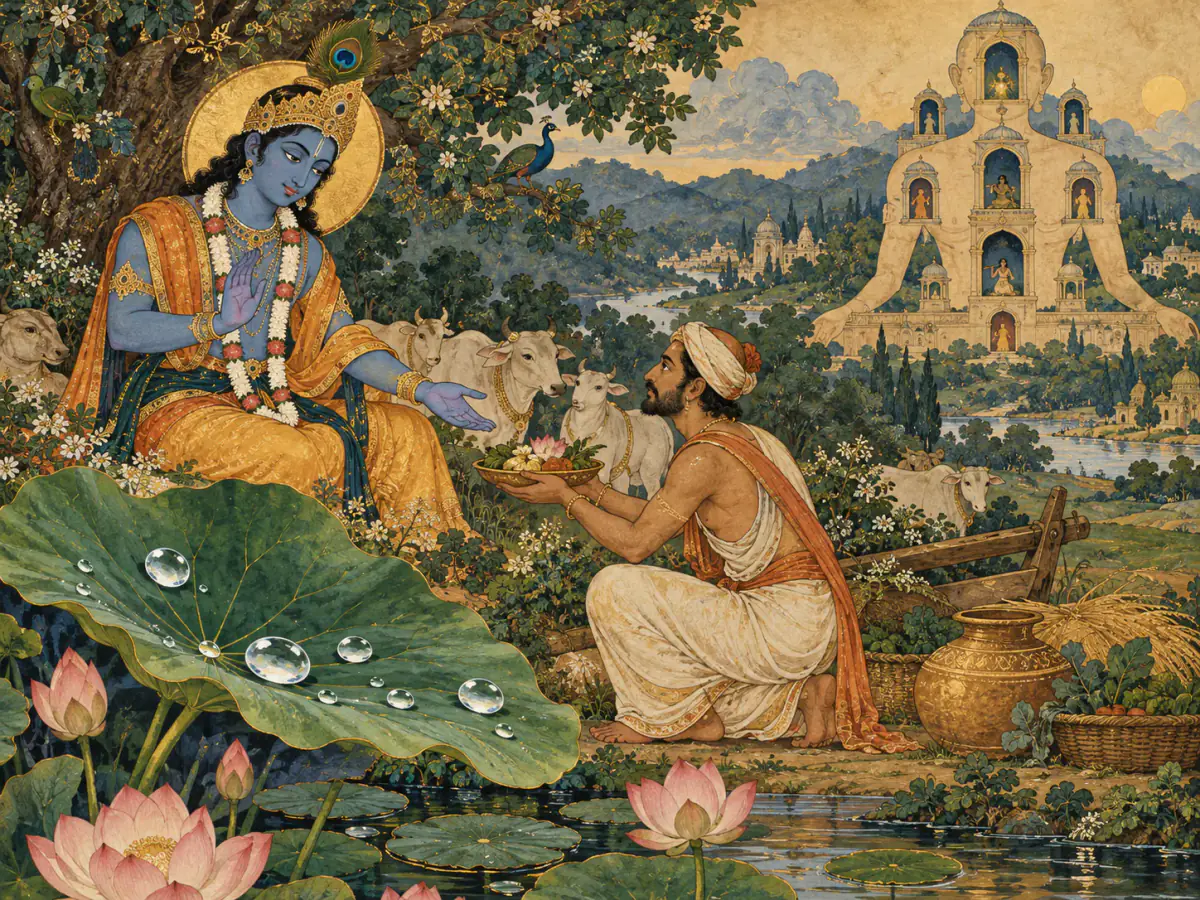
- Compare karma-sannyāsa and karma-yoga in 5.1 to 6, naming both their relation and the practical conclusion for Arjuna.
- Explain action without reaction through 5.7 to 15 using the lotus-leaf and nine-gates images without collapsing the self, body, and Lord’s agency.
- Present equal vision and the peace formula from 5.18 and 5.29, including one guardrail against sentimental or socially careless interpretation.
Action without reaction
Read from left to right. Each step creates the condition for the next.
- 01Understand clearly duty
- 02Act carefully
- 03Offer results
- 04Release the feeling that everything belongs to me
- 05Remain engaged
Essential teaching in verse order
The verses move from the first point to the conclusion
Each section gives the verse range, its meaning in simple words, and the connection to the next part of Kṛṣṇa's answer.

Renunciation and work meet at a shared goal
Arjuna again asks which path is better. Kṛṣṇa explains that both can lead to liberation but karma-yoga is easier and safer for one not yet fully purified.
Arjuna again asks whether renunciation or action is better. Kṛṣṇa says both can lead to liberation, but devotional action is easier and safer for most people because it joins spiritual purpose with daily duty.
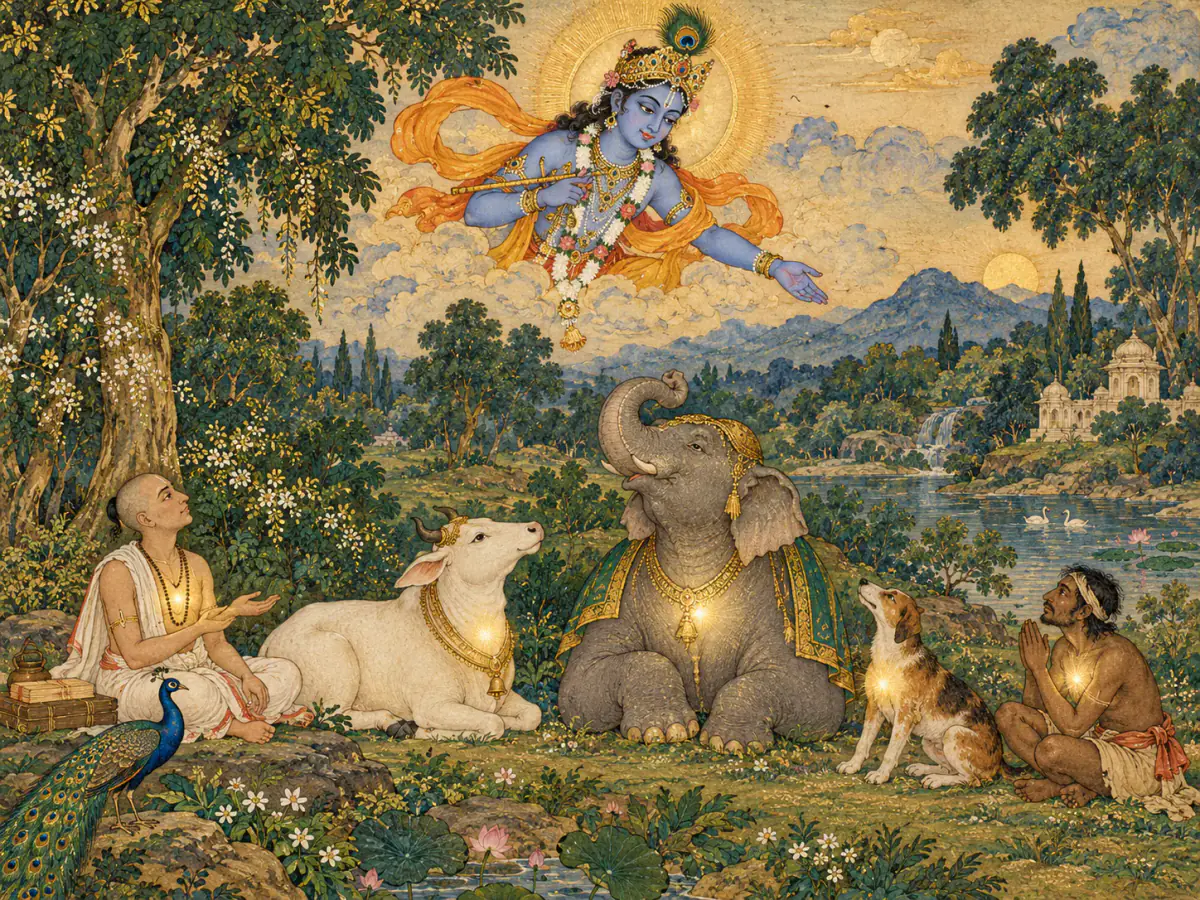
The self acts through an entrusted body
The karma-yogī offers results and remains untouched like a lotus leaf in water. The nine-gated city helps distinguish the self, body, material nature and the Lord's sanction.
The karma-yogī acts with body, mind and intelligence but offers the result to Kṛṣṇa. Like water that does not stay on a lotus leaf, material result and reaction does not stick to work done without selfish ownership.
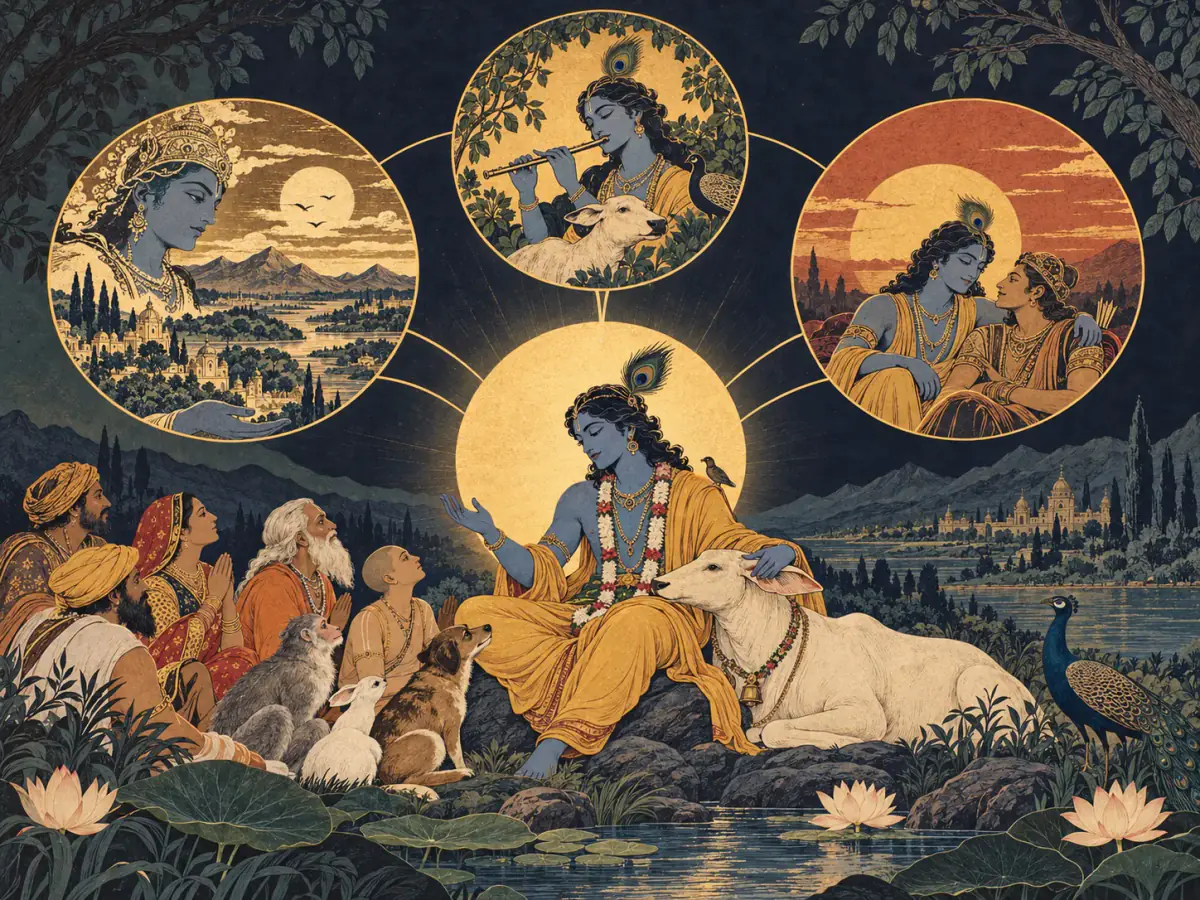
Knowledge yields equal vision and inner happiness
Spiritual vision recognises the same kind of spiritual self across bodily differences. This supports dignity while leaving room for wise, suited to the real situation responsibilities.
Spiritual knowledge helps us see the soul in every living being. Bodies, abilities and duties are different, but every soul has spiritual value. Equal vision should increase respect and wise care, not make us ignore real needs.
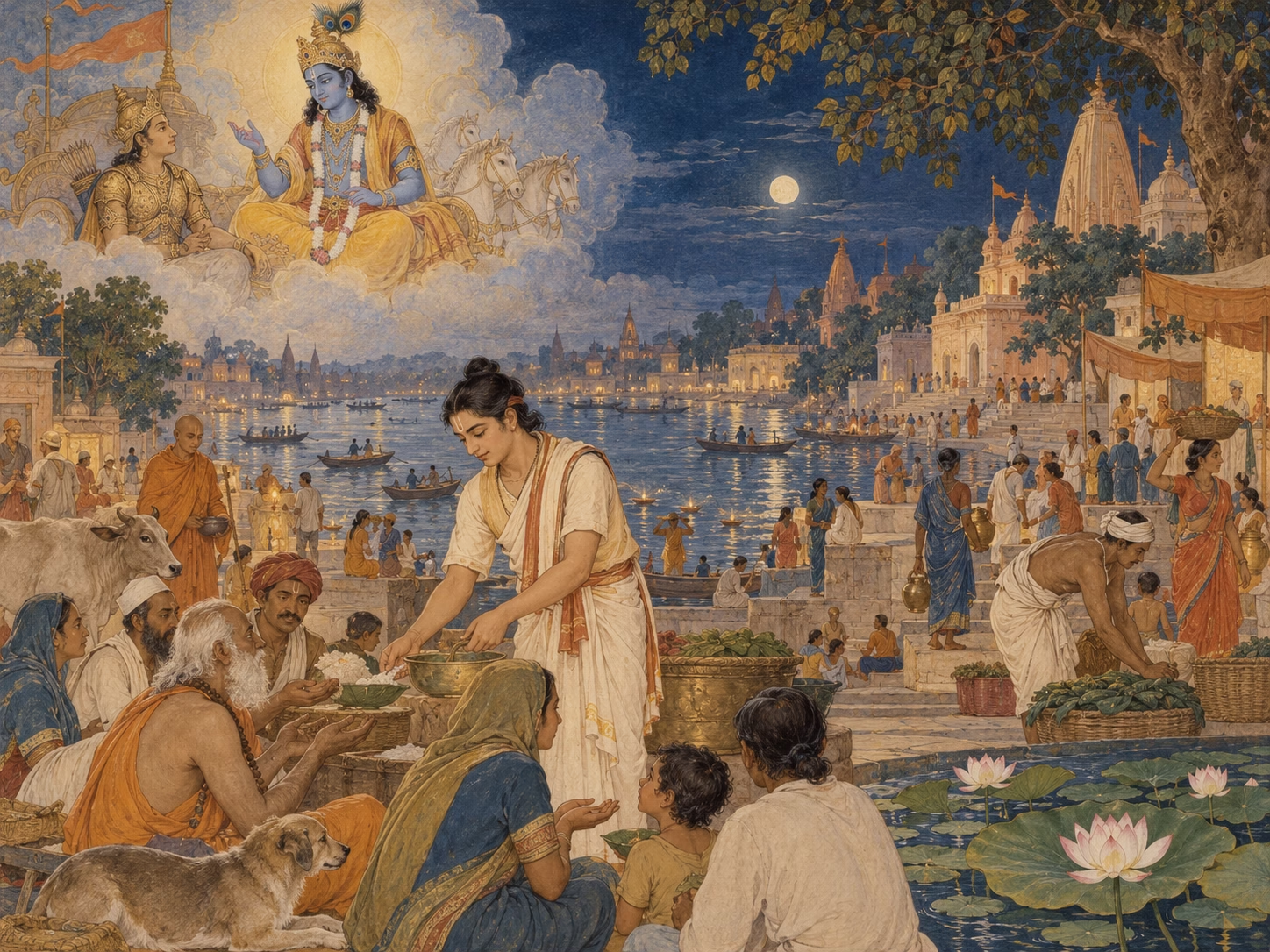
Meditation reaches its full meaning in relationship and peace
The chapter introduces meditative discipline, then names Kṛṣṇa as enjoyer of sacrifice, proprietor of all worlds and well-wishing friend of every being.
The chapter moves from right action to meditation and peace. Peace comes from knowing Kṛṣṇa as the receiver of sacrifice, the owner of everything and the loving friend of every living being.
Essential practice
Activity 1: Equal vision case council
What needs to be doneRespond to a community case through four council seats, then combine the insights into one decision. Then use the on-site or online instructions, receive one specific response, and revise the answer or work that others can see and check.
PurposeKeep the equal spiritual value of every soul together with real difference that matters in the situation, practical duty, and nonpossessive care.
SuccessA four-lens case response with one decision
Stop whenThe product is complete, one verse point has been checked, and one improvement has been made from feedback.
If You Are Studying On-Site
- Assign four council seats: equality, difference, duty, and attachment.
- Each seat gives one sentence.
- The group drafts one decision.
- A fifth learner tests whether anyone was erased.
If You Are Studying Online
- Assign one lens to each breakout participant.
- Post each sentence in a shared space.
- Combine them into one decision.
- Revise if equality was confused with sameness.
- 01Notice
Respond to a community case through four council seats, then combine the insights into one decision.
- 02Explain
Keep spiritual equality together with relevant difference, practical duty, and nonpossessive care.
- 03Improve
A four-lens case response with one decision
Complete information bank
Complete verse guide for Bhagavad-gītā Chapter 5
These blocks give the full movement, the purport meaning in simple words, the central terms and the deeper conclusion of every assigned section.
Every verse included in this lesson
The numbered markers give the complete assigned range. The explanations below tell the story, give the meaning, define the central ideas, and show how Kṛṣṇa's teaching develops from one movement to the next.
Action and renunciation
Both are considered, but devotional action is emphasized as practical and complete for Arjuna.
Both renunciation and devoted action can lead toward liberation, but detached work in devotion is easier and safer for a practitioner who is not already purified.
Action and renunciation: the deeper meaning
Renunciation and karma-yoga share a goal, but they do not demand the same readiness. Kṛṣṇa recommends a path that lets an embodied learner purify desire while still carrying responsible duties.
The shared goal does not make the methods equally practical. Act now develops into Offer.
Verses included here: 5.1, 5.2, 5.3, 5.4, 5.5, 5.6.
Lotus-leaf work
The devoted worker acts through body, mind, intelligence, and senses while offering results and remaining unattached.
The devoted worker acts with body, mind, intelligence, and senses for purification while surrendering the fruit. Like water on a lotus leaf, reaction does not cling to offered work.
Lotus-leaf work: the deeper meaning
The lotus leaf is in the water but is not soaked by it. In the same way, detachment is shown within action. The worker uses body, mind, intelligence, and senses but gives up selfish ownership of the result.
Work in the water without becoming soaked by reaction. Offer now develops into Remain unattached.
Verses included here: 5.7, 5.8, 5.9, 5.10, 5.11, 5.12.
The nine-gated city
The soul living in the body resides in the body while material nature carries action; the Lord is not the author of sinful or pious acts.
The soul living in the body resides in the body without being identical to its mechanisms. The Lord does not manufacture the jīva's selfish choice; ignorance covers knowledge while nature executes embodied action under sanction.
The nine-gated city: the deeper meaning
The nine-gated city keeps several agents distinct: the conscious resident, the body's mechanisms, material nature, and the Supreme sanction. Confusion comes when one of these is asked to explain the work of all the others.
Resident, city, mechanisms, sanction. Remain unattached now develops into See spiritually.
Verses included here: 5.13, 5.14, 5.15.
Knowledge and equal vision
Knowledge reveals reality, and the learned see living beings with vision that sees every living being as a soul.
Knowledge reveals the equal spiritual value of every soul across different bodies. Equal vision establishes dignity at the level of self while responsible action still attends to context, role, conduct, and need.
Knowledge and equal vision: the deeper meaning
Equal vision begins with the soul, not with denial of the body. Because bodies and situations differ, equal spiritual respect may require different forms of practical care rather than one mechanical treatment for everyone.
Same spiritual nature, different embodied situations. See spiritually now develops into Find inner happiness.
Verses included here: 5.16, 5.17, 5.18.
Inner happiness
Steady understanding does not chase temporary contact pleasure and discovers happiness within clear spiritual understanding.
Pleasure produced by material contact is temporary and carries distress because it ends. The wise cultivate inner spiritual happiness and tolerate impulse before leaving the body.
Inner happiness: the deeper meaning
The problem with contact pleasure is not that every pleasant experience is sinful. Its beginning and end make it unable to carry the full weight of lasting happiness. Wisdom so looks for a deeper centre.
Temporary contact versus inward spiritual joy. Find inner happiness now develops into Know Kṛṣṇa as well-wisher.
Verses included here: 5.20, 5.21, 5.22, 5.23, 5.24, 5.25, 5.26.
Meditation and peace
Regulation prepares meditation, while peace rests in knowing Kṛṣṇa as enjoyer, proprietor, and well-wisher.
The chapter closes by joining meditation to relationship with Kṛṣṇa. Peace rests in knowing who receives sacrifice, who owns all worlds, and who is the friend of every being.
Meditation and peace: the deeper meaning
The peace formula answers three kinds of anxiety: Who finally receives the offering? Who owns the field of action? Who is the well-wisher? Kṛṣṇa's relation to the world answers all three.
Enjoyer, proprietor, friend. Know Kṛṣṇa as well-wisher now develops into Act.
Verses included here: 5.27, 5.28, 5.29.
The peace triangle
Keep all three truths together. Removing one distorts the relationship.
- 01Enjoyer of sacrifice
- 02Proprietor of all worlds
- 03Well-wisher of all beings
The lotus-leaf logic
Read from left to right. Each step creates the condition for the next.
- 01Duty is performed
- 02Fruit is surrendered
- 03The feeling that everything belongs to me loosens
- 04Reaction does not cling
- 05Service continues
The complete lesson on one screen
Each row joins a verse range to its movement, central terms and main conclusion. The full explanation appears directly above the chart.
| Verse range | Movement | Key terms | Memory cue |
|---|---|---|---|
| 5.1 to 6 | Action and renunciation | sannyāsa, karma-yoga, liberation, practical path | The shared goal does not make the methods equally practical. |
| 5.7 to 12 | Lotus-leaf work | pure worker, lotus leaf, offering results, body and senses | Work in the water without becoming soaked by reaction. |
| 5.13 to 15 | The nine-gated city | nine-gated city, agency, material nature, ignorance and knowledge | Resident, city, mechanisms, sanction. |
| 5.16 to 18 | Knowledge and equal vision | knowledge as sun, sama-darśinaḥ, brāhmaṇa, cow, elephant, dog | Same spiritual nature, different embodied situations. |
| 5.20 to 26 | Inner happiness | contact pleasure, beginning and end, inner happiness, liberation | Temporary contact versus inward spiritual joy. |
| 5.27 to 29 | Meditation and peace | meditation bridge, enjoyer, proprietor, well-wisher, peace | Enjoyer, proprietor, friend. |
Why this verse guide comes between the two activities
The first activity helps you remember the order. This section gives the full meaning of the verses in simple words. The second activity then helps you explain and use what you have learnt. The pattern is explanation, practice, more explanation, and more practice.
Essential practice
Activity 2: Equal vision case lab
What needs to be doneRespond to a community case using four lenses: the equal spiritual value of every soul, real difference that matters in the situation, duty of care, and attachment to outcome.
PurposePractise the lesson's central relationship by producing something that can be checked and improved.
SuccessComplete a four-part response with one verse anchor and connect it to at least one passage or visual map.
Stop whenYou can explain how the product changed after the discussion: Did equal vision deepen practical care, or erase necessary differences?
See the person
Begin with the exact situation or claim in the task.
Notice real difference that matters in the situation
Connect this move to the passage, not only to a personal reaction.
Name the duty
Connect this move to the passage, not only to a personal reaction.
Release the feeling that everything belongs to me
Finish with a response that can be explained and improved.
If You Are Studying On-Site
- Make your own first draft.
- Explain it to one partner. Your partner checks whether the verse point and your reason are clear.
- Receive one clear question or correction.
- Improve the product before the class discussion.
If You Are Studying Online
- Write the first draft in the response box or in your own notes.
- Share only the part you want checked in chat or a breakout room.
- Use the checklist after your partner has heard your verse point and reason.
- Improve one sentence and say what you changed.
Build the product one move at a time
Each box corresponds to one step in this lesson's activity. Write enough that another reader could understand your reasoning without hearing an extra explanation.
Use this self-check before you finish
Expected product: A four-part response with one verse anchor
Debrief this activity
Did equal vision deepen practical care, or erase necessary differences?
Reference and enrichment
Use the visual summary to check your explanation
The map below helps you compare your answer with the reasoning and conclusion of the verses.
Equal vision with wise action
Compare the columns. The important point is how the ideas differ and how they work together.
- 01Same spiritual nature
- 02Different embodied conditions
- 03Equal dignity
- 04Suited to the real situation responsibility
Pause and decide
Quick check: is the main idea clear?
Why this check is here: the next lesson will build on this idea, so you should be able to explain it in your own words.
What your answer tells you
Proceed when learners select the second option and can give a non-harmful example. If you are not sure, use the explanation and visual map directly above. Say why each of the other options does not fit the meaning explained on this page, then try again.
- 01Action and renunciation
Both are considered, but devotional action is emphasized as practical and complete for Arjuna.
- 02Knowledge and equal vision
Knowledge reveals reality, and the learned see living beings with equal spiritual vision.
- 03Meditation and peace
Regulation prepares meditation, while peace rests in knowing Kṛṣṇa as enjoyer, proprietor, and well-wisher.
Reference and enrichment
Common misunderstandings and clear answers
These short answers show where a correct idea is sometimes used in the wrong way.
Equal vision is not identical treatment
The equal spiritual value of every soul supports dignity, while practical care still considers need, role, vulnerability and consequence.
Full explanation: Both renunciation and devoted action can lead toward liberation, but detached work in devotion is easier and safer for a practitioner who is not already purified. Renunciation and karma-yoga share a goal, but they do not demand the same readiness. Kṛṣṇa recommends a path that lets an embodied learner purify desire while still carrying responsible duties.
The Lord is not blamed for the jīva's chosen action
Material nature carries out action under sanction, but the living being's desire and responsibility remain relevant.
Full explanation: The devoted worker acts with body, mind, intelligence, and senses for purification while surrendering the fruit. Like water on a lotus leaf, reaction does not cling to offered work. The lotus leaf is in the water but is not soaked by it. In the same way, detachment is shown within action. The worker uses body, mind, intelligence, and senses but gives up selfish ownership of the result.
- 01Equal vision is not identical treatment
Spiritual equality supports dignity, while practical care still considers need, role, vulnerability and consequence.
- 02The Lord is not blamed for the jīva's chosen action
Material nature carries out action under sanction, but the living being's desire and responsibility remain relevant.
Essential summary
The complete lesson in clear statements
- 01
Karma-yoga and renunciation share a goal, but karma-yoga is more practical for most practitioners.
- 02
Offering results allows one to work without being soaked in reaction, like a lotus leaf in water.
- 03
The self resides in the nine-gated body without being identical to it.
- 04
Equal vision recognises spiritual identity across bodily difference.
- 05
Peace rests in knowing Kṛṣṇa as enjoyer, proprietor and well-wisher.
Do not leave without this
Prepare for the next lesson
6.1 to 32. The next guide will retell and explain this full section, so this preview is preparation rather than a missing part of the present lesson.
A four-part response with one verse anchor. Keep the revised version for later retrieval.
Sketch the mind as friend/enemy, list conditions of aṣṭāṅga-yoga in 6.10 to 17, and note the movement toward equal vision in 6.28 to 32. Memorise 5.22.
Bring one question that arose from the verse guide, one point you can explain confidently, and one point that still needs checking.
- 01Remember
Peace rests in knowing Kṛṣṇa as enjoyer, proprietor and well-wisher.
- 02Keep
A four-part response with one verse anchor
- 03Continue
Bhagavad-gītā 6.1 to 32: Mind Control, Meditation and the Practice of Yoga
Interactive self-check
How deeply do you want to check your understanding?
Choose 10, 20, or 30 questions. You will see one question at a time. Submit an answer, study the explanation and its on-page reference, then continue. A correct answer brings a small celebration.