Bhagavad-gītā Chapters 1 to 6 Part 07 of 12
Bhagavad-gītā 3.17 to 43: Leadership, Duty, Desire and Self-Mastery
Bhagavad-gītā 3.17 to 43
How can one lead responsibly while confronting desire within?
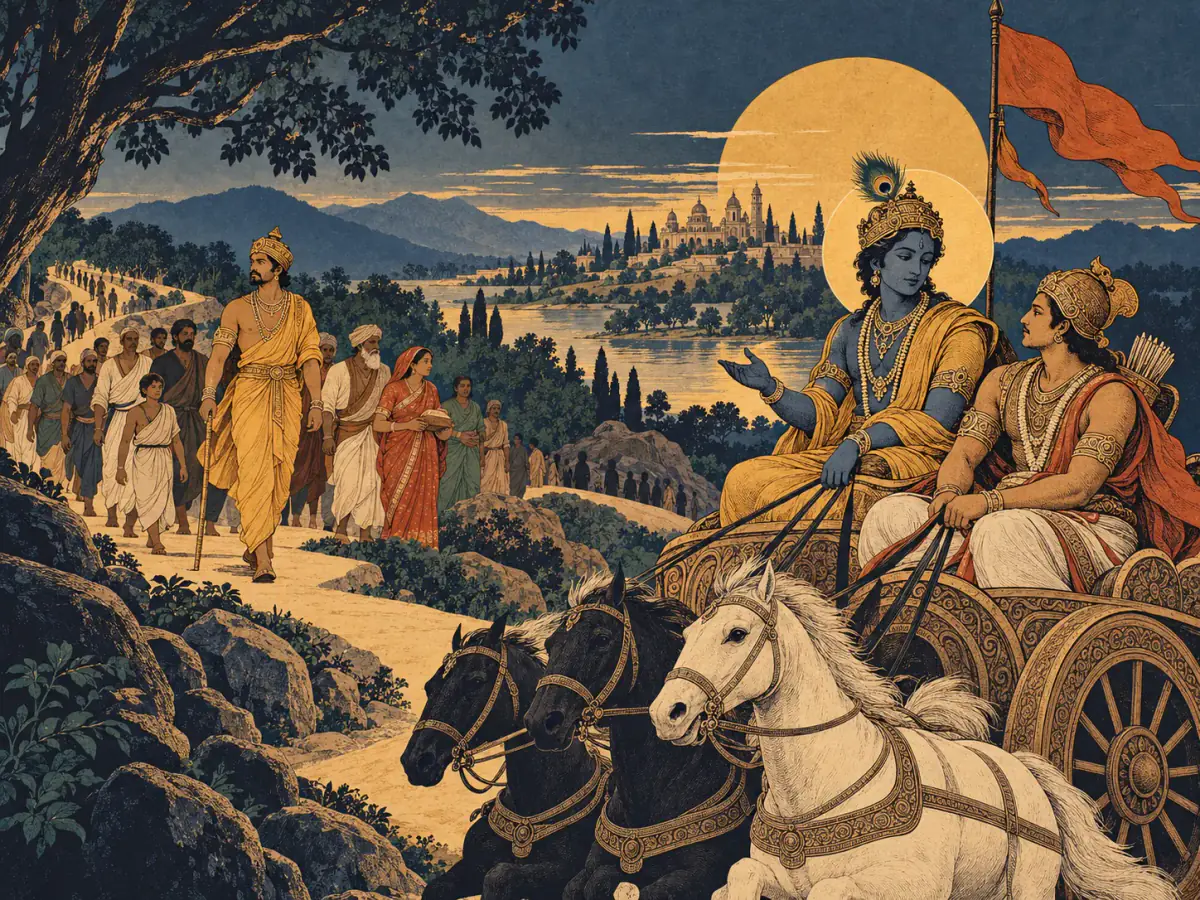
Essential preparation
Before the lesson begins
Start by checking the preparation from the previous guide. Then keep the passage and a place to record your reasoning ready.
Check the Previous Preparation
Preview: 3.17 to 43. Prepare a two-column sheet: leadership by example (3.17 to 29) and desire/lust analysis (3.36 to 43). Memorise 4.2 and review 3.27.
The present guide includes the complete explanation you need, even if you did not complete the preview.
Know Before You Begin
- This guide retells and explains Bhagavad-gītā 3.17 to 43 in order.
- No outside page is needed to understand the lesson.
- Important Sanskrit terms are explained where they appear.
Keep This Ready
- This complete guide on your screen.
- A notebook, paper, or notes app.
- A way to speak or type with a partner.
- No printed cards, book, or special materials are required.
What Will You Make?
- A correct map of the passage movement.
- A revised leadership move and a personal four-level interruption plan for senses, mind, intelligence, and spiritual purpose.
- A leadership response map
- A preparation plan for the next guide.
Reference and enrichment
See the complete passage before examining the details
Learners need to understand exemplary action, responsible engagement with people at different stages, the role and limits of varṇāśrama discussion, and the layered mechanism of lust. The visual map below gives the movement first, so every later detail has a place.
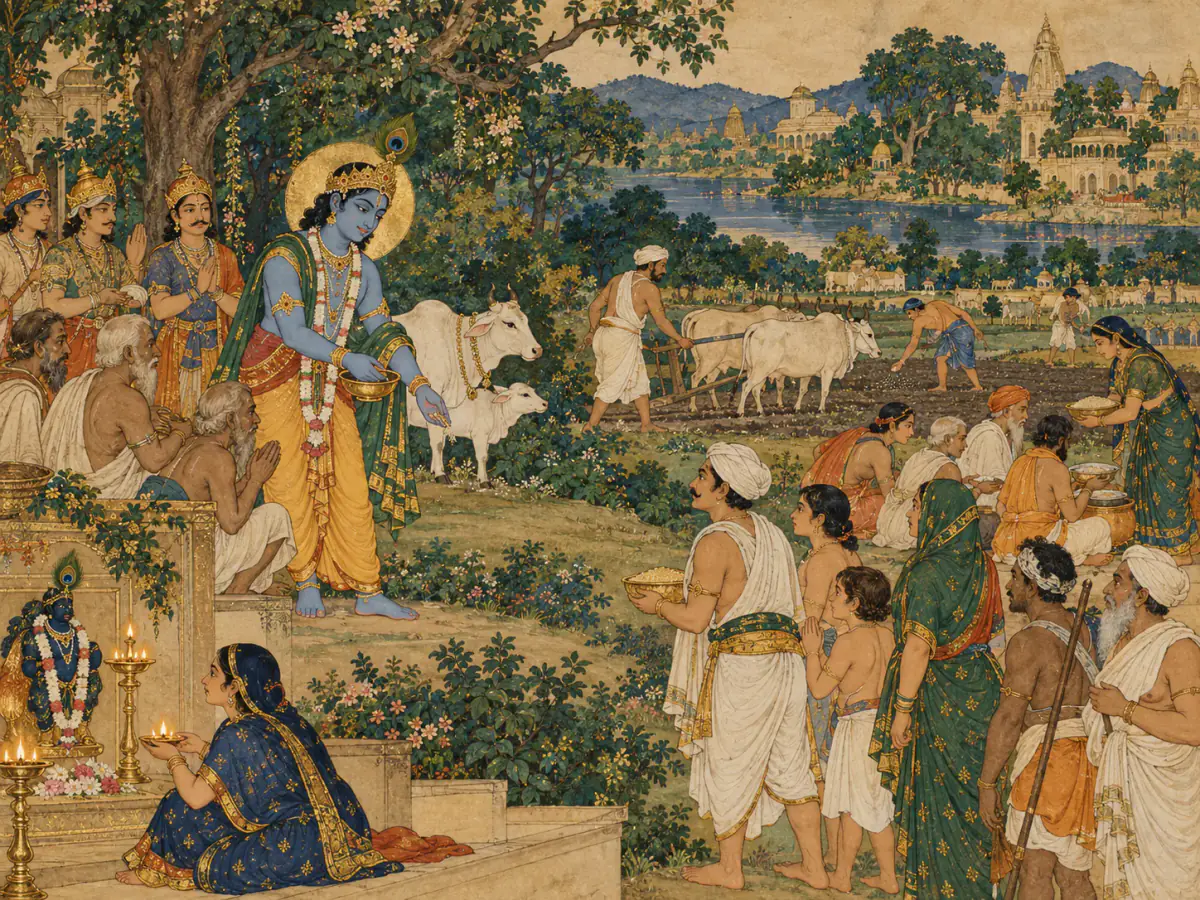
- Explain why a spiritually realised person may still act for social guidance, using 3.17 to 24 and one leadership possible meaning for daily life.
- Distinguish supportive guidance from disturbing another person’s faith in 3.25 to 29 through a teaching scenario.
- Map desire’s object, coverings, seats, and response sequence in 3.36 to 43, then design one personal interruption strategy.
The leadership ripple
Read from left to right. Each step creates the condition for the next.
- 01Leader chooses
- 02Others observe
- 03A norm forms
- 04Conduct spreads
- 05Society is shaped
Essential teaching in verse order
The verses move from the first point to the conclusion
Each section gives the verse range, its meaning in simple words, and the connection to the next part of Kṛṣṇa's answer.

Freedom from need can deepen responsibility
A spiritually realised person has no selfish duty, yet may continue to act for loka-saṅgraha, the guidance and welfare of others. Kṛṣṇa presents His own action as the highest example.
A spiritually satisfied person may not need material reward, but still acts for the good of others. People copy respected leaders. So a leader teaches not only by words, but also by visible conduct.
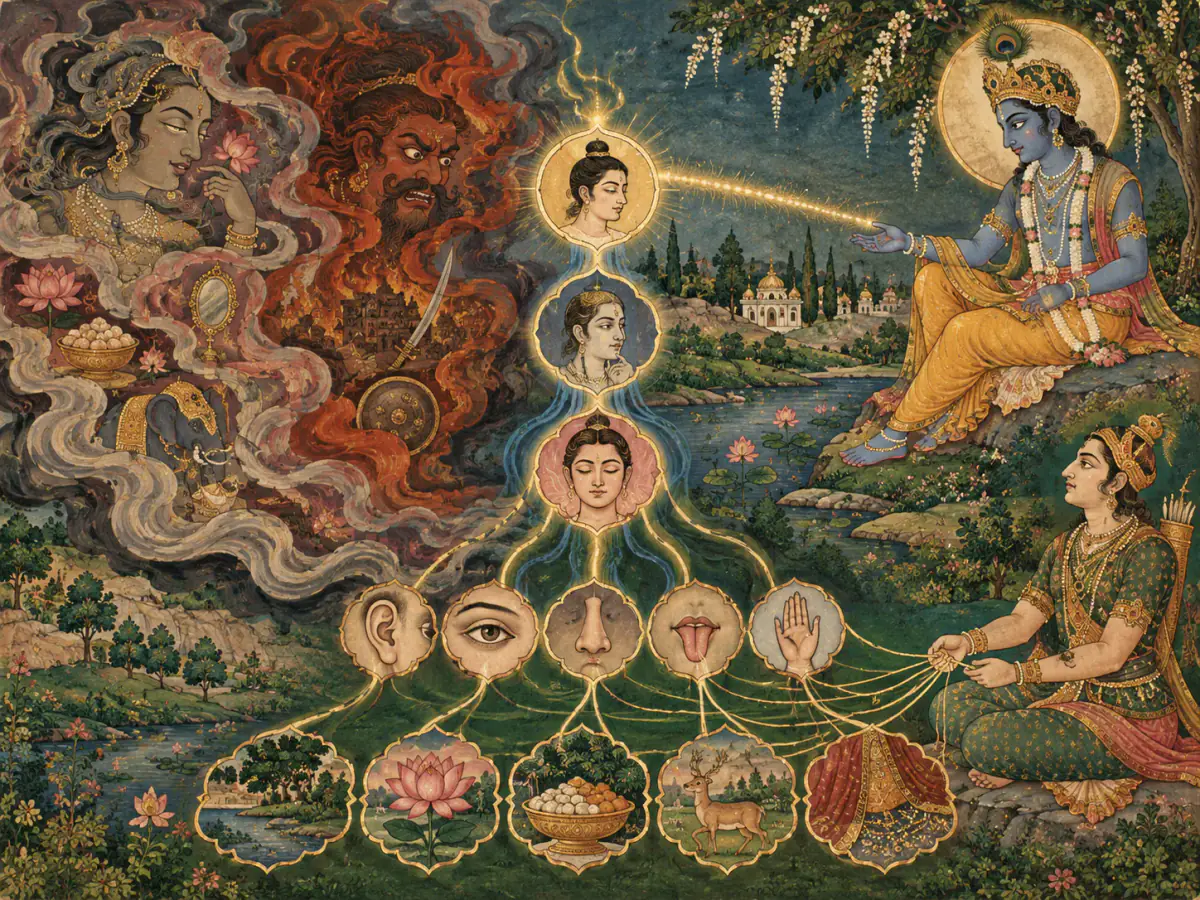
Teach without needlessly disturbing
The wise understand action through the guṇas but do not use that knowledge to unsettle people attached to work. They engage others gradually through responsible example.
The wise do not insult or suddenly confuse people who are still attached to results. They work responsibly, set a good example and slowly help others connect their work to a higher purpose.

Offering does not erase individuality
Arjuna is told to dedicate action to Kṛṣṇa without the feeling that everything belongs to me or lethargy. Acting according to one's nature is safer than imitation of another's role.
The body and mind work through material nature and its modes. False ego says, 'I alone am the doer.' Understanding nature should reduce pride, but it does not remove our duty to choose responsibly.
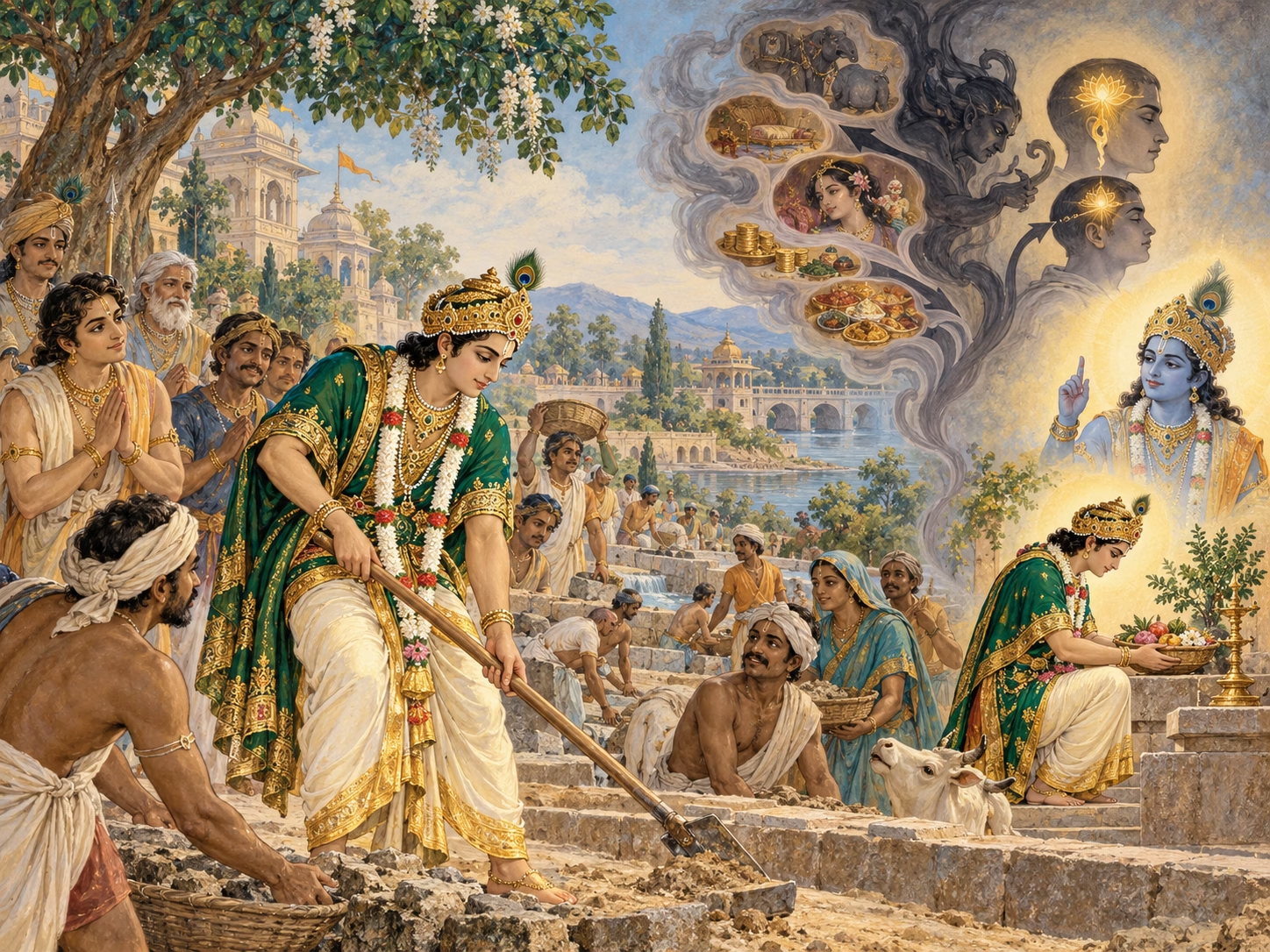
Desire is an inner adversary with locations
Lust, transformed into anger, covers knowledge and sits in senses, mind and intelligence. The response begins by regulating the senses and strengthening intelligence in knowledge of the self.
Kṛṣṇa asks Arjuna to offer his work to Him and act without selfish ownership or fear. Desire works through the senses, mind and intelligence. It is controlled when spiritual intelligence guides the lower levels.
Essential practice
Activity 1: Leadership ripple: test the example you set
What needs to be donePrepare a short role-play in which a leader's hidden motive and visible example produce different ripples. Then use the on-site or online instructions, receive one specific response, and revise the answer or work that others can see and check.
PurposeApply the teaching that influential conduct shapes others while keeping action connected to duty and Kṛṣṇa.
SuccessA three-scene role-play and a revised leadership choice
Stop whenThe product is complete, one verse point has been checked, and one improvement has been made from feedback.
If You Are Studying On-Site
- Choose roles: leader, observer, and affected person.
- Perform the first choice and its ripple.
- Pause for source-based feedback.
- Replay the scene with the revised choice.
If You Are Studying Online
- Assign the three roles in a breakout room.
- Read or act the first scene.
- Use chat for one source-based correction.
- Replay only the changed ending.
- 01Notice
Prepare a short role-play in which a leader's hidden motive and visible example produce different ripples.
- 02Explain
Apply the teaching that influential conduct shapes others while keeping action connected to duty and Kṛṣṇa.
- 03Improve
A three-scene role-play and a revised leadership choice
Complete information bank
Complete verse guide for Bhagavad-gītā 3.17 to 43
These blocks give the full movement, the purport meaning in simple words, the central terms and the deeper conclusion of every assigned section.
Every verse included in this lesson
The numbered markers give the complete assigned range. The explanations below tell the story, give the meaning, define the central ideas, and show how Kṛṣṇa's teaching develops from one movement to the next.
Why leaders still act
Even one satisfied in the self acts to maintain order, because others follow the example of a respected person.
Even one who has no selfish need continues to act for the welfare and stability of others. Leadership carries responsibility because respected conduct becomes instruction.
Why leaders still act: the deeper meaning
A person may be inwardly satisfied and still act. This removes the false choice between personal freedom and care for society. Mature freedom can express itself through steady service for the good of others.
The leader's example travels farther than the leader. Exemplary action now develops into Teach without disruption.
Verses included here: 3.17, 3.18, 3.19, 3.20, 3.21, 3.22, 3.23, 3.24.
Teach without disruption
The wise act without attachment and engage others without unsettling them through contempt or ideas that are too advanced for the person at that time.
The wise do not display superiority or abruptly disrupt people who are still attached. They model responsible action and gradually connect others to a higher purpose.
Teach without disruption: the deeper meaning
Kṛṣṇa asks the wise not to disturb those who are still attached. This does not mean hiding truth. It means teaching in a way that gives people a workable next step instead of displaying superiority.
Teach by steady example before demanding abstraction. Teach without disruption now develops into Nature acts.
Verses included here: 3.25, 3.26.
Doership and the modes
Material nature carries activity, while false ego claims independent authorship and judges others without understanding their conditioning.
Material nature carries bodily and mental activity, while false ego claims independent authorship. Understanding conditioning should reduce pride and contempt, not erase moral responsibility.
Doership and the modes: the deeper meaning
The modes of nature explain many bodily and mental movements, but they do not cancel responsibility. The teaching removes the boast of independent control while keeping the need for wise choice.
Nature acts; false ego claims total authorship. Nature acts now develops into Offer work.
Verses included here: 3.27, 3.28, 3.29.
Offer the work
Kṛṣṇa asks Arjuna to dedicate action to Him, free from the claim of ownership, lethargy, and feverish anxiety.
Kṛṣṇa asks Arjuna to offer work to Him without the feeling that everything belongs to me, selfish expectation, or feverish hesitation. The verse joins devotion, action, and inner freedom.
Offer the work: the deeper meaning
Offering work to Kṛṣṇa joins devotion and action in one instruction. Freedom from expectation, the feeling that everything belongs to me, and fever does not weaken the work. It removes the inner claims that make the work binding.
Offer the work and release the fever. Offer work now develops into Desire arises.
Verses included here: 3.30.
Nature and one’s duty
Regulation must account for conditioned nature, and one’s own duty is safer than imitating another’s.
Conditioned tendencies must be regulated, not romanticized. One's own duty, even imperfectly performed, is safer than imitation that ignores actual responsibility and qualification.
Nature and one’s duty: the deeper meaning
One's own duty is not a slogan for whatever feels natural. Nature is conditioned, and attraction and repulsion can mislead. Duty must be understood through role, qualification, scripture, and responsible guidance.
Better faithful responsibility than borrowed perfection. Desire arises now develops into Intelligence governs.
Verses included here: 3.33, 3.34, 3.35.
The enemy and the hierarchy
Desire is identified as the enemy, located in senses, mind, and intelligence, and conquered by spiritual intelligence.
Desire born from passion is named the enemy because it covers knowledge. Kṛṣṇa maps its seats and orders the response: regulate senses, strengthen intelligence, and stand in knowledge of the self.
The enemy and the hierarchy: the deeper meaning
The hierarchy of senses, mind, intelligence, and self gives a strategy. Control does not end at the senses. Intelligence must be strengthened by knowledge so that desire does not return through another door.
Meet desire by moving upward through the hierarchy. Intelligence governs now develops into Exemplary action.
Verses included here: 3.36, 3.37, 3.38, 3.39, 3.40, 3.41, 3.42, 3.43.
Where desire is met
Move from the supporting level toward the more integrated level without erasing the earlier work.
- 01Sense objects
- 02Senses
- 03Mind
- 04Intelligence
- 05Self
A leader's example becomes culture
Read from left to right. Each step creates the condition for the next.
- 01Visible choice
- 02Follower interpretation
- 03Repeated imitation
- 04Shared norm
- 05Collective consequence
The complete lesson on one screen
Each row joins a verse range to its movement, central terms and main conclusion. The full explanation appears directly above the chart.
| Verse range | Movement | Key terms | Memory cue |
|---|---|---|---|
| 3.17 to 24 | Why leaders still act | ātma-rati, self-satisfaction, Janaka, loka-saṅgraha | The leader's example travels farther than the leader. |
| 3.25 to 26 | Teach without disruption | attached worker, detached worker, do not unsettle | Teach by steady example before demanding abstraction. |
| 3.27 to 29 | Doership and the modes | prakṛti, guṇas, ahaṅkāra, kartā, conditioned action | Nature acts; false ego claims total authorship. |
| 3.30 | Offer the work | mayi, dedicate action, nirāśī, nirmama, vigata-jvara | Offer the work and release the fever. |
| 3.33 to 35 | Nature and one’s duty | nature, attraction and repulsion, sva-dharma, para-dharma | Better faithful responsibility than borrowed perfection. |
| 3.36 to 43 | The enemy and the hierarchy | kāma, krodha, senses, mind, intelligence, self | Meet desire by moving upward through the hierarchy. |
Why this verse guide comes between the two activities
The first activity helps you remember the order. This section gives the full meaning of the verses in simple words. The second activity then helps you explain and use what you have learnt. The pattern is explanation, practice, more explanation, and more practice.
Essential practice
Activity 2: Leadership and desire lab
What needs to be doneTake a fictional leadership temptation. Map the example it would set, the desire chain, and one response governed by intelligence and offering.
PurposePractise the lesson's central relationship by producing something that can be checked and improved.
SuccessComplete a leadership response map and connect it to at least one passage or visual map.
Stop whenYou can explain how the product changed after the discussion: Does the response control others, or does it first govern the leader’s own conduct?
Name the desire
Begin with the exact situation or claim in the task.
Trace the public example
Connect this move to the passage, not only to a personal reaction.
Move up the hierarchy
Connect this move to the passage, not only to a personal reaction.
Choose visible conduct
Finish with a response that can be explained and improved.
If You Are Studying On-Site
- Make your own first draft.
- Explain it to one partner. Your partner checks whether the verse point and your reason are clear.
- Receive one clear question or correction.
- Improve the product before the class discussion.
If You Are Studying Online
- Write the first draft in the response box or in your own notes.
- Share only the part you want checked in chat or a breakout room.
- Use the checklist after your partner has heard your verse point and reason.
- Improve one sentence and say what you changed.
Build the product one move at a time
Each box corresponds to one step in this lesson's activity. Write enough that another reader could understand your reasoning without hearing an extra explanation.
Use this self-check before you finish
Expected product: A leadership response map
Debrief this activity
Does the response control others, or does it first govern the leader’s own conduct?
Reference and enrichment
Use the visual summary to check your explanation
The map below helps you compare your answer with the reasoning and conclusion of the verses.
Meet desire in the right order
Move from the supporting level toward the more integrated level without erasing the earlier work.
- 01Regulate the senses
- 02Steady the mind
- 03Strengthen intelligence
- 04Remember the self
- 05Act for Kṛṣṇa
Pause and decide
Quick check: is the main idea clear?
Why this check is here: the next lesson will build on this idea, so you should be able to explain it in your own words.
What your answer tells you
Proceed when learners select the second option and name a likely learner or social effect. If you are not sure, use the explanation and visual map directly above. Say why each of the other options does not fit the meaning explained on this page, then try again.
- 01Why leaders still act
Even one satisfied in the self acts to maintain order, because others follow the example of a respected person.
- 02Offer the work
Kṛṣṇa asks Arjuna to dedicate action to Him, free from proprietorship, lethargy, and feverish anxiety.
- 03The enemy and the hierarchy
Desire is identified as the enemy, located in senses, mind, and intelligence, and conquered by spiritual intelligence.
Reference and enrichment
Common misunderstandings and clear answers
These short answers show where a correct idea is sometimes used in the wrong way.
Leadership is not visibility alone
The relevant question is what conduct followers learn and what welfare the example supports.
Full explanation: Even one who has no selfish need continues to act for the welfare and stability of others. Leadership carries responsibility because respected conduct becomes instruction. A person may be inwardly satisfied and still act. This removes the false choice between personal freedom and care for society. Mature freedom can express itself through steady service for the good of others.
Guṇa analysis is not fatalism
Recognising material influence supports wiser regulation and service; it does not cancel moral responsibility.
Full explanation: The wise do not display superiority or abruptly disrupt people who are still attached. They model responsible action and gradually connect others to a higher purpose. Kṛṣṇa asks the wise not to disturb those who are still attached. This does not mean hiding truth. It means teaching in a way that gives people a workable next step instead of displaying superiority.
- 01Leadership is not visibility alone
The relevant question is what conduct followers learn and what welfare the example supports.
- 02Guṇa analysis is not fatalism
Recognising material influence supports wiser regulation and service; it does not cancel moral responsibility.
Essential summary
The complete lesson in clear statements
- 01
Self-realisation does not excuse neglect of the people shaped by one's example.
- 02
Kṛṣṇa acts to maintain order although He has nothing to gain.
- 03
Wise guidance engages people without contempt or premature disruption.
- 04
Action occurs through the guṇas, while false ego claims the idea that I alone control every action.
- 05
Desire is addressed through regulation, intelligence and knowledge of the self.
Do not leave without this
Prepare for the next lesson
4.1 to 15. The next guide will retell and explain this full section, so this preview is preparation rather than a missing part of the present lesson.
A leadership response map. Keep the revised version for later retrieval.
Create a paramparā timeline from 4.1 to 3 and a claim to evidence table for Kṛṣṇa’s divine appearance that is not forced by material nature in 4.5 to 9. Memorise 4.8.
Bring one question that arose from the verse guide, one point you can explain confidently, and one point that still needs checking.
- 01Remember
Desire is addressed through regulation, intelligence and knowledge of the self.
- 02Keep
A leadership response map
- 03Continue
Bhagavad-gītā 4.1 to 15: Paramparā, Avatāra and Kṛṣṇa's Transcendental Nature
Interactive self-check
How deeply do you want to check your understanding?
Choose 10, 20, or 30 questions. You will see one question at a time. Submit an answer, study the explanation and its on-page reference, then continue. A correct answer brings a small celebration.