Bhagavad-gītā Chapters 1 to 6 Part 08 of 12
Bhagavad-gītā 4.1 to 15: Paramparā, Avatāra and Kṛṣṇa's Divine nature beyond matter
Bhagavad-gītā 4.1 to 15
Why do source, succession, and the Lord’s divine nature beyond matter matter?
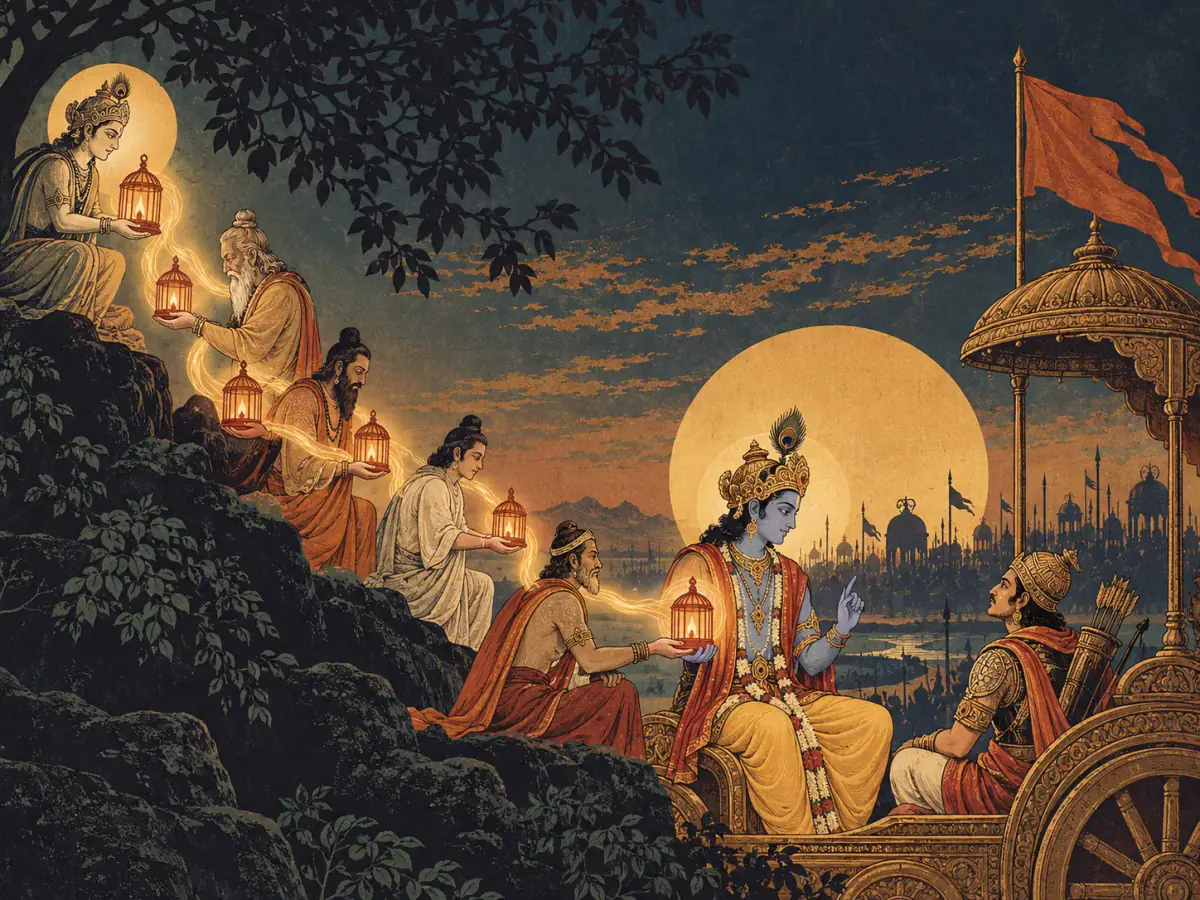
Essential preparation
Before the lesson begins
Start by checking the preparation from the previous guide. Then keep the passage and a place to record your reasoning ready.
Check the Previous Preparation
Preview: 4.1 to 15. Create a paramparā timeline from 4.1 to 3 and a claim to evidence table for Kṛṣṇa’s divine appearance that is not forced by material nature in 4.5 to 9. Memorise 4.8.
The present guide includes the complete explanation you need, even if you did not complete the preview.
Know Before You Begin
- This guide retells and explains Bhagavad-gītā 4.1 to 15 in order.
- No outside page is needed to understand the lesson.
- Important Sanskrit terms are explained where they appear.
Keep This Ready
- This complete guide on your screen.
- A notebook, paper, or notes app.
- A way to speak or type with a partner.
- No printed cards, book, or special materials are required.
What Will You Make?
- A correct map of the passage movement.
- A clear explanation with claim, evidence, analogy if used, and clear rejection of one misreading.
- A transmission map with two safeguards
- A preparation plan for the next guide.
Reference and enrichment
See the complete passage before examining the details
Learners need to explain why disciplic succession matters, why Arjuna is a suitable recipient, and how Kṛṣṇa’s appearance and action differ from conditioned birth and karma. The visual map below gives the movement first, so every later detail has a place.
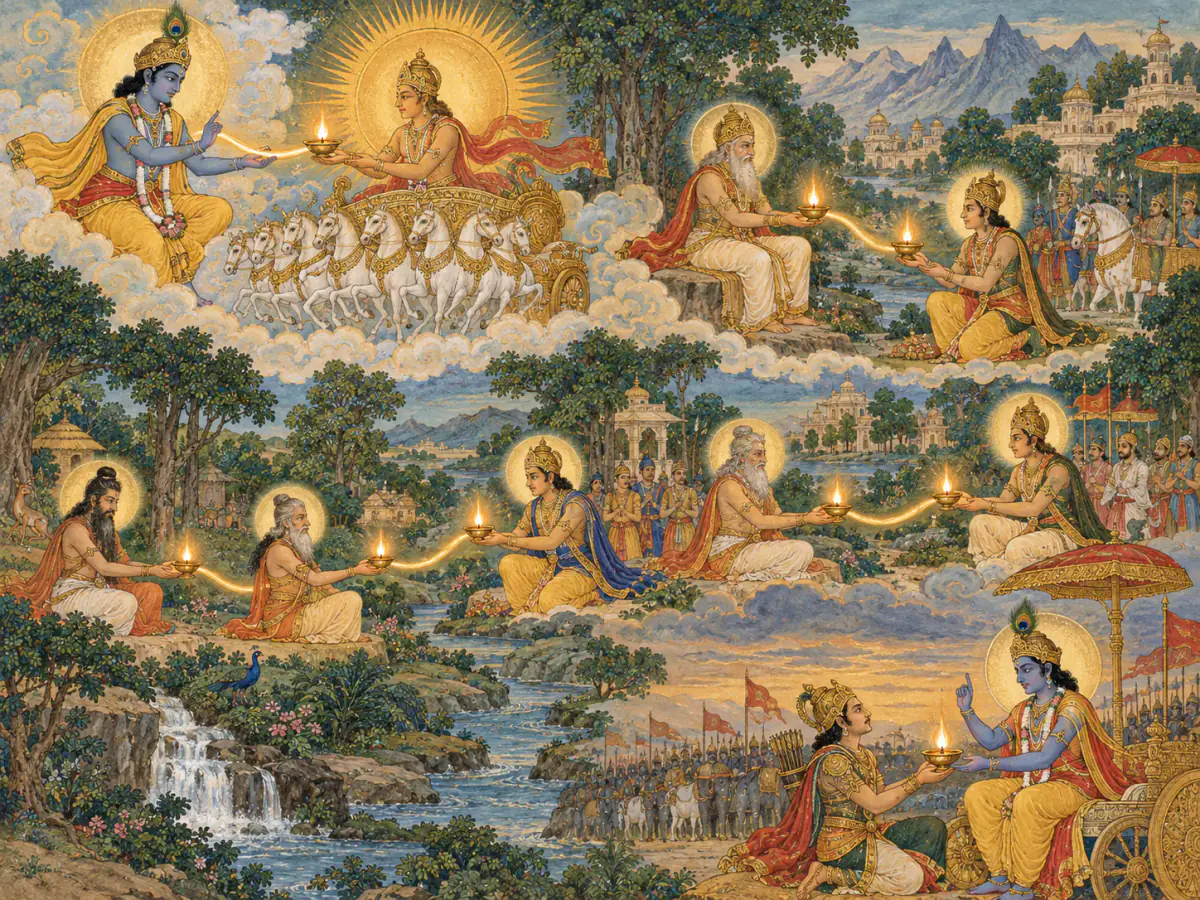
- Reconstruct the transmission sequence in 4.1 to 3 and explain two consequences of sa kāleneha mahatā for preserving teachings.
- Present a clear argument for Kṛṣṇa’s divine appearance that is not forced by material nature using 4.5 to 9 and at least two precise textual differences.
- Explain 4.11 to 15 without using the passage to excuse wrongdoing, fatalism, or birth-based reduction of varṇa.
Paramparā preserves meaning
Read from left to right. Each step creates the condition for the next.
- 01Kṛṣṇa
- 02Vivasvān
- 03Manu
- 04Ikṣvāku
- 05Rājarṣis
- 06Arjuna
Essential teaching in verse order
The verses move from the first point to the conclusion
Each section gives the verse range, its meaning in simple words, and the connection to the next part of Kṛṣṇa's answer.
Knowledge travels through relationship
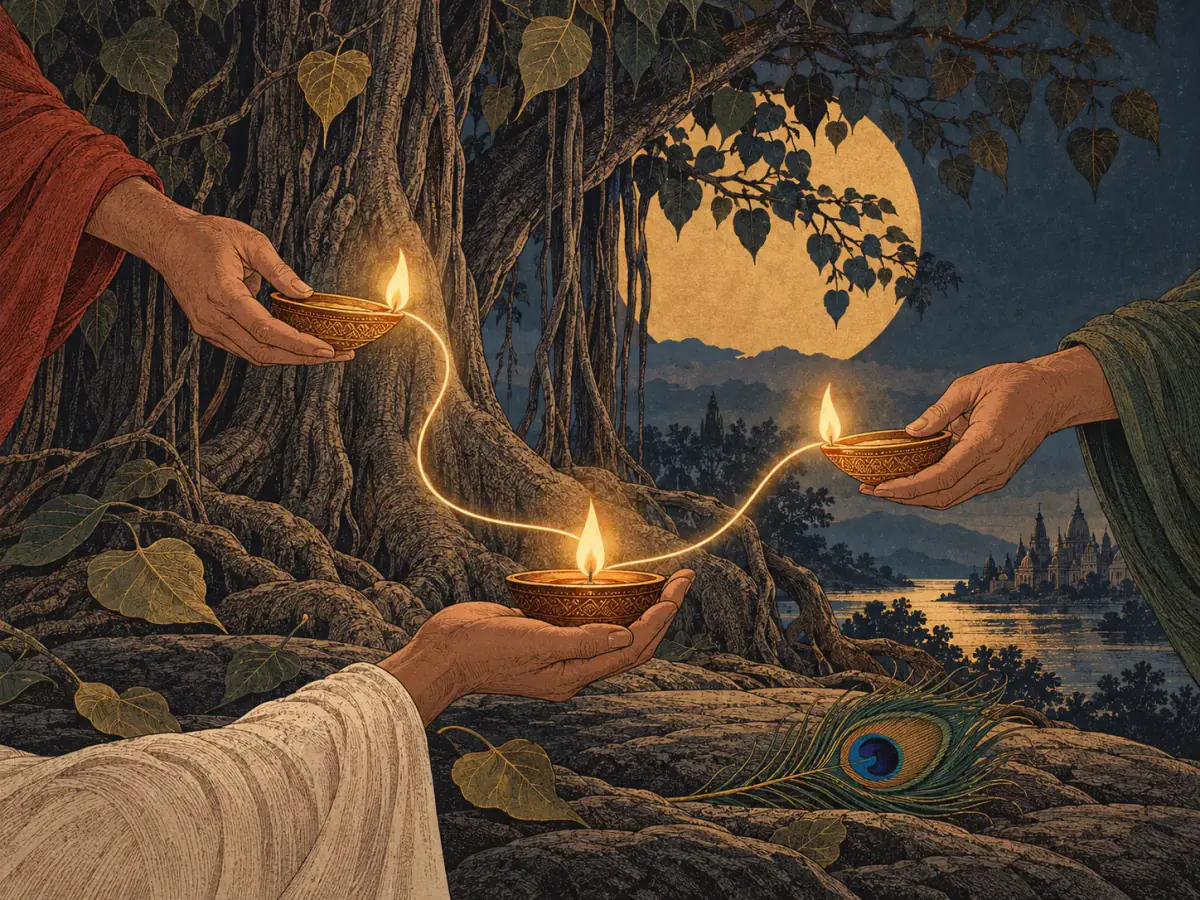
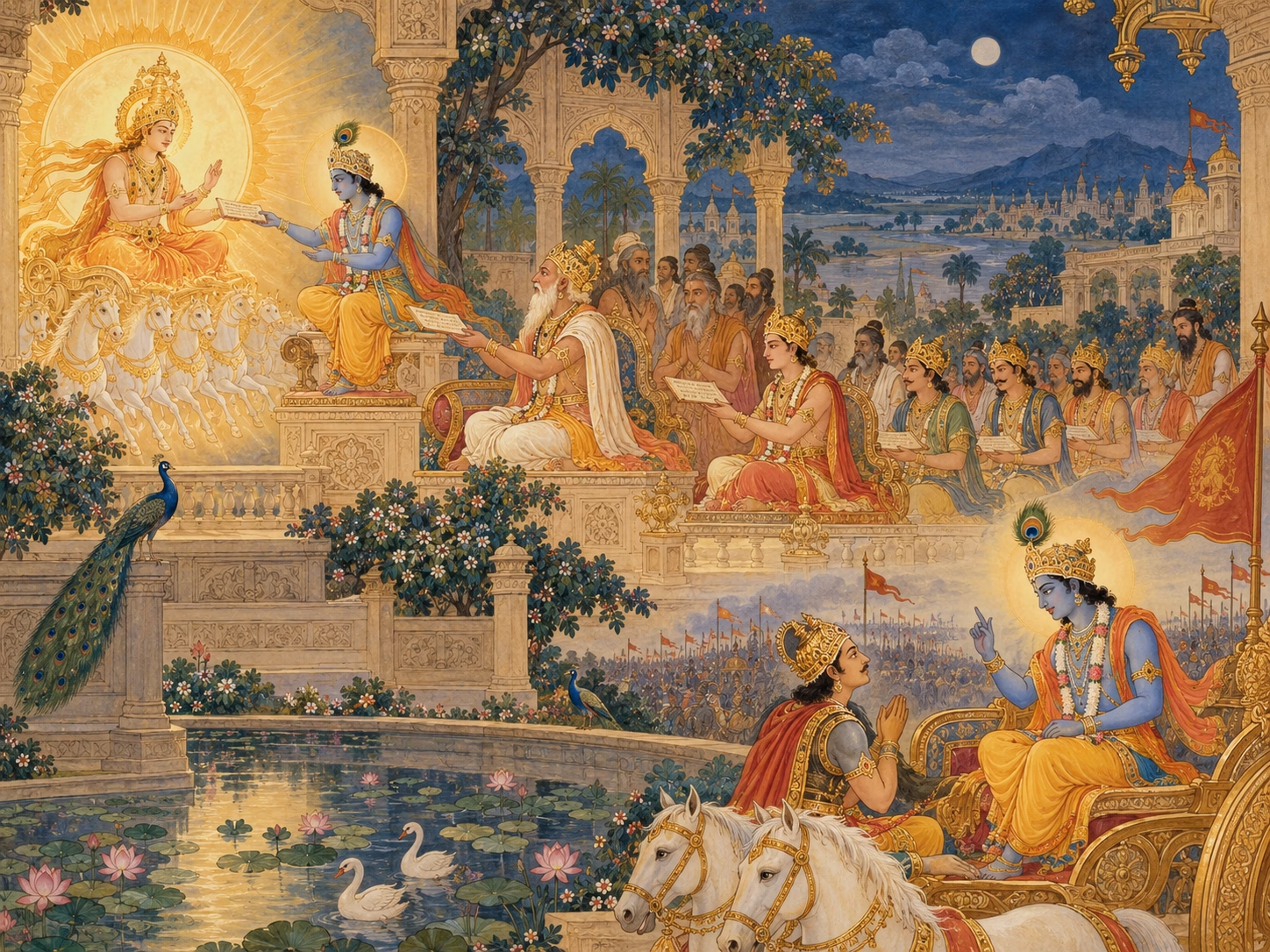
Kṛṣṇa describes a transmission through Vivasvān, Manu and Ikṣvāku. He speaks again to Arjuna because Arjuna is devotee and friend, capable of receiving the mystery.
Kṛṣṇa says that this yoga was taught through a line of teachers and saintly kings. The line became broken, so He teaches it again to Arjuna. Arjuna can receive it because he is both Kṛṣṇa's devotee and friend.
Kṛṣṇa's birth is not forced like ours
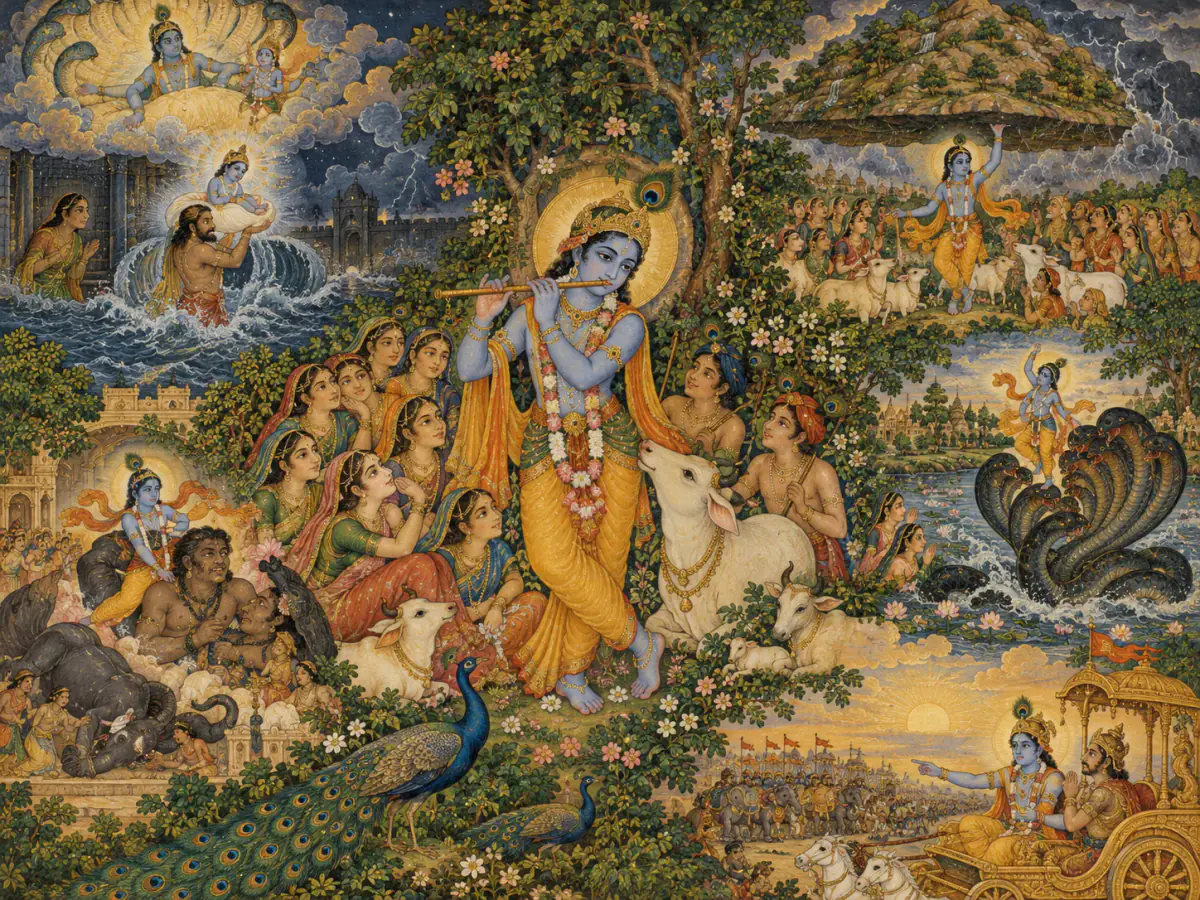
Arjuna asks a historical question, and Kṛṣṇa distinguishes His remembered births and divine appearance that is not forced by material nature through His own potency from the conditioned soul's birth.
Arjuna asks how Kṛṣṇa could have taught the sun-god long ago. Kṛṣṇa explains that He remembers His appearances and comes by His own spiritual power. His birth is not forced by karma like ours.
Avatāra has purpose
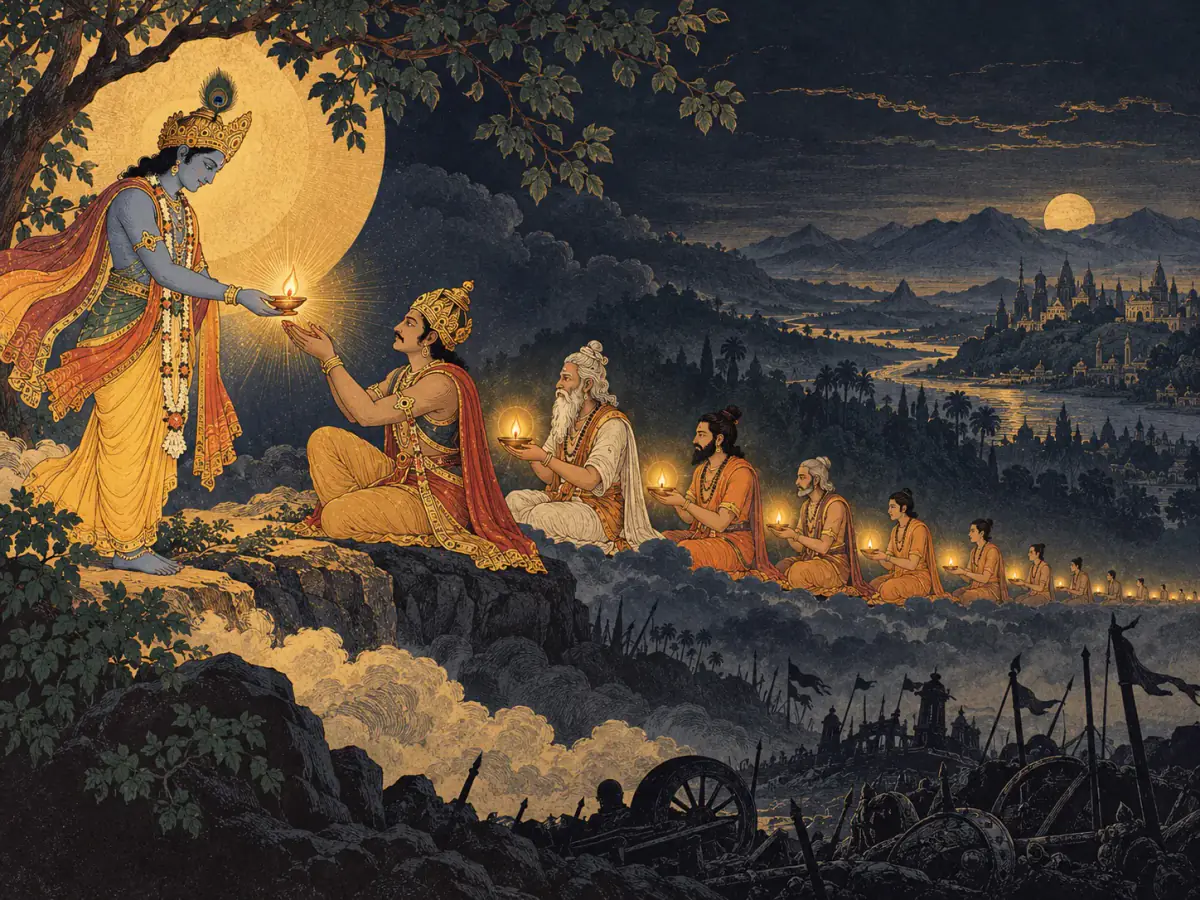
The Lord appears when dharma declines, protecting devotees, restraining destructive forces and reestablishing dharma. Knowing His birth and activities in truth transforms the soul's destination.
The Lord appears when dharma declines. He protects devotees, controls destructive people and restores dharma. His appearance is an act of His own will, not a material body forced upon Him.
Giving and receiving does not mean all paths are identical
Kṛṣṇa reciprocates according to approach and helps material action without being bound by it. Varṇa is presented through qualities and work, while Kṛṣṇa remains transcendental to the system.
Kṛṣṇa responds according to how people approach Him, but this does not mean every path gives the same result. He establishes social order through qualities and work, yet He remains above material result and reaction.
Essential practice
Activity 1: Transmission drift detector
What needs to be doneCompare a source statement with three retellings, identify the first drift, and write a safeguard. Then use the on-site or online instructions, receive one specific response, and revise the answer or work that others can see and check.
PurposeExperience why paramparā preserves speaker, relationship, purpose, and conclusion rather than only repeating a slogan.
SuccessA drift report and two safeguards for passing on the teaching without changing its meaning
Stop whenThe product is complete, one verse point has been checked, and one improvement has been made from feedback.
If You Are Studying On-Site
- One learner reads the source silently.
- Three learners relay it without notes.
- Compare the final version with the page.
- Name and repair the first drift.
If You Are Studying Online
- Use private chat or breakout turns for the relay.
- Do not copy and paste the source.
- Compare the final retelling on screen.
- Record two safeguards.
- 01Notice
Compare a source statement with three retellings, identify the first drift, and write a safeguard.
- 02Explain
Experience why paramparā preserves speaker, relationship, purpose, and conclusion rather than merely repeating a slogan.
- 03Improve
A drift report and two safeguards for faithful transmission
Complete information bank
Complete verse guide for Bhagavad-gītā 4.1 to 15
These blocks give the full movement, the purport meaning in simple words, the central terms and the deeper conclusion of every assigned section.
Every verse included in this lesson
The numbered markers give the complete assigned range. The explanations below tell the story, give the meaning, define the central ideas, and show how Kṛṣṇa's teaching develops from one movement to the next.
Knowledge through succession
Kṛṣṇa describes an ancient transmission through saintly rulers and renews it for Arjuna as devotee and friend.
The yoga is ancient and relationally transmitted. It became obscured over time, so Kṛṣṇa renews it for Arjuna as devotee and friend, not as a private invention.
Knowledge through succession: the deeper meaning
The opening of Chapter 4 gives a history of relationship. The teaching passes through known persons and responsibilities. When the line is broken, Kṛṣṇa renews the same yoga rather than inventing a fashionable replacement.
Source, succession, relationship, renewal. Knowledge given now develops into Knowledge received.
Verses included here: 4.1, 4.2, 4.3.
Divine memory and appearance
Arjuna asks about chronology, and Kṛṣṇa distinguishes His remembered, divine appearance that is not forced by material nature from ordinary birth.
Arjuna asks how Kṛṣṇa could have taught the sun-god. Kṛṣṇa distinguishes His complete memory and voluntary appearance through His own potency from conditioned birth under karma.
Divine memory and appearance: the deeper meaning
Arjuna's historical question is welcomed. Kṛṣṇa answers by comparing memory, cause, and embodiment. Divine appearance looks human, yet it is not forced by past karma or covered by forgetfulness.
The Lord remembers and appears by choice. Knowledge received now develops into Succession obscured.
Verses included here: 4.4, 4.5, 4.6.
Why the Lord appears
When dharma declines, the Lord appears to protect devotees, restrain destructive forces, and reestablish dharma.
Divine descent has stated purposes and is not a material emergency imposed on the Lord. Protection, restraint, and restoration are coordinated aspects of His action.
Why the Lord appears: the deeper meaning
Protection, restraint, and restoration belong together. If one is removed, the purpose of divine descent can be reduced either to sentiment, punishment alone, or a vague promise that nothing difficult will happen.
Protect, restrain, restore. Succession obscured now develops into Knowledge renewed.
Verses included here: 4.7, 4.8.
Knowing in truth
Knowing the divine nature beyond matter of the Lord’s appearance and activities leads beyond repeated material birth.
Liberating knowledge is not mere historical recognition. One understands the divine nature beyond matter and purpose of Kṛṣṇa's appearance and activities in truth.
Knowing in truth: the deeper meaning
To know Kṛṣṇa's birth in truth means to understand its spiritual nature and purpose. Mere acceptance of a date or event does not yet reveal why His appearance is unlike conditioned birth.
Know the appearance as divine, not ordinary. Knowledge renewed now develops into The Lord appears.
Verses included here: 4.9.
Giving and receiving
Freed from attachment, fear, and anger, seekers approach the Lord, who reciprocates according to their approach.
Purified seekers take shelter of Kṛṣṇa, and He reciprocates according to approach. Giving and receiving does not make every motive or path identical in object or result.
Giving and receiving: the deeper meaning
Giving and receiving is personal and exact. Kṛṣṇa responds to the way a person approaches Him. So the verse honours different approaches without saying that every object, motive, practice, and result is identical.
Approach shapes giving and receiving. The Lord appears now develops into Dharma is restored.
Verses included here: 4.10, 4.11.
Results, order, and transcendence
Material worship seeks quick fruit, while the Lord establishes social order yet remains unattached and beyond material result and reaction.
Material worship seeks rapid fruit. Kṛṣṇa establishes the fourfold social order through qualities and work, yet remains unbound because He is unattached and transcendental.
Results, order, and transcendence: the deeper meaning
The Lord arranges social functions through qualities and work but remains untouched by the reactions of that arrangement. This keeps divine authority distinct from both hereditary pride and social vagueness.
The arranger is not bound by the arrangement. Dharma is restored now develops into Knowledge given.
Verses included here: 4.12, 4.13, 4.14, 4.15.
Three purposes of appearance
Keep all three truths together. Removing one distorts the relationship.
- 01Protect devotees
- 02Restrain destructive forces
- 03Reestablish dharma
Four safeguards for transmission
Compare the columns. The important point is how the ideas differ and how they work together.
- 01Authorised source
- 02The original meaning
- 03Qualified relationship
- 04Application without distortion
The complete lesson on one screen
Each row joins a verse range to its movement, central terms and main conclusion. The full explanation appears directly above the chart.
| Verse range | Movement | Key terms | Memory cue |
|---|---|---|---|
| 4.1 to 3 | Knowledge through succession | Vivasvān, Manu, Ikṣvāku, rājarṣis, paramparā | Source, succession, relationship, renewal. |
| 4.4 to 6 | Divine memory and appearance | Arjuna's historical question, many births, divine memory, ātma-māyā | The Lord remembers and appears by choice. |
| 4.7 to 8 | Why the Lord appears | dharma decline, protection, restraint of miscreants, restoration | Protect, restrain, restore. |
| 4.9 | Knowing in truth | divya birth and activity, tattvataḥ, no rebirth, attain Kṛṣṇa | Know the appearance as divine, not ordinary. |
| 4.10 to 11 | Giving and receiving | attachment, fear, anger, knowledge, giving and receiving | Approach shapes giving and receiving. |
| 4.12 to 15 | Results, order, and transcendence | quick results, demigod worship, guṇa and karma, varṇa, nonattachment | The arranger is not bound by the arrangement. |
Why this verse guide comes between the two activities
The first activity helps you remember the order. This section gives the full meaning of the verses in simple words. The second activity then helps you explain and use what you have learnt. The pattern is explanation, practice, more explanation, and more practice.
Essential practice
Activity 2: Source-fidelity relay
What needs to be donePass a four-sentence teaching through three learners. Compare the final version with the source, identify drift, and design two safeguards.
PurposePractise the lesson's central relationship by producing something that can be checked and improved.
SuccessComplete a transmission map with two safeguards and connect it to at least one passage or visual map.
Stop whenYou can explain how the product changed after the discussion: What was lost first: wording, relationship, purpose, or conclusion?
Receive
Begin with the exact situation or claim in the task.
Restate
Connect this move to the passage, not only to a personal reaction.
Check
Connect this move to the passage, not only to a personal reaction.
Correct
Finish with a response that can be explained and improved.
If You Are Studying On-Site
- Make your own first draft.
- Explain it to one partner. Your partner checks whether the verse point and your reason are clear.
- Receive one clear question or correction.
- Improve the product before the class discussion.
If You Are Studying Online
- Write the first draft in the response box or in your own notes.
- Share only the part you want checked in chat or a breakout room.
- Use the checklist after your partner has heard your verse point and reason.
- Improve one sentence and say what you changed.
Build the product one move at a time
Each box corresponds to one step in this lesson's activity. Write enough that another reader could understand your reasoning without hearing an extra explanation.
Use this self-check before you finish
Expected product: A transmission map with two safeguards
Debrief this activity
What was lost first: wording, relationship, purpose, or conclusion?
Reference and enrichment
Use the visual summary to check your explanation
The map below helps you compare your answer with the reasoning and conclusion of the verses.
The avatāra argument
Read from left to right. Each step creates the condition for the next.
- 01Unborn Lord
- 02Appears by own potency
- 03Protects and restores
- 04Acts transcendentally
- 05Known in truth, liberates
Pause and decide
Quick check: is the main idea clear?
Why this check is here: the next lesson will build on this idea, so you should be able to explain it in your own words.
What your answer tells you
Proceed when learners select the second option and connect relationship to authorised understanding rather than social status alone. If you are not sure, use the explanation and visual map directly above. Say why each of the other options does not fit the meaning explained on this page, then try again.
- 01Knowledge through succession
Kṛṣṇa describes an ancient transmission through saintly rulers and renews it for Arjuna as devotee and friend.
- 02Knowing in truth
Knowing the transcendental nature of the Lord’s appearance and activities leads beyond repeated material birth.
- 03Results, order, and transcendence
Material worship seeks quick fruit, while the Lord establishes social order yet remains unattached and beyond material reaction.
Reference and enrichment
Common misunderstandings and clear answers
These short answers show where a correct idea is sometimes used in the wrong way.
Paramparā is not mere repetition
It preserves meaning received through the proper teaching line through faithful hearing, realization, teaching and accountable relationship.
Full explanation: The yoga is ancient and relationally transmitted. It became obscured over time, so Kṛṣṇa renews it for Arjuna as devotee and friend, not as a private invention. The opening of Chapter 4 gives a history of relationship. The teaching passes through known persons and responsibilities. When the line is broken, Kṛṣṇa renews the same yoga rather than inventing a fashionable replacement.
Giving and receiving is not moral equivalence
Verse 4.11 does not make every motive, action or interpretation equally true or spiritually fruitful.
Full explanation: Arjuna asks how Kṛṣṇa could have taught the sun-god. Kṛṣṇa distinguishes His complete memory and voluntary appearance through His own potency from conditioned birth under karma. Arjuna's historical question is welcomed. Kṛṣṇa answers by comparing memory, cause, and embodiment. Divine appearance looks human, yet it is not forced by past karma or covered by forgetfulness.
- 01Paramparā is not mere repetition
It preserves authorised meaning through faithful hearing, realization, teaching and accountable relationship.
- 02Reciprocity is not moral equivalence
Verse 4.11 does not make every motive, action or interpretation equally true or spiritually fruitful.
Essential summary
The complete lesson in clear statements
- 01
Bhagavad-gītā knowledge is received through disciplic succession.
- 02
Arjuna's devotion and friendship make him an authorised recipient.
- 03
Kṛṣṇa remembers His appearances and comes by His own potency.
- 04
The Lord's appearance protects devotees and reestablishes dharma.
- 05
Kṛṣṇa helps material action yet remains unbound by it.
Do not leave without this
Prepare for the next lesson
4.16 to 42. The next guide will retell and explain this full section, so this preview is preparation rather than a missing part of the present lesson.
A transmission map with two safeguards. Keep the revised version for later retrieval.
Sort examples into karma, akarma, and vikarma; list the sacrifices in 4.24 to 33; prepare two questions about 4.34. Memorise 4.9.
Bring one question that arose from the verse guide, one point you can explain confidently, and one point that still needs checking.
- 01Remember
Kṛṣṇa facilitates material action yet remains unbound by it.
- 02Keep
A transmission map with two safeguards
- 03Continue
Bhagavad-gītā 4.16 to 42: Action, Sacrifice, Spiritual Knowledge and Inquiry
Interactive self-check
How deeply do you want to check your understanding?
Choose 10, 20, or 30 questions. You will see one question at a time. Submit an answer, study the explanation and its on-page reference, then continue. A correct answer brings a small celebration.