Bhagavad-gītā Chapters 1 to 6 Part 06 of 12
Bhagavad-gītā 3.1 to 16: Karma-yoga, Sacrifice and the Yajña Cycle
Bhagavad-gītā 3.1 to 16
How does offered work sustain both society and spiritual growth?
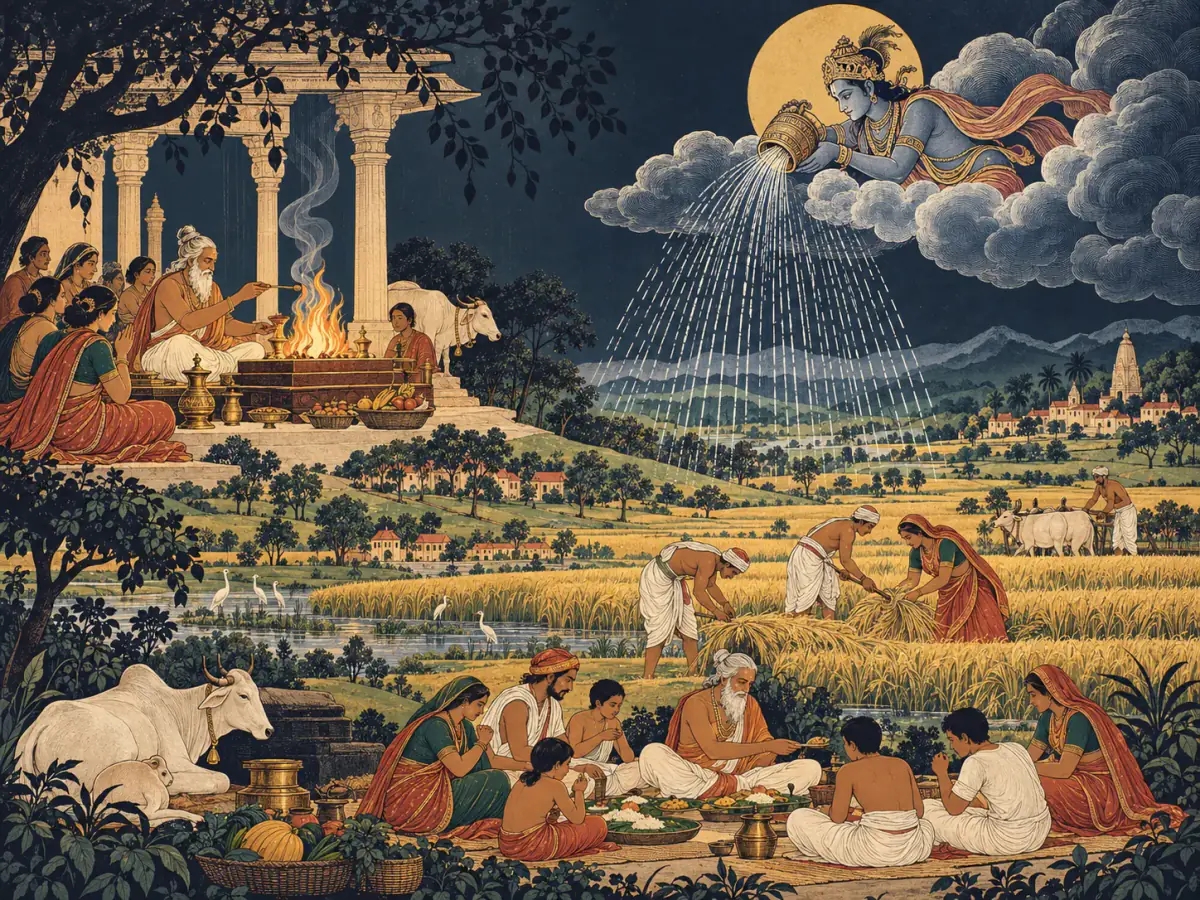
Essential preparation
Before the lesson begins
Start by checking the preparation from the previous guide. Then keep the passage and a place to record your reasoning ready.
Check the Previous Preparation
Preview: 3.1 to 16. Draw the yajña cycle and write one paragraph comparing renunciation of work with work offered in sacrifice. Review verses 2.7 to 2.44 and begin 3.27.
The present guide includes the complete explanation you need, even if you did not complete the preview.
Know Before You Begin
- This guide retells and explains Bhagavad-gītā 3.1 to 16 in order.
- No outside page is needed to understand the lesson.
- Important Sanskrit terms are explained where they appear.
Keep This Ready
- This complete guide on your screen.
- A notebook, paper, or notes app.
- A way to speak or type with a partner.
- No printed cards, book, or special materials are required.
What Will You Make?
- A correct map of the passage movement.
- A labelled cycle with verse ranges, plus one text claim and one clearly marked contemporary application.
- A repaired cycle diagram and one service commitment
- A preparation plan for the next guide.
Reference and enrichment
See the complete passage before examining the details
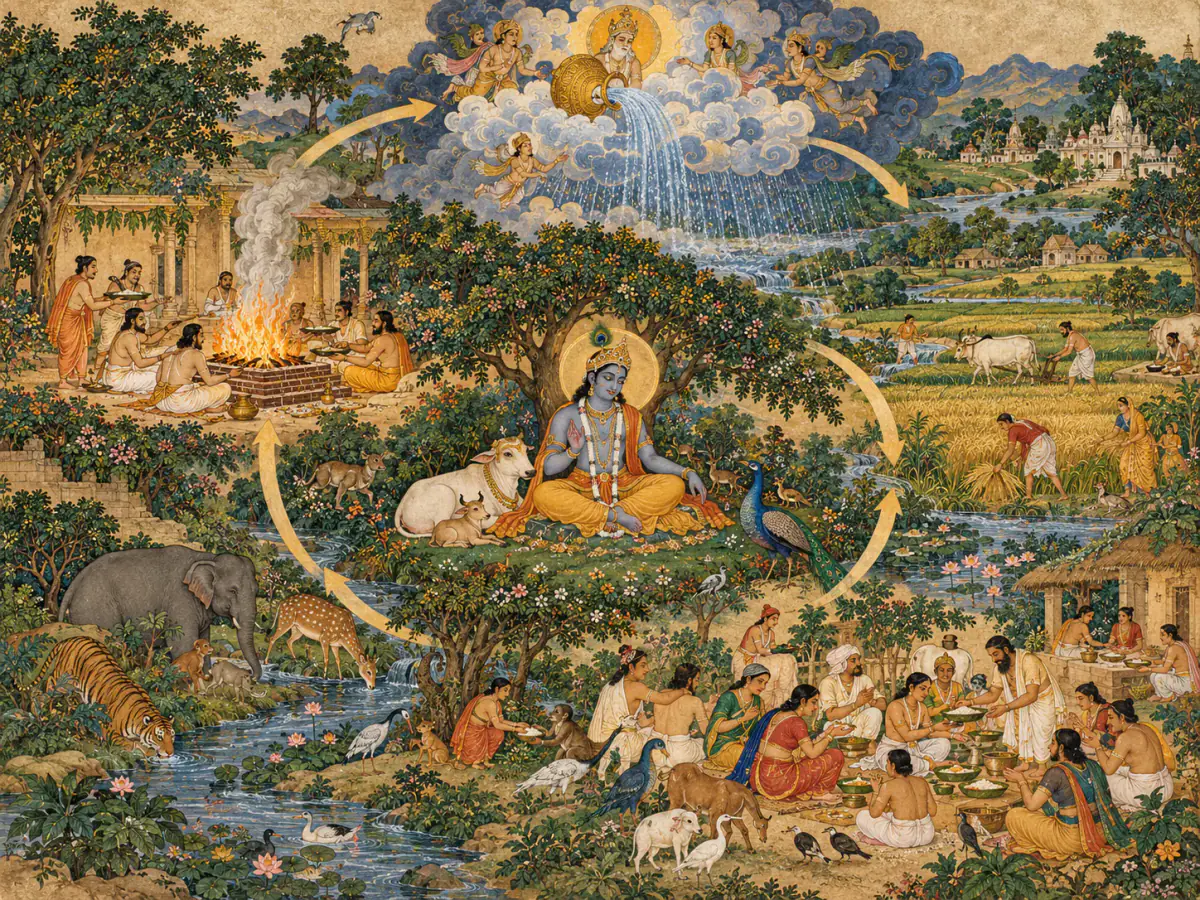
Learners need to answer Arjuna’s apparent conflict between knowledge and action, explain why action is unavoidable, and understand the yajña cycle without reducing it to a modern slogan. The visual map below gives the movement first, so every later detail has a place.
- Explain why karma-yoga is preferable to premature renunciation for Arjuna, using 3.1 to 9 and one analogy or example.
- Reconstruct the 3.10 to 16 yajña cycle and explain its theological logic in plain language.
- Present a carefully bounded application of saṅkīrtana-yajña or ecological responsibility that distinguishes the text from contemporary conclusion.
The yajña cycle
Follow the complete circle. A broken link weakens the whole relationship.
- 01Responsible work
- 02Sacrifice
- 03Rain and provision
- 04Food
- 05Living beings
- 06Responsible work
Essential teaching in verse order
The verses move from the first point to the conclusion
Each section gives the verse range, its meaning in simple words, and the connection to the next part of Kṛṣṇa's answer.
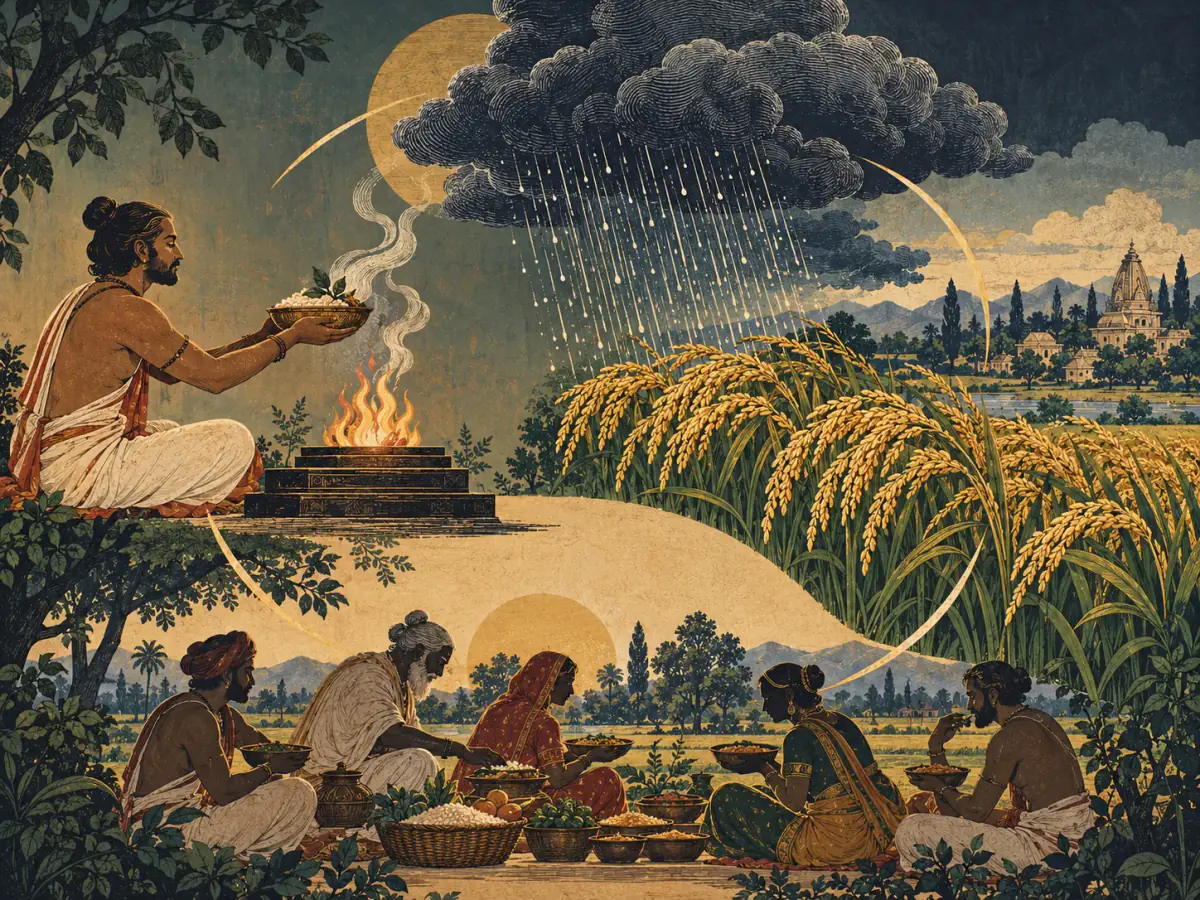
Arjuna asks for one clear path
He hears praise of intelligence and an instruction to fight, then asks Kṛṣṇa to resolve the apparent contradiction. The question carries forward the tension of Chapter 2.
Arjuna thinks Kṛṣṇa has praised knowledge but is asking him to act. He so asks for one clear path. His question allows Kṛṣṇa to explain how knowledge and right action work together.
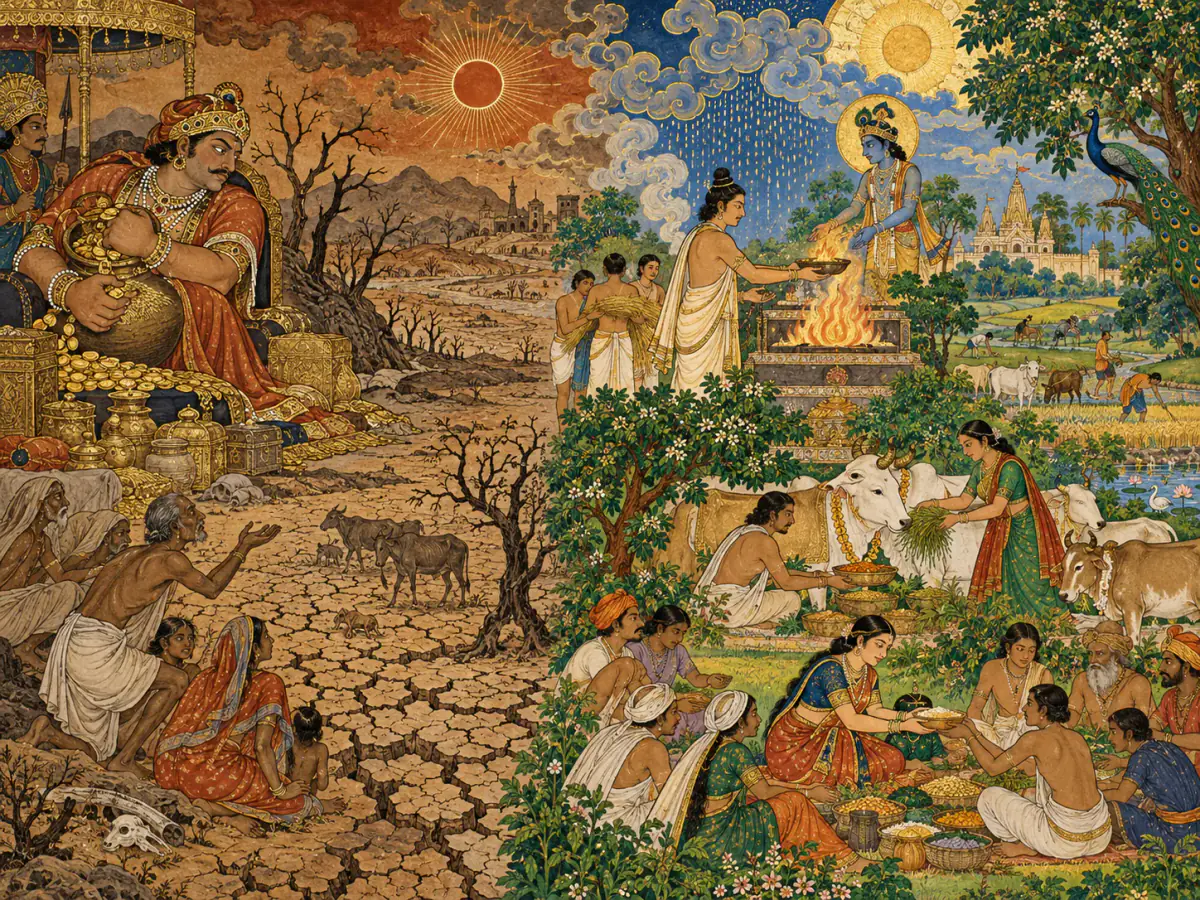
No embodied person remains inactive
Action occurs through material nature even when one outwardly withdraws. Kṛṣṇa so teaches disciplined work offered for Viṣṇu rather than artificial renunciation.
No embodied person can stop all action. Even keeping the body alive requires work. Freedom from karma does not come by looking inactive; it comes when work is done with the right purpose and without selfish ownership.
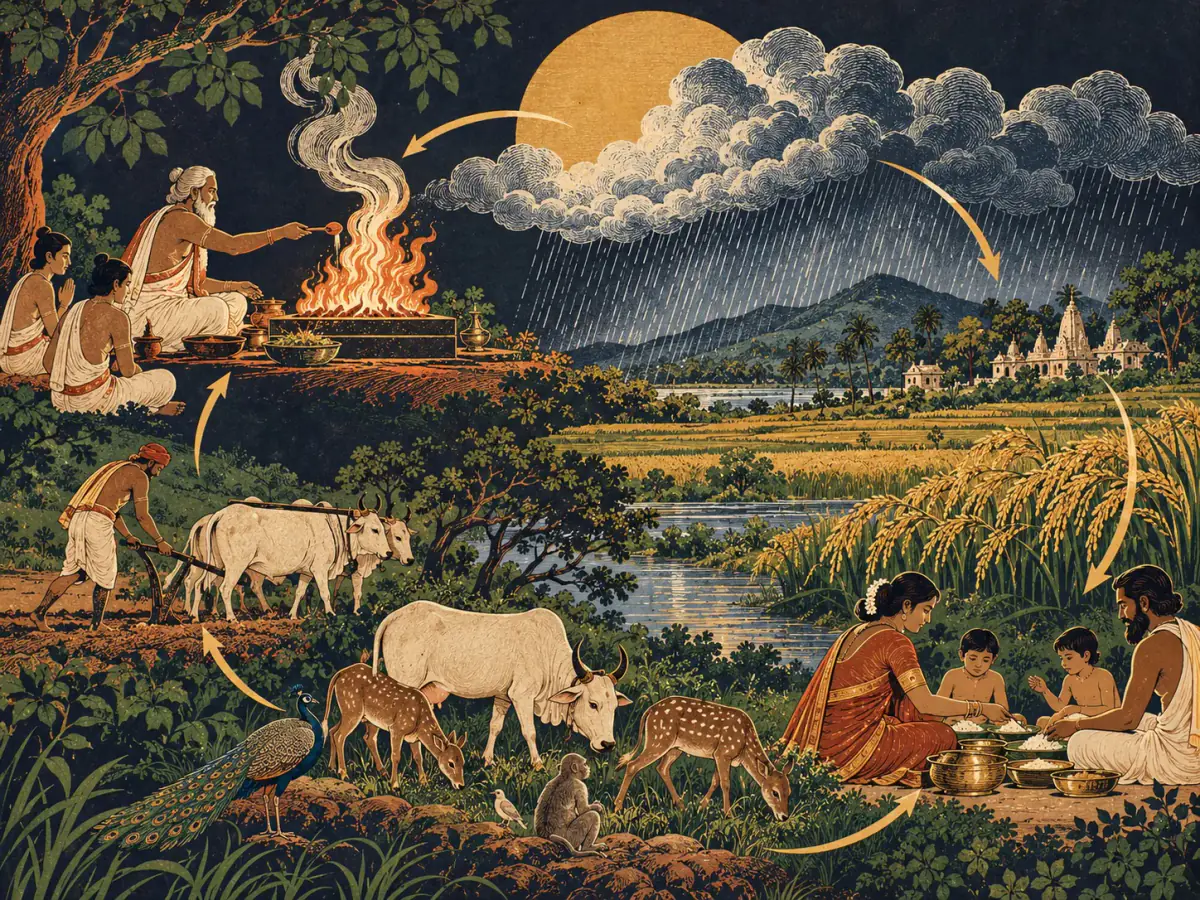
Yajña transforms taking into giving and receiving
Sacrifice places human consumption within gratitude, offering and mutual nourishment. Receiving without offering is criticised as theft.
A person may control the body while the mind still thinks about sense pleasure. That is not true control. Work offered to Viṣṇu uses the same body and abilities in service, so the work purifies instead of binding the worker.
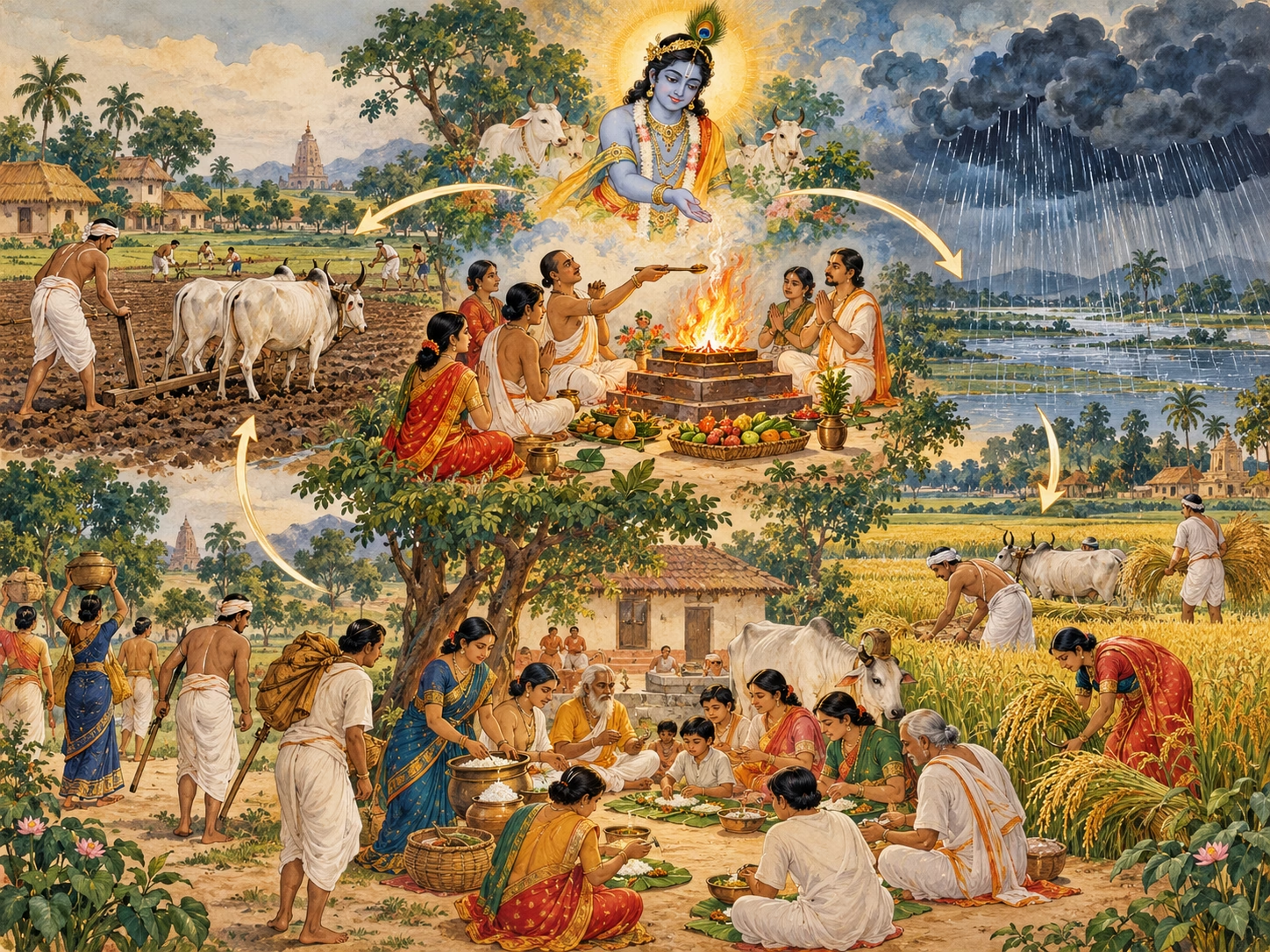
The cycle joins matter, duty and sacred order
Living beings depend on food, food on rain, rain on sacrifice and sacrifice on prescribed action grounded in scripture. The diagram should preserve this theological sequence.
Life depends on a cycle of work, offering, rain, food and nourishment. We receive help from many sources and should give back through sacrifice, gratitude and service. Taking everything only for ourselves breaks this cycle.
Essential practice
Activity 1: Yajña cycle repair: find the broken relationship
What needs to be doneDiagnose where a village case breaks the yajña cycle and propose a repair that includes offering, stewardship, and shared benefit. Then use the on-site or online instructions, receive one specific response, and revise the answer or work that others can see and check.
PurposeSee sacrifice as based on giving and receiving, grateful, and supporting rather than as a private bargain for consumption.
SuccessA repaired yajña cycle with one concrete action
Stop whenThe product is complete, one verse point has been checked, and one improvement has been made from feedback.
If You Are Studying On-Site
- Mark the broken link alone.
- Build the repair in a group of three.
- Assign speaker, source checker, and challenger.
- Revise after the challenge.
If You Are Studying Online
- Select the broken link.
- Build one shared cycle in a document or chat.
- One learner checks the source logic.
- Submit the revised repair.
- 01Notice
Diagnose where a village case breaks the yajña cycle and propose a repair that includes offering, stewardship, and shared benefit.
- 02Explain
See sacrifice as reciprocal, grateful, and sustaining rather than as a private bargain for consumption.
- 03Improve
A repaired yajña cycle with one concrete action
Complete information bank
Complete verse guide for Bhagavad-gītā 3.1 to 16
These blocks give the full movement, the purport meaning in simple words, the central terms and the deeper conclusion of every assigned section.
Every verse included in this lesson
The numbered markers give the complete assigned range. The explanations below tell the story, give the meaning, define the central ideas, and show how Kṛṣṇa's teaching develops from one movement to the next.
Arjuna asks again
Arjuna sees tension between intelligence and action and asks for one clear path.
Arjuna hears praise of spiritual intelligence and criticism of work done mainly for material results, then asks why action is still required. His question gives Kṛṣṇa an opportunity to distinguish paths and stages.
Arjuna asks again: the deeper meaning
Arjuna's question is reasonable because Chapter 2 praised knowledge while still calling him to action. Chapter 3 does not dismiss the question. It explains how knowledge can guide work instead of competing with it.
Confusion asks for one clear direction. Work now develops into Offer.
Verses included here: 3.1, 3.2.
No one avoids action
Different disciplines are named, yet embodied life cannot remain without action even for a moment.
Different dispositions may emphasize analysis or devoted action, but no embodied person remains actionless. Freedom from reaction is not produced by only stopping visible work.
No one avoids action: the deeper meaning
Visible inactivity and freedom from reaction are not the same. The body, senses, and mind continue to act. The important question is what directs the work and who is treated as its owner and enjoyer.
No one escapes action by appearance alone. Offer now develops into Receive.
Verses included here: 3.3, 3.4, 3.5.
Regulation and offering
External restraint without inner discipline is insufficient; work offered as sacrifice avoids bondage.
External restraint with a mind dwelling on objects is hypocrisy. Regulated work offered for Viṣṇu purifies because the same outward capacity is connected to sacrifice.
Regulation and offering: the deeper meaning
The contrast is between hidden sense thought and offered work. A still body can carry an active field of desire, while responsible action can purify when its centre is service to Viṣṇu.
Do not only stop; redirect and offer. Receive now develops into Nourish.
Verses included here: 3.6, 3.7, 3.8, 3.9.
Based on giving and receiving nourishment
The creator establishes sacrifice with living beings and describes a cycle of responsible mutual support.
Sacrifice is introduced as a based on giving and receiving order rather than a private technique for acquisition. Receiving and giving belong together within dependence on the Supreme arrangement.
Based on giving and receiving nourishment: the deeper meaning
The yajña cycle begins with gift and dependence. Human beings do not create life, rain, food, or natural order by private power. Offering teaches us to receive without pretending to be independent owners.
Nourishment is received and returned through offering. Nourish now develops into Share.
Verses included here: 3.10, 3.11, 3.12.
Honoured remnants
Those who receive sanctified remnants are freed from reaction, while self-centred consumption carries reaction.
Food received after sacrifice is connected to purification and gratitude. Consumption prepared only for oneself expresses isolation and carries reaction.
Honoured remnants: the deeper meaning
Sanctified remnants join ordinary eating to gratitude and relationship. The outward act may look similar, but its meaning changes when food is first received as grace and not prepared only for private enjoyment.
Receive as grace, not as private possession. Share now develops into Continue the cycle.
Verses included here: 3.13.
The wheel of responsibility
Food, rain, sacrifice, prescribed work, and revealed direction form a supporting cycle.
The wheel connects life, nourishment, natural provision, sacrifice, and responsible work. Refusing one's contribution while consuming the benefits breaks the supporting relationship.
The wheel of responsibility: the deeper meaning
The wheel links sacred instruction, work, sacrifice, natural provision, food, and life. Removing one link changes the whole picture. The teaching is wider than a ritual and deeper than a modern environmental slogan.
Life depends on a wheel of work, offering, and provision. Continue the cycle now develops into Work.
Verses included here: 3.14, 3.15, 3.16.
Two ways to act
Compare the columns. The important point is how the ideas differ and how they work together.
- 01Consume privately: take, possess, isolate
- 02Offer and share: serve, receive, nourish
Why work becomes yoga
Read from left to right. Each step creates the condition for the next.
- 01Duty is recognised
- 02Work is offered
- 03The feeling that everything belongs to me decreases
- 04Others are nourished
- 05Consciousness is purified
The complete lesson on one screen
Each row joins a verse range to its movement, central terms and main conclusion. The full explanation appears directly above the chart.
| Verse range | Movement | Key terms | Memory cue |
|---|---|---|---|
| 3.1 to 2 | Arjuna asks again | Arjuna's question, intelligence and action, mixed instruction | Confusion asks for one clear direction. |
| 3.3 to 5 | No one avoids action | jñāna-yoga, karma-yoga, niṣkarmatā, unavoidable action | No one escapes action by appearance alone. |
| 3.6 to 9 | Regulation and offering | mithyācāra, regulated senses, yajña, Viṣṇu, bondage | Do not only stop; redirect and offer. |
| 3.10 to 12 | Based on giving and receiving nourishment | Prajāpati, yajña, devas, giving and receiving, provision | Nourishment is received and returned through offering. |
| 3.13 | Honoured remnants | yajña-śiṣṭa, sanctified remnants, selfish cooking, reaction | Receive as grace, not as private possession. |
| 3.14 to 16 | The wheel of responsibility | food, rain, sacrifice, duty, Veda, Supreme | Life depends on a wheel of work, offering, and provision. |
Why this verse guide comes between the two activities
The first activity helps you remember the order. This section gives the full meaning of the verses in simple words. The second activity then helps you explain and use what you have learnt. The pattern is explanation, practice, more explanation, and more practice.
Essential practice
Activity 2: Broken-cycle repair
What needs to be doneDiagnose a fictional community project in which one link of the cycle is missing. Redesign the work as service, offering, fair reception, and renewed contribution.
PurposePractise the lesson's central relationship by producing something that can be checked and improved.
SuccessComplete a repaired cycle diagram and one service commitment and connect it to at least one passage or visual map.
Stop whenYou can explain how the product changed after the discussion: How does offering change the same outward work?
Locate the broken link
Begin with the exact situation or claim in the task.
Name who is affected
Connect this move to the passage, not only to a personal reaction.
Restore giving and receiving
Connect this move to the passage, not only to a personal reaction.
Choose a repeatable action
Finish with a response that can be explained and improved.
If You Are Studying On-Site
- Make your own first draft.
- Explain it to one partner. Your partner checks whether the verse point and your reason are clear.
- Receive one clear question or correction.
- Improve the product before the class discussion.
If You Are Studying Online
- Write the first draft in the response box or in your own notes.
- Share only the part you want checked in chat or a breakout room.
- Use the checklist after your partner has heard your verse point and reason.
- Improve one sentence and say what you changed.
Build the product one move at a time
Each box corresponds to one step in this lesson's activity. Write enough that another reader could understand your reasoning without hearing an extra explanation.
Use this self-check before you finish
Expected product: A repaired cycle diagram and one service commitment
Debrief this activity
How does offering change the same outward work?
Reference and enrichment
Use the visual summary to check your explanation
The map below helps you compare your answer with the reasoning and conclusion of the verses.
Two economies of action
Compare the columns. The important point is how the ideas differ and how they work together.
- 01Taking without offering
- 02Possession without gratitude
- 03Offering and giving and receiving
- 04Receiving as entrusted service
Pause and decide
Quick check: is the main idea clear?
Why this check is here: the next lesson will build on this idea, so you should be able to explain it in your own words.
What your answer tells you
Proceed when learners select the first option and can distinguish unavoidable action from purified intention. If you are not sure, use the explanation and visual map directly above. Say why each of the other options does not fit the meaning explained on this page, then try again.
- 01Arjuna asks again
Arjuna sees tension between intelligence and action and asks for one clear path.
- 02Reciprocal nourishment
The creator establishes sacrifice with living beings and describes a cycle of responsible mutual support.
- 03The wheel of responsibility
Food, rain, sacrifice, prescribed work, and revealed direction form a sustaining cycle.
Reference and enrichment
Common misunderstandings and clear answers
These short answers show where a correct idea is sometimes used in the wrong way.
Inactivity is not automatically renunciation
The body and mind still act; purification concerns consciousness, duty and offering.
Full explanation: Arjuna hears praise of spiritual intelligence and criticism of work done mainly for material results, then asks why action is still required. His question gives Kṛṣṇa an opportunity to distinguish paths and stages. Arjuna's question is reasonable because Chapter 2 praised knowledge while still calling him to action. Chapter 3 does not dismiss the question. It explains how knowledge can guide work instead of competing with it.
Modern ecological application is an conclusion
It may be fruitful, but it should be labelled as an application rather than equated with the whole scriptural teaching.
Full explanation: Different dispositions may emphasize analysis or devoted action, but no embodied person remains actionless. Freedom from reaction is not produced by only stopping visible work. Visible inactivity and freedom from reaction are not the same. The body, senses, and mind continue to act. The important question is what directs the work and who is treated as its owner and enjoyer.
- 01Inactivity is not automatically renunciation
The body and mind still act; purification concerns consciousness, duty and offering.
- 02Modern ecological application is an inference
It may be fruitful, but it should be labelled as an application rather than equated with the whole scriptural teaching.
Essential summary
The complete lesson in clear statements
- 01
Arjuna's Chapter 3 question arises from an apparent tension in Chapter 2.
- 02
Outward withdrawal cannot stop the activity of embodied nature.
- 03
Work for Viṣṇu frees action from binding selfish reaction.
- 04
Yajña places livelihood inside offering, gratitude and giving and receiving.
- 05
The 3.14 to 16 cycle links living beings, food, rain, sacrifice, action and sacred instruction.
Do not leave without this
Prepare for the next lesson
3.17 to 43. The next guide will retell and explain this full section, so this preview is preparation rather than a missing part of the present lesson.
A repaired cycle diagram and one service commitment. Keep the revised version for later retrieval.
Prepare a two-column sheet: leadership by example (3.17 to 29) and desire/lust analysis (3.36 to 43). Memorise 4.2 and review 3.27.
Bring one question that arose from the verse guide, one point you can explain confidently, and one point that still needs checking.
- 01Remember
The 3.14 to 16 cycle links living beings, food, rain, sacrifice, action and sacred instruction.
- 02Keep
A repaired cycle diagram and one service commitment
- 03Continue
Bhagavad-gītā 3.17 to 43: Leadership, Duty, Desire and Self-Mastery
Interactive self-check
How deeply do you want to check your understanding?
Choose 10, 20, or 30 questions. You will see one question at a time. Submit an answer, study the explanation and its on-page reference, then continue. A correct answer brings a small celebration.