Bhagavad-gītā Chapters 1 to 6 Part 05 of 12
Bhagavad-gītā 2.54 to 72: Steady Wisdom, Sense Control and Higher Taste
Bhagavad-gītā 2.54 to 72
What steadies consciousness when the senses and mind pull outward?

Essential preparation
Before the lesson begins
Start by checking the preparation from the previous guide. Then keep the passage and a place to record your reasoning ready.
Check the Previous Preparation
Preview: 2.54 to 72. Make a symptom to speech to sitting to walking chart of the sthita-dhīr and annotate one sense-control analogy. Memorise 2.44.
The present guide includes the complete explanation you need, even if you did not complete the preview.
Know Before You Begin
- This guide retells and explains Bhagavad-gītā 2.54 to 72 in order.
- No outside page is needed to understand the lesson.
- Important Sanskrit terms are explained where they appear.
Keep This Ready
- This complete guide on your screen.
- A notebook, paper, or notes app.
- A way to speak or type with a partner.
- No printed cards, book, or special materials are required.
What Will You Make?
- A correct map of the passage movement.
- A corrected sequence, one interruption point, and a revised higher-taste plan.
- A before-and-after pathway
- A preparation plan for the next guide.
Reference and enrichment
See the complete passage before examining the details
Learners need to organise Kṛṣṇa’s description of steady wisdom and move from suppression-based sense control to a based on the verses account of higher taste and devotional absorption. The visual map below gives the movement first, so every later detail has a place.
- Organise 2.55 to 72 under symptoms, speech, sitting or restraint, and walking or conduct, with one verse example in each category.
- Explain the sequence of contemplative fall-down in 2.62 to 63 and propose one interruption point suitable for personal practice.
- Compare restraint and higher taste using 2.58 to 61 and one handbook analogy, without treating an analogy as a complete proof.
The downward spiral
Read from left to right. Each step creates the condition for the next.
- 01Contemplate
- 02Attach
- 03Desire
- 04Anger
- 05Delusion
- 06Memory lost
- 07Intelligence lost
Essential teaching in verse order
The verses move from the first point to the conclusion
Each section gives the verse range, its meaning in simple words, and the connection to the next part of Kṛṣṇa's answer.

Steady wisdom becomes visible
Arjuna asks how a spiritually realised person speaks, sits and walks. Kṛṣṇa answers through desire, composure, attachment and conduct rather than through appearance alone.
Arjuna asks how we can recognise a person of steady wisdom. Kṛṣṇa answers through the person's desires, reactions, speech and conduct. Steady wisdom is shown in daily life, not by dress or appearance alone.
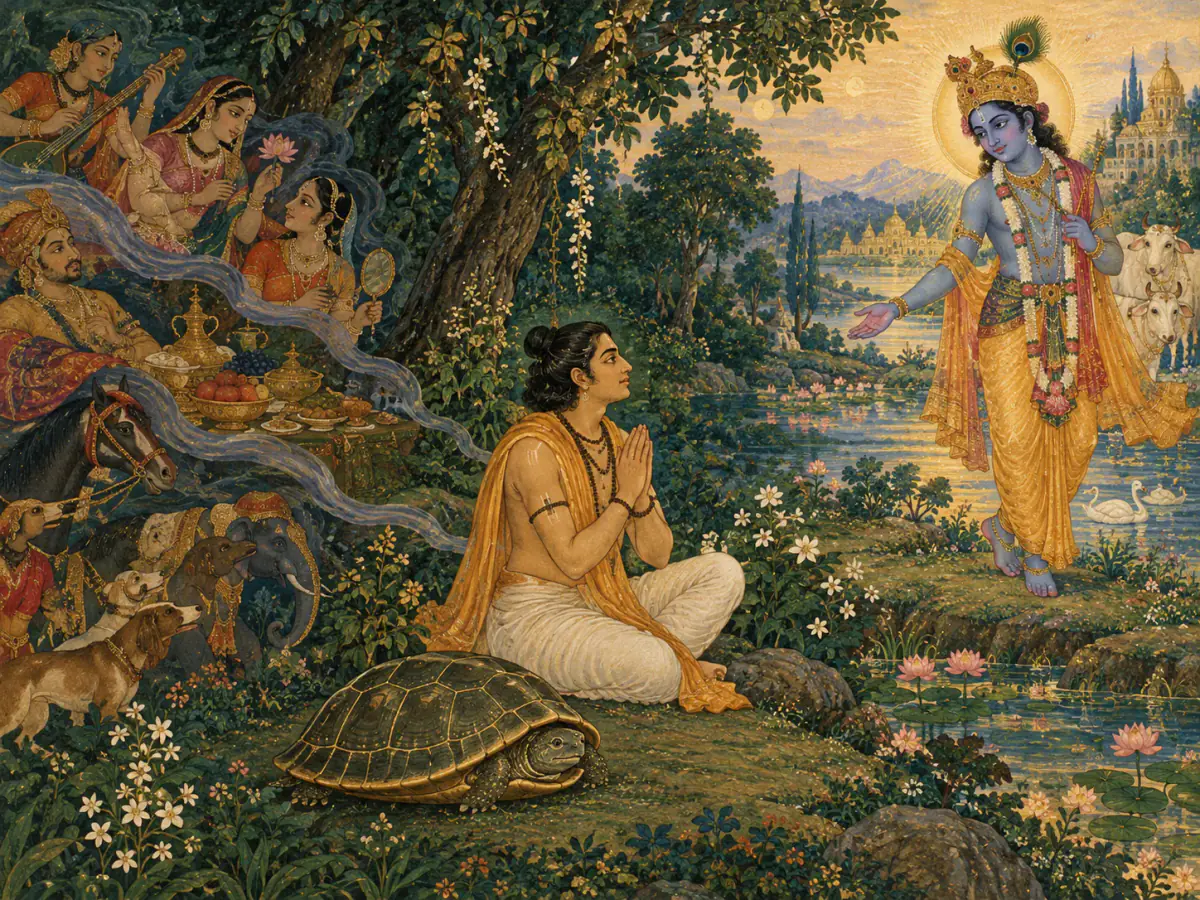
Withdrawal needs a positive centre
The tortoise image illustrates deliberate use and withdrawal of the senses. Mere restriction leaves taste behind, while higher taste gives a new direction to desire.
The tortoise draws in its limbs when needed and brings them out for a purpose. In the same way, the senses should be used or restrained under spiritual guidance. Empty restriction is weak, but a higher spiritual taste gives the mind a better direction.

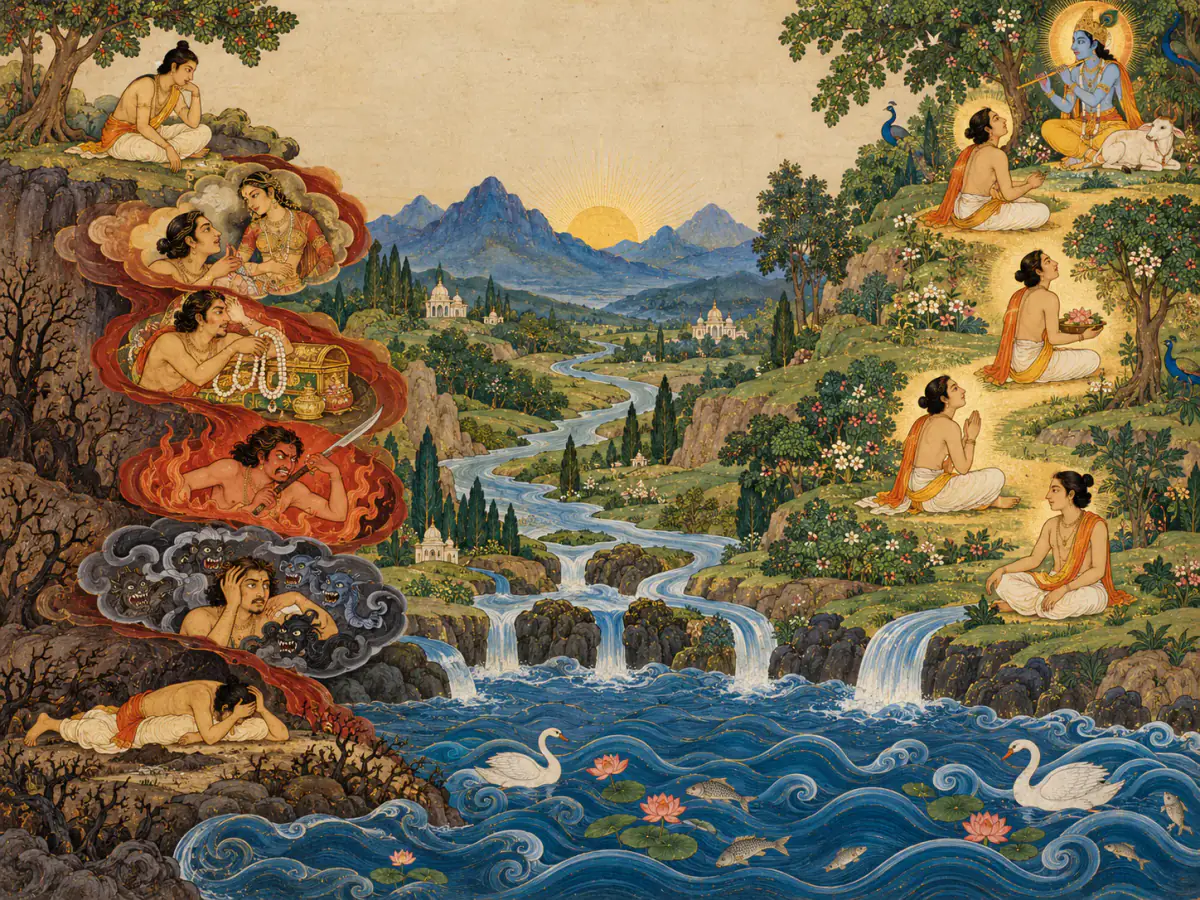
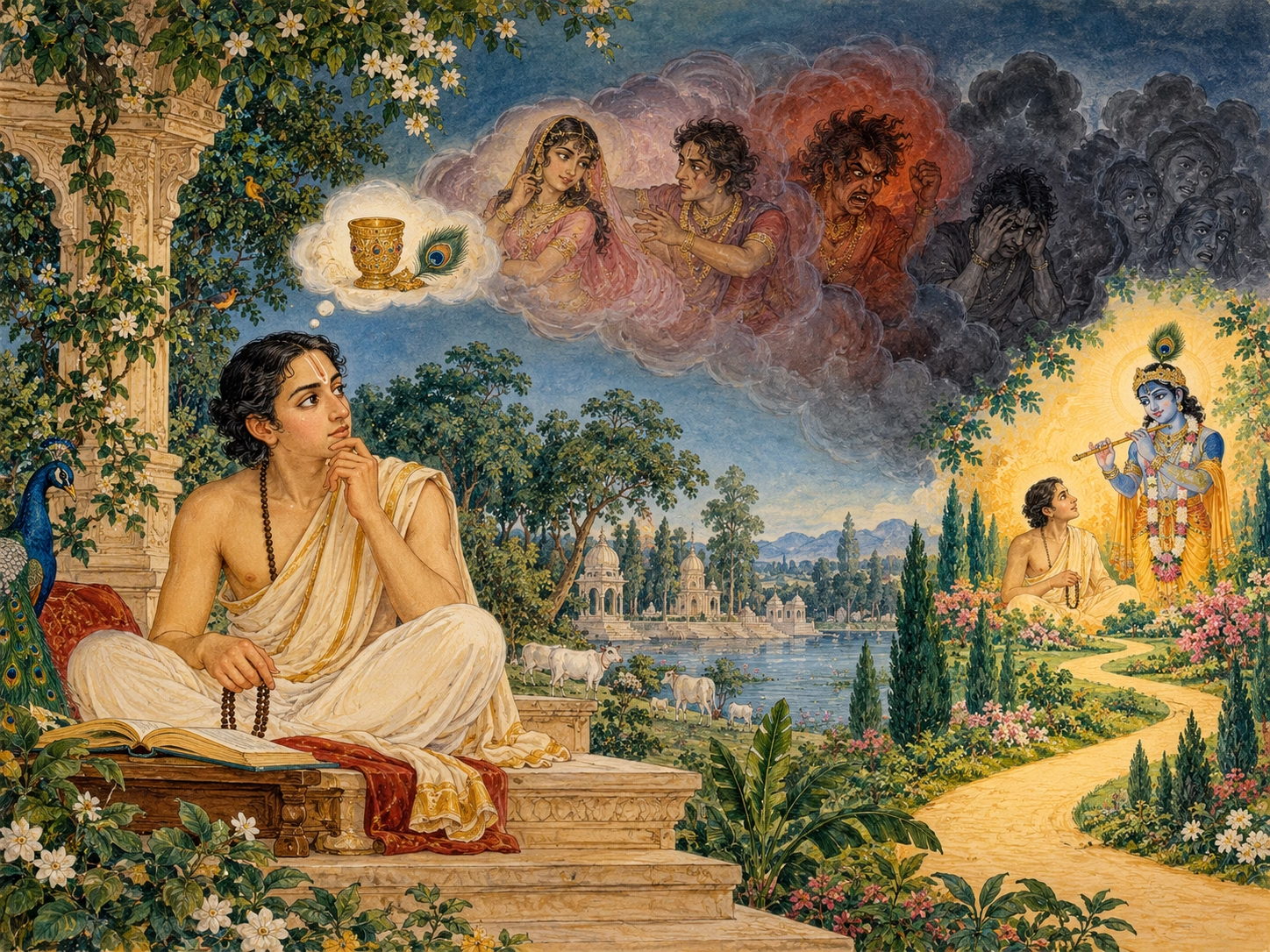
Fall-down has a sequence
Repeated contemplation grows into attachment, then desire, anger, delusion, loss of memory and destruction of intelligence. Mapping the sequence helps identify earlier intervention points.
The fall begins with repeated thought about a sense object. Thought grows into attachment, desire, anger, confusion, loss of memory and loss of intelligence. We should act early in the chain, before desire and anger become strong.
Peace is steadiness during movement
Regulated engagement under spiritual direction brings clarity. Like the ocean receiving rivers without overflow, steady consciousness is not dependent on the absence of desires.
A steady person can meet desires without being ruled by them, just as the ocean receives many rivers without overflowing. Peace does not require an empty world. It requires a mind guided by spiritual purpose.
Essential practice
Activity 1: Interruption studio: redesign the downward spiral
What needs to be doneTrace one ordinary distraction through the spiral, then build an earlier return using regulation and higher taste. Then use the on-site or online instructions, receive one specific response, and revise the answer or work that others can see and check.
PurposeRecognize the earliest practical intervention before desire, anger, and delusion gain force.
SuccessA before-and-after pathway
Stop whenThe product is complete, one verse point has been checked, and one improvement has been made from feedback.
If You Are Studying On-Site
- Choose a fictional case, not another person's weakness.
- Draw the first three links.
- Let a partner mark the earliest turning point.
- Add a higher-taste alternative.
If You Are Studying Online
- Use the fields to trace a fictional case.
- Share the earliest link, not private details.
- Receive one suggested interruption.
- Keep only the suggestion that fits the teaching.
- 01Notice
Trace one ordinary distraction through the spiral, then build an earlier return using regulation and higher taste.
- 02Explain
Recognize the earliest practical intervention before desire, anger, and delusion gain force.
- 03Improve
A before-and-after pathway
Complete information bank
Complete verse guide for Bhagavad-gītā 2.54 to 72
These blocks give the full movement, the purport meaning in simple words, the central terms and the deeper conclusion of every assigned section.
Every verse included in this lesson
The numbered markers give the complete assigned range. The explanations below tell the story, give the meaning, define the central ideas, and show how Kṛṣṇa's teaching develops from one movement to the next.
The steady person
Steady wisdom is seen in freedom from desire to own and control, agitation, and attraction or aversion.
Arjuna asks for visible characteristics. Kṛṣṇa answers through desire, emotional steadiness, freedom from the feeling that everything belongs to me, and conduct rather than costume or external pose.
The steady person: the deeper meaning
Arjuna asks how steady wisdom can be recognised. Kṛṣṇa answers through desire, reaction, speech, and conduct. Spiritual maturity is so tested in relationship and choice, not guessed from dress or pose.
Steady wisdom becomes visible in response and relationship. Contemplation now develops into Attachment.
Verses included here: 2.54, 2.55, 2.56, 2.57.
The tortoise
The senses can be withdrawn from their objects as a tortoise withdraws its limbs.
The tortoise withdraws or extends its limbs according to purpose. The analogy teaches governed engagement, not hatred of the senses or permanent escape from responsibility.
The tortoise: the deeper meaning
The tortoise can extend its limbs as well as withdraw them. The image is about governed use. The senses are not enemies to destroy; they are powers that must serve a wise purpose.
Withdraw when needed; engage under purpose. Attachment now develops into Desire.
Verses included here: 2.58.
Higher taste
Restraint alone leaves taste behind, but a higher spiritual taste transforms attraction.
Restriction may remove an object while leaving attraction intact. A higher spiritual taste changes the centre of desire and gives regulation a positive direction.
Higher taste: the deeper meaning
Removing an object may leave the inner taste untouched. Higher taste works at the level of attraction. It gives the mind a positive spiritual centre instead of asking it to live in an empty space.
A higher taste succeeds where emptiness does not. Desire now develops into Anger.
Verses included here: 2.59.
The downward spiral
Uncontrolled senses and repeated contemplation develop through attachment, desire, anger, delusion, and ruined intelligence.
The fall is presented as a causal chain beginning with repeated attention. Because later links are stronger, wise practice interrupts contemplation and attachment early.
The downward spiral: the deeper meaning
The fall begins before visible anger. Repeated attention quietly gives an object emotional weight. This is why early care of attention is often wiser than waiting to fight a fully formed desire.
Attention becomes destiny through a chain of links. Anger now develops into Delusion.
Verses included here: 2.60, 2.61, 2.62, 2.63.
Regulated engagement
Freedom from attraction and aversion, guided senses, and grace restore steadiness.
Regulated engagement free from attraction and repulsion brings grace and clarity. The senses are not erased; they are directed by spiritual intelligence.
Regulated engagement: the deeper meaning
Freedom from attraction and repulsion does not make a person dull. It makes perception clearer because liking and disliking no longer decide every judgement before intelligence can speak.
Regulation restores clarity. Delusion now develops into Loss of intelligence.
Verses included here: 2.64, 2.65, 2.66, 2.67, 2.68.
Oceanlike peace
The wise orient differently from the fully absorbed in material life and remain steady like an ocean receiving rivers.
The fully absorbed in material life and spiritually awake value different objects. Like an ocean that remains steady while rivers enter, the wise person receives desires without becoming their servant.
Oceanlike peace: the deeper meaning
The ocean is full, not empty. Its steadiness comes from depth and fixed boundaries, not from the absence of rivers. In the same way, peace rests on spiritual fullness rather than on a world without movement.
Many rivers enter; the ocean keeps its level. Loss of intelligence now develops into Contemplation.
Verses included here: 2.69, 2.70, 2.71, 2.72.
The upward practice
Read from left to right. Each step creates the condition for the next.
- 01Notice
- 02Withdraw
- 03Remember purpose
- 04Seek higher taste
- 05Re-engage wisely
- 06Become steady
Three strategies and their limits
Compare the columns. The important point is how the ideas differ and how they work together.
- 01Indulgence: strengthens habit
- 02Suppression alone: taste remains
- 03Higher taste: desire is given a new direction
- 04Regulated service: senses gain purpose
The complete lesson on one screen
Each row joins a verse range to its movement, central terms and main conclusion. The full explanation appears directly above the chart.
| Verse range | Movement | Key terms | Memory cue |
|---|---|---|---|
| 2.54 to 57 | The steady person | sthita-prajña, desire, self-satisfaction, attachment, fear, anger | Steady wisdom becomes visible in response and relationship. |
| 2.58 | The tortoise | kūrma, senses, sense objects, withdrawal | Withdraw when needed; engage under purpose. |
| 2.59 | Higher taste | viṣaya, rasa, paraṁ dṛṣṭvā, higher taste | A higher taste succeeds where emptiness does not. |
| 2.60 to 63 | The downward spiral | dhyāna, saṅga, kāma, krodha, moha, smṛti-bhraṁśa, buddhi-nāśa | Attention becomes destiny through a chain of links. |
| 2.64 to 68 | Regulated engagement | rāga-dveṣa, prasāda, controlled senses, steady intelligence | Regulation restores clarity. |
| 2.69 to 72 | Oceanlike peace | night and day, ocean, desire, ahaṅkāra, brahma-nirvāṇa | Many rivers enter; the ocean keeps its level. |
Why this verse guide comes between the two activities
The first activity helps you remember the order. This section gives the full meaning of the verses in simple words. The second activity then helps you explain and use what you have learnt. The pattern is explanation, practice, more explanation, and more practice.
Essential practice
Activity 2: Steady-wisdom case practice
What needs to be doneTrace a fictional distraction through the downward spiral, then redesign the same moment using regulated engagement and higher taste.
PurposePractise the lesson's central relationship by producing something that can be checked and improved.
SuccessComplete a before-and-after pathway and connect it to at least one passage or visual map.
Stop whenYou can explain how the product changed after the discussion: Which intervention acts earliest, and which one only manages the final symptom?
Find the first link
Begin with the exact situation or claim in the task.
Name the turning point
Connect this move to the passage, not only to a personal reaction.
Add a higher taste
Connect this move to the passage, not only to a personal reaction.
Choose one visible response
Finish with a response that can be explained and improved.
If You Are Studying On-Site
- Make your own first draft.
- Explain it to one partner. Your partner checks whether the verse point and your reason are clear.
- Receive one clear question or correction.
- Improve the product before the class discussion.
If You Are Studying Online
- Write the first draft in the response box or in your own notes.
- Share only the part you want checked in chat or a breakout room.
- Use the checklist after your partner has heard your verse point and reason.
- Improve one sentence and say what you changed.
Build the product one move at a time
Each box corresponds to one step in this lesson's activity. Write enough that another reader could understand your reasoning without hearing an extra explanation.
Use this self-check before you finish
Expected product: A before-and-after pathway
Debrief this activity
Which intervention acts earliest, and which one only manages the final symptom?
Reference and enrichment
Use the visual summary to check your explanation
The map below helps you compare your answer with the reasoning and conclusion of the verses.
Interrupt the spiral early
Read from left to right. Each step creates the condition for the next.
- 01Notice attention
- 02Change the cue
- 03Remember the purpose
- 04Choose a devotional action
- 05Review and repeat
Pause and decide
Quick check: is the main idea clear?
Why this check is here: the next lesson will build on this idea, so you should be able to explain it in your own words.
What your answer tells you
Proceed when learners select the second option and can connect it to redirection, not only avoidance. If you are not sure, use the explanation and visual map directly above. Say why each of the other options does not fit the meaning explained on this page, then try again.
- 01The steady person
Steady wisdom is seen in freedom from possessive desire, agitation, and attraction or aversion.
- 02The downward spiral
Uncontrolled senses and repeated contemplation develop through attachment, desire, anger, delusion, and ruined intelligence.
- 03Oceanlike peace
The wise orient differently from the materially absorbed and remain steady like an ocean receiving rivers.
Reference and enrichment
Common misunderstandings and clear answers
These short answers show where a correct idea is sometimes used in the wrong way.
Sense control is not sensory hatred
The senses are engaged or withdrawn according to a higher purpose rather than treated as enemies in themselves.
Full explanation: Arjuna asks for visible characteristics. Kṛṣṇa answers through desire, emotional steadiness, freedom from the feeling that everything belongs to me, and conduct rather than costume or external pose. Arjuna asks how steady wisdom can be recognised. Kṛṣṇa answers through desire, reaction, speech, and conduct. Spiritual maturity is so tested in relationship and choice, not guessed from dress or pose.
Steadiness is not emotional numbness
The sthita-prajña is not ruled by elation and distress, yet remains responsive and responsible.
Full explanation: The tortoise withdraws or extends its limbs according to purpose. The analogy teaches governed engagement, not hatred of the senses or permanent escape from responsibility. The tortoise can extend its limbs as well as withdraw them. The image is about governed use. The senses are not enemies to destroy; they are powers that must serve a wise purpose.
- 01Sense control is not sensory hatred
The senses are engaged or withdrawn according to a higher purpose rather than treated as enemies in themselves.
- 02Steadiness is not emotional numbness
The sthita-prajña is not ruled by elation and distress, yet remains responsive and responsible.
Essential summary
The complete lesson in clear statements
- 01
Steady wisdom is recognised through desire, speech, restraint and conduct.
- 02
The tortoise analogy teaches purposeful regulation of the senses.
- 03
Higher taste addresses the attraction that restriction alone leaves intact.
- 04
The 2.62 to 63 sequence shows how attention can grow into destructive action.
- 05
The ocean image presents steadiness in the presence of incoming desires.
Do not leave without this
Prepare for the next lesson
3.1 to 16. The next guide will retell and explain this full section, so this preview is preparation rather than a missing part of the present lesson.
A before-and-after pathway. Keep the revised version for later retrieval.
Draw the yajña cycle and write one paragraph comparing renunciation of work with work offered in sacrifice. Review verses 2.7 to 2.44 and begin 3.27.
Bring one question that arose from the verse guide, one point you can explain confidently, and one point that still needs checking.
- 01Remember
The ocean image presents steadiness in the presence of incoming desires.
- 02Keep
A before-and-after pathway
- 03Continue
Bhagavad-gītā 3.1 to 16: Karma-yoga, Sacrifice and the Yajña Cycle
Interactive self-check
How deeply do you want to check your understanding?
Choose 10, 20, or 30 questions. You will see one question at a time. Submit an answer, study the explanation and its on-page reference, then continue. A correct answer brings a small celebration.