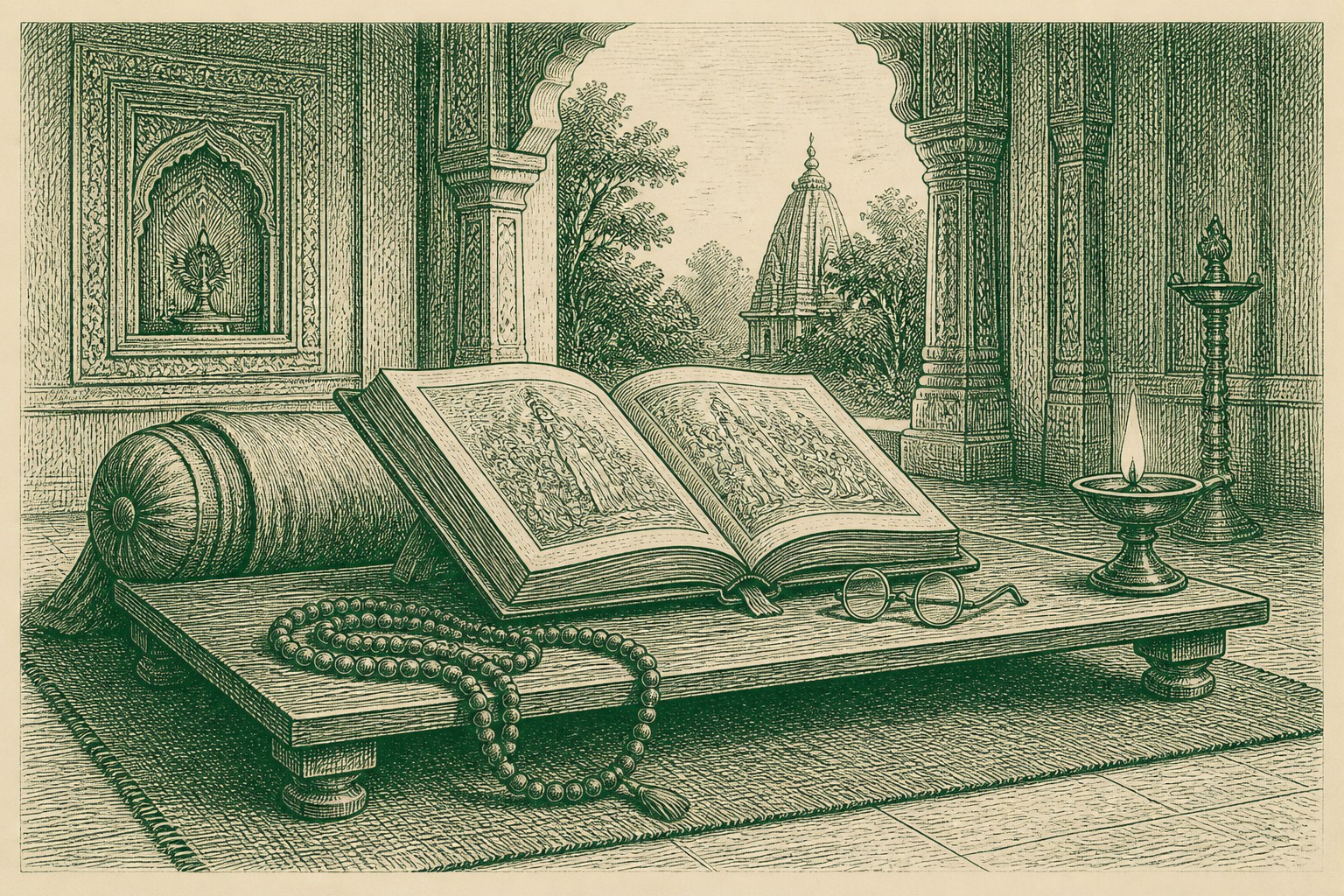
A life centered on Bhāgavatam
Guru Mahārāja is a senior disciple of His Divine Grace A. C. Bhaktivedanta Swami Prabhupāda. His devotional life is closely associated with sustained hearing and teaching of Śrīmad-Bhāgavatam, approached verse by verse and conclusion by conclusion.
For me, this is more than a description of what he teaches. It is a picture of how spiritual life can be lived. The same scripture is heard again, not because it has become familiar, but because the heart has not finished receiving it.
His example keeps bringing me back to patient attention. A verse can be known by memory while its demand has barely entered one’s conduct. Repeated hearing gives that distance a chance to close.
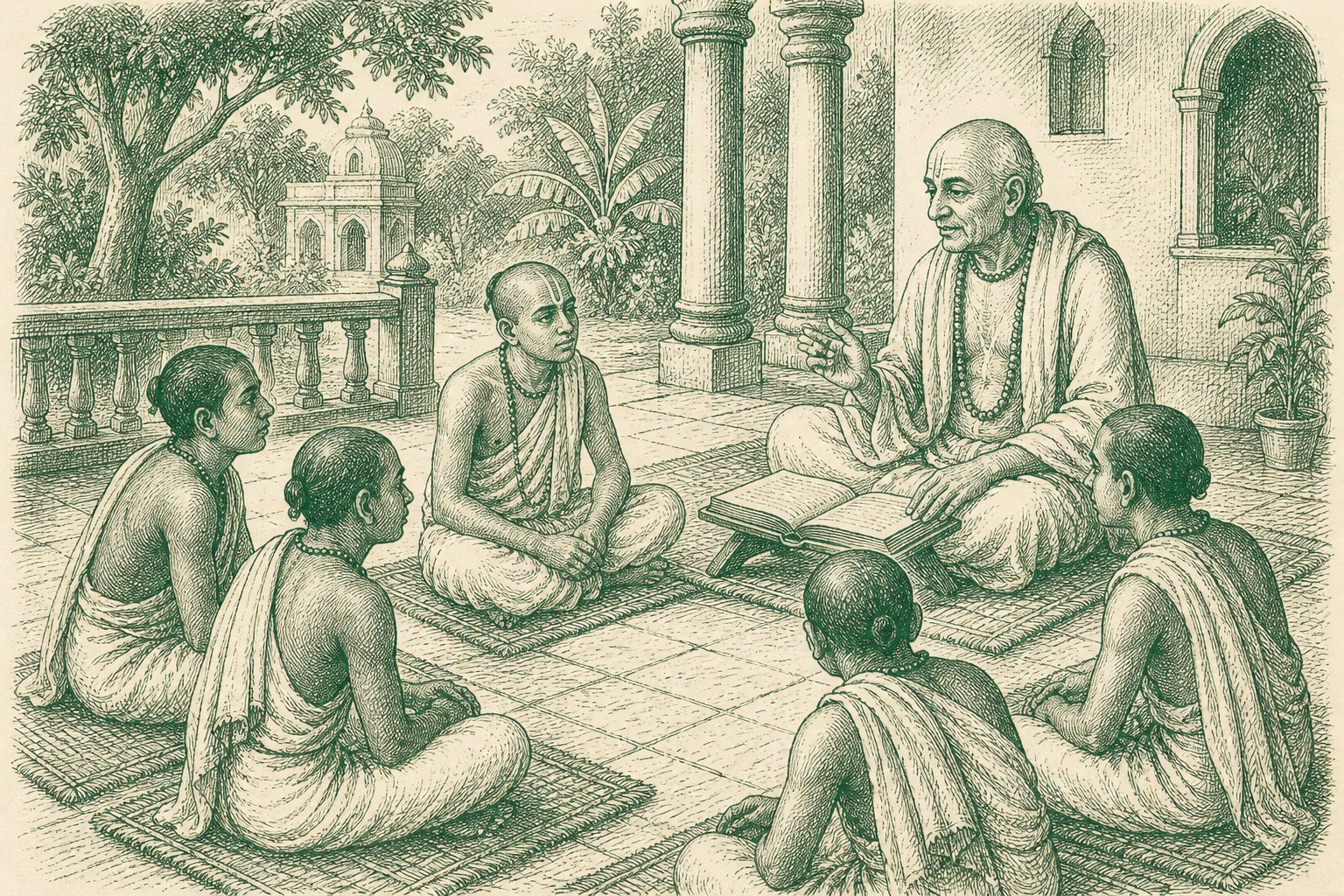
Hearing becomes relationship
A spiritual master does not simply place information before a student. He teaches within a relationship of trust, correction, example, and service. That relationship gives knowledge weight. What is heard must eventually be carried.
The disciple listens, reflects, tries to serve, notices what remains unchanged, and returns to hear again. This rhythm is quiet, but it slowly transforms spiritual study from consumption into responsibility.
Hear
Receive the teaching without rushing past it.
Reflect
Let it question habits, motives, and assumptions.
Serve
Give the teaching a practical form through action.
Return
Come back with greater honesty and attention.
What I receive from his teaching
- A conviction that Śrīmad-Bhāgavatam deserves close and repeated hearing
- Attention to the words of the ācāryas rather than novelty for its own sake
- The understanding that learning matures through service and conduct
- A reminder that devotion is personal, relational, and accountable
- Respect for careful language and the precise devotional conclusions of the tradition
- The courage to let genuine instruction disturb comfortable habits
Guru is not a decorative idea in spiritual life. Guru is the living relationship through which hearing becomes responsibility.
Guru within paramparā
The Gaudiya Vaiṣṇava tradition understands spiritual knowledge as received through disciplic succession. Guru does not replace śāstra or the previous ācāryas. Guru helps the disciple hear them faithfully and apply their instruction in a life of service.
That is why this website places Guru Mahārāja and Śrīla Prabhupāda before my own writing. Whatever is useful here belongs to a stream of teaching larger than the writer.
Paramparā also protects spiritual life from becoming self-invented. The disciple is not asked to suppress thought, but to think in the company of those who have heard before, served before, and shown what fidelity looks like over time.

A disciple’s daily responsibility
Gratitude becomes meaningful when it changes the shape of an ordinary day. It may appear as steadier sādhana, a more careful response, restraint before speaking, willingness to serve, or the humility to ask for help.
I do not want devotion to my spiritual master to remain only in formal language. The deeper offering is to let instruction become visible in choices that no audience will applaud.
Attention
Listen closely enough to be corrected.
Conduct
Let understanding enter speech and action.
Gratitude
Remember that spiritual life is received.
Service
Offer time, ability, and care without display.
Why I keep returning
Some teachings answer a question. Others reveal that the question itself was too small. Guru Mahārāja’s emphasis on Bhāgavatam repeatedly moves my attention from quick solutions toward the deeper work of relationship with Kṛṣṇa.
I return because hearing under guidance exposes the difference between sounding certain and becoming sincere. It asks for less performance and more transformation.
This page is therefore not an attempt to summarize a spiritual master. It is a disciple’s acknowledgment of the person through whom the path became immediate, demanding, and alive.